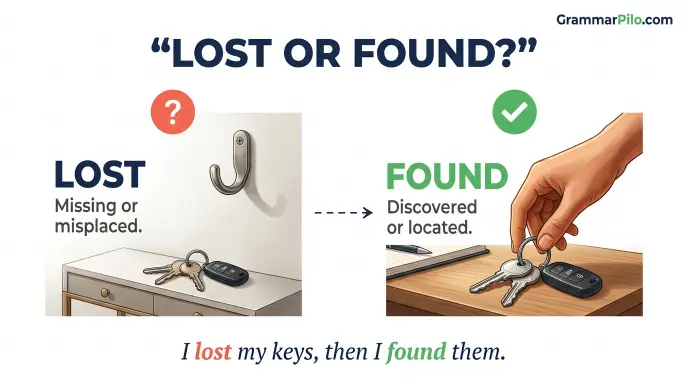
Lost or found have opposite meanings, but both words are commonly used to describe the location or condition of people, objects, and other things.
Lost means something cannot be found, has gone missing, or is no longer under someone’s control. Found means something has been discovered, located, or recovered. For example, “I lost my keys” means the keys are missing, while “I found my keys” means I located them.
These words appear frequently in everyday conversations, school assignments, workplace emails, news reports, and messages about missing belongings.
People also encounter them in phrases such as “lost and found,” “lost property,” “found a solution,” and “found someone waiting.”
Understanding found or lost is easier when you remember that one describes something missing or gone, while the other often describes the discovery of something. However, found has additional meanings, including establishing an organization or building something on a particular basis.
This guide explains the difference between found and lost, shows how to use each word correctly, and provides practical examples to help you choose the right word in any situation.
Quick Answer
Lost means missing, misplaced, unable to be located, or no longer possessed. It is the past tense and past participle of lose. Found is the past tense and past participle of find, meaning discovered or located.
For example, “I lost my wallet yesterday, but I found it this morning.” The phrase lost and found refers to a place where missing belongings are kept after someone discovers and hands them in.
Lost vs. Found at a Glance
The main difference between lost and found is the condition or action each word describes.
| Feature | Lost | Found |
| Basic meaning | Missing or no longer possessed | Discovered or located |
| Base verb | Lose | Find |
| Past tense | Lost | Found |
| Past participle | Lost | Found |
| Present tense example | I lose things sometimes. | I find things sometimes. |
| Past tense example | I lost my phone. | I found my phone. |
| Common phrase | Lost property | Lost and found |
| Emotional use | Feeling confused or without direction | Discovering clarity or a sense of purpose |
| Example | She lost her notebook. | She found her notebook. |
Easy memory trick: Lost means something is missing. Found means something has been discovered.
What Does Lost Mean?
Lost is the past tense and past participle of the verb lose. It describes something that has gone missing, cannot be located, or is no longer available to someone. It can also describe a person who does not know where to go or feels confused about what to do.
Lost as a Verb
When used as a verb, lost describes an event that happened in the past or an action connected to the present perfect tense.
Examples include the following:
- I lost my house keys on the way home.
- She lost her phone during the trip.
- They lost the final match by two points.
- We have lost the document containing the meeting notes.
- He lost his wallet but later recovered it.
In each example, lost refers to something that was misplaced, no longer possessed, or no longer available.
Lost as an Adjective
Lost can also describe a condition or state.
Examples include the following:
- The lost child was reunited with her parents.
- I felt lost in the unfamiliar city.
- The team looked lost without its captain.
- We searched for the lost dog throughout the neighborhood.
In these sentences, lost describes the condition of a person, animal, or group.
Common Expressions With Lost
Several everyday expressions use lost:
- Lost property: Belongings that someone has misplaced.
- Lost cause: A person or situation considered unlikely to succeed.
- Get lost: To become unable to find the correct route, or an informal expression telling someone to go away.
- Lost in thought: Deeply absorbed in thinking.
- Lost time: Time that has been wasted or missed.
- Lost opportunity: A chance that is no longer available.
The meaning depends on the surrounding words and context.
What Does Found Mean?
Found is the past tense and past participle of the verb find. It usually means discovered, located, or encountered something that was previously unknown or missing.
Examples include the following:
- I found my glasses under the sofa.
- She found a wallet near the entrance.
- We found the answer to the question.
- They have found a better way to organize the files.
- He found his missing passport in a drawer.
Found can refer to physical objects, information, answers, opportunities, and solutions.
Found as a Verb
As a verb, found often describes the act of locating or discovering something.
Examples include the following:
- The students found the correct answer.
- I found an interesting article for my research.
- The police found the missing bicycle.
- She found a quiet place to study.
- We found the restaurant easily.
Found does not always mean recovering something that was lost. It can also mean discovering something for the first time.
Found as an Adjective
In some contexts, found describes something discovered or recovered.
Examples include the following:
- The found wallet was handed to the receptionist.
- The museum displayed found objects in its exhibition.
- The rescued dog was taken to a local shelter.
The adjective is less common in ordinary conversation than the verb form.
Found Can Also Mean Established
There is another important meaning of found. As a separate verb, it can mean to establish or create an organization, institution, or settlement.
Examples include the following:
- She helped found a nonprofit organization.
- The university was founded in the nineteenth century.
- They founded a company to develop educational software.
In this sense, found is not the past tense of find. It is the base form of a different verb meaning to establish. Its past tense and past participle are founded.
Compare these examples:
- Find: They found the missing book.
- Found: They founded a new library.
The first sentence means they located a book. The second means they established a library.
The Difference Between Lost and Found in Grammar
Lost and found are both irregular verb forms. Neither follows the regular pattern of adding ed to the base verb.
| Base verb | Present tense | Past tense | Past participle |
| Lose | Lose | Lost | Lost |
| Find | Find | Found | Found |
| Found, meaning establish | Found | Founded | Founded |
Lost in Different Tenses
The word lost can appear in several grammatical structures:
- Simple past: I lost my notebook yesterday.
- Present perfect: I have lost my notebook.
- Past perfect: I had lost my notebook before the class began.
- Passive construction: The document was lost during the move.
Found in Different Tenses
Found also appears in different grammatical structures:
- Simple past: I found my notebook yesterday.
- Present perfect: I have found my notebook.
- Past perfect: I had found my notebook before the teacher arrived.
- Passive construction: The document was found under the desk.
Remember that found is the past form of find, while founded is the past form of the verb meaning establish.
Lost and Found in American and British English
There is no spelling difference between lost and found in American and British English. Both varieties use the same spellings and grammatical forms.
| Usage | American English | British English |
| Missing item | Lost item | Lost item |
| Recovered item | Found item | Found item |
| Place for missing belongings | Lost and found | Lost property office or lost and found |
| Example | I lost my umbrella. | I lost my umbrella. |
| Example | I found my bag. | I found my bag. |
The main difference appears in terminology. In the United States, found and lost is a common name for a designated place where missing belongings are collected. In the United Kingdom, lost property and lost property office are also widely used.
Both expressions are understandable internationally. Choose the wording that best suits your audience and the organization you are communicating with.
Common Mistakes When Using Lost or Found
Although the meanings are straightforward, writers sometimes confuse these words or use the wrong verb form.
Mistake 1: Using Found When Something Is Still Missing
Incorrect: I found my keys, but I still cannot locate them.
Correct: I lost my keys, but I still cannot locate them.
Use lost when the keys are missing. Use found after you have located them.
Mistake 2: Using Lost Instead of Found
Incorrect: I lost my wallet under the desk and picked it up.
Better: I found my wallet under the desk and picked it up.
The second sentence clearly describes discovering the wallet. The first would suggest that the wallet went missing, so the intended meaning is less clear.
Mistake 3: Writing Finded Instead of Found
Incorrect: She finded her missing notebook.
Correct: She found her missing notebook.
Find is an irregular verb, so its simple past form is found, not finded.
Mistake 4: Confusing Found With Founded
Incorrect: They found a school in 1995, meaning they established it.
Correct: They founded a school in 1995.
Use founded when talking about establishing a school, business, institution, or organization. Use found when talking about discovering or locating something.
Mistake 5: Mixing Up Lost and Lose
Incorrect: I loose my keys every week.
Correct: I lose my keys every week.
Lose is the present tense verb. Lost is its past tense and past participle. Loose is a different word that usually means not tight.
Lost or Found in Everyday Examples
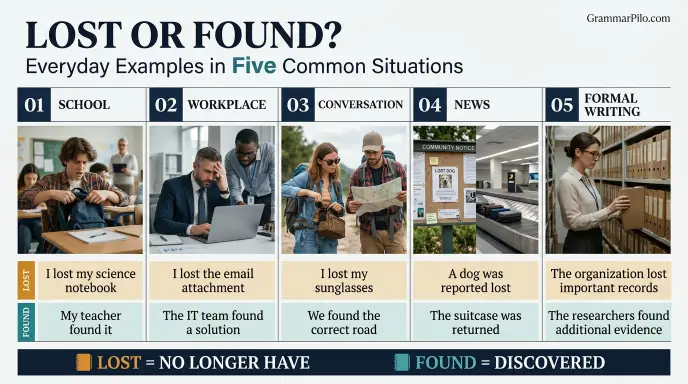
The following examples show how these words work in different situations.
In School
Lost: I lost my science notebook before the examination.
Found: My teacher found the notebook in the classroom.
Lost: The student felt lost during the difficult lesson.
Found: She found the correct answer after reviewing her notes.
In Emails and Workplace Communication
Lost: I seem to have lost the attachment from the original email.
Found: I found the attachment and have included it in this message.
Lost: We lost access to the shared folder this morning.
Found: The IT team found a solution to the access problem.
In Everyday Conversation
Lost: Have you seen my sunglasses? I think I lost them.
Found: I found them on the kitchen counter.
Lost: We got lost while driving through the countryside.
Found: We found the correct road after checking the map.
In News and Public Notices
Lost: A dog was reported lost near the public park.
Found: A dog was found near the public park and taken to a local shelter.
Lost: The family reported a lost suitcase at the airport.
Found: The suitcase was found and returned to its owner.
In Formal Writing
Lost: The organization lost several important records during the office relocation.
Found: The missing records were found in a storage cabinet.
Lost: The research team lost access to some original documents.
Found: The researchers found additional evidence in the archived files.
These examples demonstrate that lost and found can describe physical objects, information, opportunities, and even emotional states.
Understanding the Phrase Lost and Found
The phrase lost and found refers to a designated place or service where items that people have misplaced are kept after someone discovers or hands them in.
You might see a found and lost desk at an airport, school, shopping center, hotel, library, or sports facility.
Examples include the following:
- Please check the lost and found for your missing jacket.
- I handed the keys to the lost and found office.
- The school keeps forgotten lunch boxes in its lost and found.
- Someone returned my water bottle to the lost and found desk.
The phrase combines two opposite ideas. Lost describes the original problem, while found describes the discovery that may help solve it.
In British English, you may also see the term lost property office, especially in public transportation and large venues.
Found vs. Lost: A Quick Comparison Table
| Situation | Use Lost | Use Found |
| A missing phone | I lost my phone. | I found my phone. |
| A misplaced document | The document is lost. | The document was found. |
| A wrong direction | We got lost. | We found the right route. |
| A research answer | We lost the original notes. | We found new evidence. |
| An emotional state | He felt lost after moving. | He found a sense of purpose. |
| An organization | Not normally used for establishing it | The organization was founded in 2020. |
The key question is simple: Are you describing something missing, or are you describing the discovery of something? Use lost for the first meaning and found for the second.
Lost or Found: Google Trends and Modern Usage
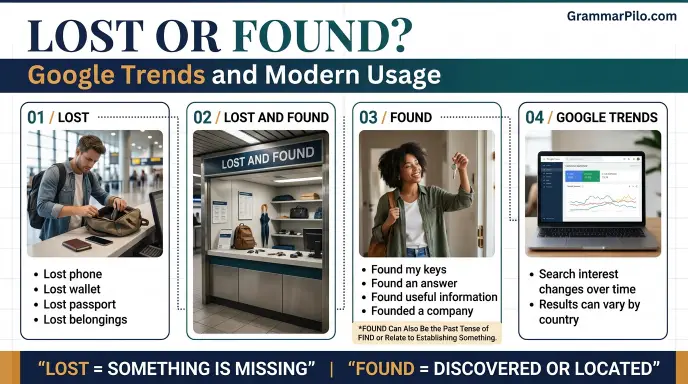
Lost and found are established everyday English terms that appear in conversations, public notices, travel information, workplace messages, and online searches.
The phrase lost and found is particularly useful when people are looking for missing belongings at airports, schools, hotels, public venues, and transportation facilities.
Searches involving lost items may also include the name of a particular object, such as a lost phone, lost wallet, or lost passport.
Found is also common in searches about locating missing items, discovering information, and finding answers to everyday problems.
Its additional meaning in phrases such as found a company or founded an organization creates a separate usage pattern.
Exact search interest can change over time and by region. No verified live Google Trends figures are provided here, so numerical search volumes or trend rankings should not be assumed.
For current comparisons, enter “lost,” “found,” and “lost and found” into Google Trends and select the relevant country and time range.
A Simple Trick to Remember Lost and Found
Use this memory trick to distinguish the words quickly:
- Lost = missing: You do not know where something is, or you no longer have it.
- Found = discovered: You locate something or discover something new.
- Founded = established: You create an organization, institution, or company.
Think of this short sequence:
First: I lost my keys.
Next: I searched for them.
Finally: I found my keys.
The sequence shows the relationship between the words. Lost describes the problem, and found describes the discovery that resolves it.
Frequently Asked Questions
1. Is found or lost correct?
Both words are correct, but they have different meanings. Lost means missing or no longer possessed, while found means discovered or located. The right choice depends on the intended meaning.
2. What is the difference between lost and found?
Lost is the past tense and past participle of lose. Found is the past tense and past participle of find. For example, “I lost my bag” describes the bag going missing, while “I found my bag” describes locating it.
3. Is found the past tense of find?
Yes. Find becomes found in the simple past tense. For example, “I find my keys” is present tense, while “I found my keys yesterday” is past tense.
4. Is lost the past tense of lose?
Yes. Lost is both the simple past tense and past participle of lose. For example, “I lost my ticket” and “I have lost my ticket” are both correct.
5. Should I say lost and found or found and lost?
The established expression is lost and found. It commonly names a place where missing belongings are collected and kept for their owners. “Found and lost” is not the standard expression for this service.
6. What does lost and found mean?
Lost and found refers to a place or service where items that have gone missing are held after someone discovers or hands them in. It is commonly found in schools, airports, hotels, and other public places.
7. Is found the same as founded?
No. Found is the past tense of find when it means discovered or located. Founded is the past tense of found when it means established. For example, “I found a wallet” and “She founded a company” have different meanings.
8. Are lost and found spelled differently in British and American English?
No. Both words have the same spelling in American and British English. However, British English also commonly uses the term lost property for missing belongings and the places that collect them.
9. Can lost be used as an adjective?
Yes. Lost can describe a missing object, a person who cannot find the correct route, or someone who feels confused or uncertain. For example, “The lost child was found” and “I felt lost during the discussion” are both correct.
10. How can I remember when to use lost or found?
Remember that lost means missing, while found means discovered. You can also remember the phrase “I lost it, then I found it.” This simple sequence makes the difference easy to recall.
Conclusion
Lost and found are two common English words with opposite meanings in many everyday situations.
Lost is the past tense and past participle of lose, and it describes something missing, misplaced, or no longer possessed. Found is the past tense and past participle of find, and it describes discovering or locating something.
The difference becomes clear when you use both words in one sentence. “I lost my wallet yesterday, but I found it this morning” shows how the words relate to each other. Lost identifies the problem, while found describes the discovery.
It is also important to distinguish found from founded. Found means discovered when it comes from find, while founded means established when it comes from the separate verb found.
This distinction is especially useful in formal writing and discussions about companies, schools, and organizations.
The established phrase lost and found refers to a place where missing belongings are kept after they are discovered. Although British and American English use the same spelling for lost and found, some British organizations prefer the term lost property.
Remember the simple rule: Use lost for something missing and found for something discovered. With this distinction in mind, you can use both words confidently in conversations, emails, schoolwork, and professional writing.
What to Read Next

I’m Sloane Mercer, a U.S.-based English language writer focused on grammar, spelling, vocabulary, and everyday English usage. Through GrammarPilo, I provide clear and practical explanations to help readers choose the right words and communicate with confidence.






2 thoughts on “Lost or Found: Difference, Meaning & Examples (2026)”