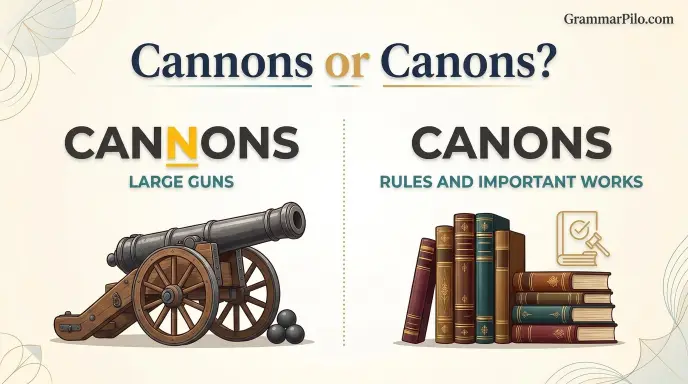
Cannons and canons are both correct English words, but they have different meanings. Cannons are large guns used to fire heavy projectiles, while canons are accepted rules, principles, standards, or important works that belong to a particular field. The correct spelling depends on what you want to describe.
People often search for cannons or canons because the words sound alike and differ by only one letter. This can cause confusion when writing about military history, books, religion, music, or popular culture.
For example, a history article may discuss cannons used in a battle, while a literature article may explain the canon of classic English novels.
The difference is easy to remember once you connect each word with its meaning. Cannons have an extra “n” and refer to weapons. Canons refer to rules, accepted principles, or works considered important within a tradition. Neither spelling is incorrect, but using the wrong one can change the meaning of your sentence.
In this guide, you will learn the definitions, origins, common uses, spelling differences, and practical examples of cannons and canons. You will also discover how to avoid common mistakes and choose the correct word in everyday and formal writing.
Quick Answer: Cannons or Canons?
Cannons are large guns, while canons are rules, principles, standards, or recognized collections of works.
| Word | Meaning | Example |
| Cannons | Large guns that fire projectiles | The soldiers moved the cannons into position. |
| Canons | Accepted rules or important works | The novel is part of the literary canon. |
Easy way to remember: Cannons have an extra n for weapons that make a powerful bang. Canons often relate to rules, traditions, or works that are officially or widely recognized.
Both words are correct, but they are not interchangeable.
Definition and Meaning of Cannons and Canons
Although these words sound the same, they describe different things. Understanding their meanings is the best way to choose the right spelling.
What Does Cannons Mean?
Cannons is the plural form of cannon. A cannon is a large gun designed to fire heavy projectiles. Cannons have been used in warfare, naval battles, fortifications, and ceremonial displays.
The word commonly appears in discussions of military history and weapons.
Examples include:
- The army positioned its cannons near the fortress.
- Historic cannons remain on display outside the museum.
- The ship carried several cannons during the battle.
- The old fort was built to withstand attacks from enemy cannons.
Cannons are usually associated with historical artillery, although the word may also appear in descriptions of modern or ceremonial equipment.
What Does Canons Mean?
Canons is the plural form of canon. The word has several meanings depending on the context.
It can refer to:
- Rules or principles: The canons of professional conduct guide the members.
- Religious laws: The church follows established canons.
- Literary works: The novel is included in the canon of classic literature.
- Official storylines: The event is part of the series’ established canon.
- Standards in art or music: The canons of the tradition influence its style.
In each case, canons refers to accepted principles, rules, or recognized works rather than weapons.
Are Cannons and Canons Different Words?
Yes. They are separate words with different meanings, even though they are pronounced alike in most varieties of English.
For example:
- Cannons: The soldiers fired the cannons during the battle.
- Canons: The students studied the canons of classical literature.
The first sentence concerns weapons. The second concerns a recognized body of literature or its governing principles.
The Origin and History of Cannons and Canons
The words cannon and canon have different histories. Their similar spelling and pronunciation can make them easy to confuse, but their origins help explain their distinct meanings.
Where Does the Word Cannon Come From?
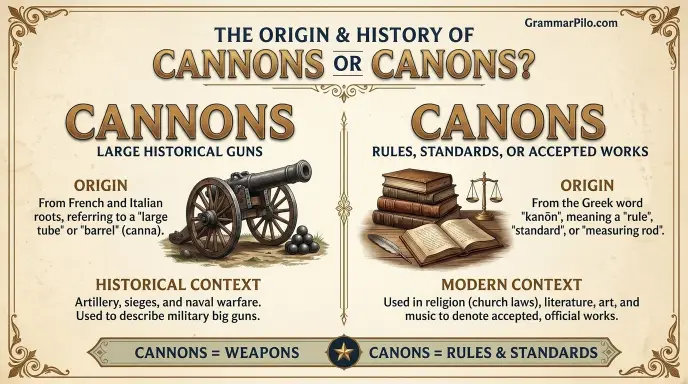
The English word cannon came through French and Italian forms associated with a large tube or barrel. Its deeper history is linked to words meaning a tube or pipe.
The word became associated with artillery as large gunpowder powered weapons developed and spread across Europe and other regions. Cannons played an important role in military history, particularly in sieges, naval warfare, and the development of fortifications.
Over time, cannon became the standard English word for this type of weapon. Its regular plural form is cannons.
Example: The museum displays several cannons from an earlier period of military history.
Where Does the Word Canon Come From?
The word canon came into English through Latin, from Greek kanōn, meaning a rule, measuring rod, or standard.
Its meaning developed to include accepted rules and principles, especially in religious and institutional settings. It later became common in discussions of literature, art, music, and other fields.
For example, the literary canon refers to works considered especially important or influential within a literary tradition. In religious contexts, canons may refer to established rules or regulations.
The plural form is canons.
Example: The course examines several works that belong to the traditional literary canon.
Why Are Cannons and Canons Often Confused?
The words differ by only one letter in their singular forms:
- Cannon means a large gun.
- Canon means a rule, standard, or recognized body of works.
Their plural forms, cannons and canons, retain the same difference. Since the words are pronounced alike, writers must use context and meaning to select the correct spelling.
Cannons vs. Canons: Key Differences
The main difference is what each word describes. Cannons refers to physical weapons, while canons refers to accepted rules, standards, or collections of works.
| Feature | Cannons | Canons |
| Singular form | Cannon | Canon |
| Part of speech | Noun | Noun |
| Main meaning | Large guns | Rules, principles, or recognized works |
| Common context | Military history and artillery | Religion, literature, art, and traditions |
| Example | The cannons guarded the fort. | The canons guide the institution. |
| Extra letter | Double n in the middle | Single n in the middle |
When Should You Use Cannons?
Use cannons when discussing weapons, artillery, historic battles, or objects designed to fire projectiles.
For example:
- The soldiers loaded the cannons.
- The castle’s cannons faced the sea.
- The museum preserves several historic cannons.
- The naval ship carried cannons for defense.
When Should You Use Canons?
Use canons when discussing rules, standards, accepted principles, or recognized collections of works.
For example:
- The canons of the organization explain its responsibilities.
- The literary canons include influential works from different periods.
- The scholars debated the canons of classical art.
- The series follows the established canons of its fictional universe.
Can the Words Be Used Interchangeably?
No. The words have different meanings, so replacing one with the other can make a sentence incorrect or confusing.
Incorrect: The museum displayed several canons from the battlefield.
If the writer means large weapons, the correct sentence is:
Correct: The museum displayed several cannons from the battlefield.
Similarly, if the writer is discussing rules or accepted principles, canons is the correct choice.
Common Uses of Cannons and Canons
Both words appear in several areas of writing, but their contexts are different.
Cannons in Military History
The word cannons is common in historical accounts of battles, wars, fortresses, and naval combat.
Examples include:
- The army moved its cannons toward the enemy’s position.
- The fortress was equipped with heavy cannons.
- Historians studied how cannons changed naval warfare.
- The soldiers repaired the old cannons before the battle.
Canons in Religion and Institutions
In religious or institutional contexts, canons can refer to formal rules or established principles.
Examples include:
- The council reviewed the canons governing the institution.
- Students learned about the historical development of church canons.
- The organization follows its established canons of conduct.
The precise meaning depends on the institution and the subject being discussed.
Canons in Literature and Art
In literature, the canon is a collection of works widely recognized as important or influential. In art and music, the word can refer to accepted principles or established traditions.
Examples include:
- The course explores the canons of English literature.
- Several modern writers have challenged the traditional literary canon.
- The exhibition examines the canons of classical art.
- The professor discussed the changing canon of world literature.
Canons in Movies, Television, and Games
In entertainment, canon often means the events, characters, and details officially accepted as part of a fictional story.
Examples include:
- The character’s return is part of the series canon.
- Fans debated which events belong to the official canon.
- The game expands the established canon of the fictional universe.
The plural canons can refer to multiple accepted rules or bodies of works, although canon is often used as a collective noun when discussing one fictional universe.
Common Mistakes When Using Cannons or Canons
These words are easy to confuse, especially when writing quickly. The following mistakes can change the meaning of a sentence.
Using Canons When You Mean Weapons
Because canon sounds like cannon, writers sometimes leave out the extra n when discussing artillery.
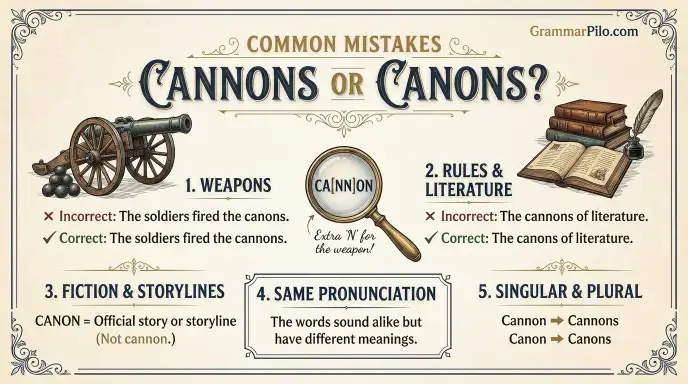
Incorrect: The soldiers fired the canons at the enemy fort.
Correct: The soldiers fired the cannons at the enemy fort.
The extra n in cannons helps identify the word as the plural of cannon, meaning a large gun.
Using Cannons When You Mean Rules
The opposite mistake happens when writers use cannons in a discussion of principles or recognized works.
Incorrect: The author challenged the cannons of traditional literature.
Correct: The author challenged the canons of traditional literature.
The second sentence refers to accepted works or standards within literature, not weapons.
Confusing Canon With Cannon in Fiction
Writers and fans sometimes discuss if a scene is canon. In this context, canon means that an event or detail belongs to the officially recognized storyline.
Correct: That episode is not part of the series canon.
Using cannon in this context would refer to a weapon and would not express the intended meaning.
Assuming the Words Have Different Pronunciations
In most English varieties, cannon and canon sound alike. Their spelling and meaning distinguish them, not a reliable difference in pronunciation.
When writing, consider the context before choosing the word.
Forgetting the Singular Forms
Remember that cannons comes from cannon, while canons comes from canon.
- One cannon, two cannons.
- One canon, two canons.
Knowing the singular forms makes the plural spellings easier to remember.
Everyday Examples of Cannons and Canons
The following examples show how each word works in different situations.
Examples of Cannons in Sentences
- The museum has three historic cannons outside its main entrance.
- The soldiers positioned their cannons along the hill.
- The old warship carried several cannons.
- Visitors learned how cannons were used in earlier battles.
- The fortress was designed to protect the city from enemy cannons.
- The historical painting shows soldiers standing beside their cannons.
- The guide explained how heavy cannons changed military strategy.
Examples of Canons in Sentences
- The students studied the canons of classical literature.
- The institution follows established canons of conduct.
- Critics debated the traditional canons of modern art.
- The scholar examined the religious canons of the period.
- The film’s ending became part of the official story canon.
- The course explores how literary canons change over time.
- The organization reviewed its canons before updating its policies.
In Emails and Professional Writing
Using cannons:
“The historical report includes a section on the cannons used to defend the coastal fortress.”
Using canons:
“The research paper examines the canons of literary criticism and their influence on modern writing.”
Examples in News and Educational Content
A history article might explain how cannons affected the outcome of a battle. A literature article might examine how writers enter or leave the literary canon.
Both words are appropriate in these contexts because each describes a different subject.
Google Trends and Modern Usage
People search for cannons and canons in connection with spelling questions, history, literature, religion, and entertainment.
Why Do People Search for Cannons or Canons?
The words have similar spellings and identical or very similar pronunciations in many English accents. This makes it easy to confuse them when writing from memory.
Common search phrases include:
- cannons or canons
- cannons vs. canons
- canons vs. cannons
- cannon meaning
- canon meaning
- literary canon meaning
- historical cannons
These searches reflect different interests. Some people want to confirm a spelling, while others want to understand a word used in a particular subject.
What Does Modern Usage Show?
The word cannons commonly appears in historical writing, military museums, discussions of artillery, and descriptions of weapons.
The word canons appears in literary criticism, religious history, institutional rules, and discussions of fictional universes. In entertainment communities, canon is especially familiar as a term for events officially recognized as part of a story.
Search interest varies by topic, region, and time. Without current Google Trends data, it would be misleading to give exact search figures or claim that one spelling receives more searches worldwide.
Practical takeaway: Look at the subject of the sentence. If it concerns weapons, use cannons. If it concerns rules, principles, or recognized works, use canons.
Cannons vs. Canons: Comparison Table
| Question | Cannons | Canons |
| What is the singular form? | Cannon | Canon |
| What does it mean? | Large guns | Rules, principles, or recognized works |
| Is it a correct spelling? | Yes | Yes |
| Is it used in military history? | Yes | Sometimes, if discussing military rules or standards |
| Is it used in literature? | Only when referring to weapons | Yes, when discussing recognized works or standards |
| Is it used in religion? | Generally for weapons | Yes, for certain established rules |
| Does it have an extra n? | Yes | No |
Cannons or Canons: Which Is Correct?
Both are correct words. Choose cannons for large guns and canons for accepted rules, principles, or recognized collections of works.
Canons or Cannons: Does the Order Matter?
No. The meaning of each word stays the same regardless of the order in which you compare them. Canons or cannons and cannons or canons refer to the same two words.
Cannons and Canons: Are They Homophones?
In most English accents, cannons and canons are pronounced the same way. They are commonly treated as homophones, which are words that sound alike but have different meanings and spellings.
Cannon vs. Canon: What Is the Difference?
Cannon is a large gun, while canon refers to a rule, standard, or recognized body of works. Their plural forms are cannons and canons.
Frequently Asked Questions
1. Is It Cannons or Canons?
Both spellings are correct, but they have different meanings. Cannons are large guns, while canons are rules, principles, or recognized works.
2. What Is the Difference Between a Cannon and a Canon?
A cannon is a large gun that fires projectiles. A canon is an accepted rule, standard, or recognized collection of works, such as the literary canon.
3. Are Cannons and Canons Pronounced the Same?
In most English accents, yes. They are commonly pronounced alike, so context is important when deciding which spelling to use.
4. What Does Canons Mean in Literature?
In literature, canons can refer to accepted principles or bodies of works considered important within a tradition. The literary canon includes works widely recognized for their influence or significance.
5. What Does Canon Mean in Movies and Games?
In movies, television, and games, canon refers to the events, characters, and details officially recognized as part of a fictional universe. The plural canons can refer to multiple accepted rules or collections, depending on the context.
6. Is Cannons the Plural of Cannon?
Yes. Cannons is the standard plural form of cannon, which means a large gun designed to fire projectiles.
7. How Can I Remember Cannons vs. Canons?
Remember that cannons has an extra n and refers to weapons. Canons has one n in the middle and often refers to rules, principles, or important works.
Conclusion: Remember the Extra N in Cannons
The difference between cannons and canons comes down to spelling and meaning. Cannons is the plural of cannon, a large gun used to fire projectiles. Canons is the plural of canon, a word used for accepted rules, standards, principles, or recognized collections of works.
Both spellings are correct, but they cannot be used interchangeably. If you are writing about a historic battlefield, artillery, or military equipment, choose cannons. If you are discussing literary works, religious rules, artistic principles, or official storylines, choose canons.
The easiest way to remember the distinction is to connect the extra n in cannons with the weapon. When writing about a canon of literature or a set of rules, use the shorter spelling.
Once you understand the meanings, you can use cannons or canons confidently in essays, articles, reports, and everyday writing. Always consider the context, and the correct spelling will become much easier to identify.
You May Also Like Related Article

I’m Claire Morgan, the author behind Grammarpilo.com, where I write about English grammar, sentence structure, punctuation, and everyday language. My goal is to make grammar simple, clear, and practical, helping readers understand the rules and apply them with confidence in real-world writing.






1 thought on “Cannons or Canons: Understand Difference & Never Mix Them Up”