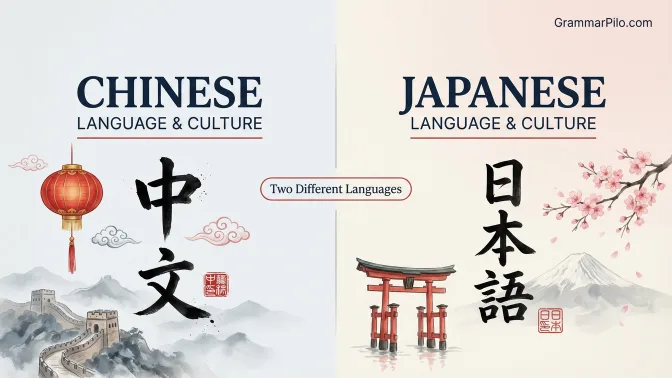
Chinese and Japanese are different languages associated with two distinct East Asian countries, China and Japan.
Although they share some historical and cultural influences, they have different grammar systems, pronunciation, vocabulary, writing conventions, and national identities. Chinese is primarily associated with China, while Japanese is the main language of Japan.
The comparison between Chinese or Japanese often comes up because the two languages use some similar looking written characters. Japanese includes kanji, a writing system that historically developed from Chinese characters.
This visual similarity can make written Chinese and Japanese appear alike to people who are unfamiliar with either language. However, their spoken forms and grammatical structures are quite different.
Understanding the difference is useful for students, travelers, language learners, writers, and anyone interested in East Asian cultures.
This guide compares Chinese and Japanese through their origins, writing systems, pronunciation, grammar, vocabulary, everyday usage, and cultural backgrounds.
Quick Answer: Chinese or Japanese?
Chinese and Japanese are two separate languages, not different versions of the same language. Chinese belongs to the Sino Tibetan language family, while Japanese is generally classified as a Japonic language.
| Feature | Chinese | Japanese |
| Main country | China | Japan |
| Language family | Sino Tibetan | Japonic |
| Main writing systems | Chinese characters | Kanji, hiragana, katakana |
| Basic word order | Usually Subject Verb Object | Usually Subject Object Verb |
| Pronunciation | Includes lexical tones | Uses pitch accent and other pronunciation features |
| Native speakers | Primarily in China and Chinese speaking communities worldwide | Primarily in Japan and Japanese speaking communities worldwide |
Easy way to remember: Chinese and Japanese share some historical writing influences, but they are different languages with distinct grammar, pronunciation, and vocabulary.
Definition and Meaning of Chinese and Japanese
The words Chinese and Japanese can refer to languages, people, national identities, and cultural traditions. Their exact meanings depend on the context.
What Does Chinese Mean?
Chinese generally refers to something connected with China, its people, languages, or culture.
As a language label, Chinese can refer to a group of related language varieties spoken by communities in China and elsewhere. Mandarin is the most widely spoken variety and serves as the official standard language of mainland China.
Other major Chinese varieties include Cantonese, Wu, Min, and Hakka. These varieties can differ considerably in pronunciation and vocabulary.
Examples include:
- She is learning Chinese at university.
- Mandarin Chinese is widely used in mainland China.
- Chinese characters are used in several East Asian writing traditions.
- The museum features traditional Chinese art and history.
The word Chinese can also describe nationality, cultural heritage, food, literature, and other aspects of life connected with China.
What Does Japanese Mean?
Japanese refers to something connected with Japan, its people, language, or culture.
As a language, Japanese is the primary language spoken in Japan. It has a distinctive grammatical structure and uses three main writing systems: kanji, hiragana, and katakana.
Examples include:
- He is studying Japanese before visiting Tokyo.
- Japanese grammar uses particles to show relationships between words.
- Many Japanese words are written using a combination of kanji and hiragana.
- The library has a large collection of Japanese literature.
The word Japanese can also describe people, traditions, architecture, cuisine, entertainment, and other aspects of Japanese society.
Are Chinese and Japanese the Same?
No. Chinese and Japanese are separate languages. They have different grammar, pronunciation, and vocabulary, even though Japanese uses many characters that originated in Chinese writing.
A person who speaks Mandarin does not automatically understand spoken Japanese. Similarly, knowing Japanese does not mean someone can understand spoken Chinese.
Their shared historical connections are important, but they should not be confused with linguistic identity.
The Origin and History of Chinese and Japanese
Chinese and Japanese have different linguistic histories, although their writing traditions became connected through centuries of cultural exchange.
Where Does the Chinese Language Come From?
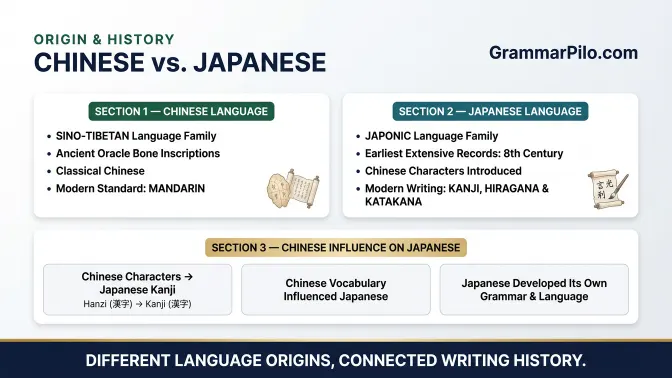
Chinese belongs to the Sino Tibetan language family. Its history extends back thousands of years, with early written evidence appearing in ancient inscriptions, including oracle bone inscriptions from the Shang dynasty.
Over time, Chinese developed into several major historical stages and regional varieties. Classical Chinese became an influential written language across East Asia and played an important role in literature, philosophy, government, and education.
Modern Mandarin developed from northern Chinese varieties and became the basis of Standard Chinese.
Today, Mandarin is the official standard language of mainland China and Taiwan, while Chinese communities around the world also speak other varieties.
Where Does the Japanese Language Come From?
Japanese belongs to the Japonic language family. Its deeper origins remain a subject of linguistic research, and it is not classified as a member of the Sino Tibetan language family.
The earliest surviving extensive written records of Japanese date from around the eighth century. Before a fully developed Japanese writing system emerged, Chinese characters were introduced through cultural contact with the Asian mainland.
Japanese speakers adapted these characters to represent Japanese words and sounds. Over time, hiragana and katakana developed from simplified forms of Chinese characters.
This process created the writing system used in modern Japanese.
How Did Chinese Influence Japanese?
Chinese culture and writing had a major influence on Japan, particularly through literature, religion, government, philosophy, and education.
Chinese characters, known as hanzi in Chinese and kanji in Japanese, became an important part of Japanese writing. Japanese also adopted many words of Chinese origin, although their pronunciation and usage often changed over time.
Despite these influences, Japanese did not become a form of Chinese. It developed its own grammar, vocabulary, and spoken language.
Chinese vs. Japanese Writing Systems
One of the most noticeable differences between Chinese and Japanese is how they are written.
How Is Chinese Written?
Modern Chinese primarily uses Chinese characters, called hanzi. Each character generally represents a syllable and carries meaning or contributes to the meaning of a word.
For example:
| Chinese Character | Pinyin | English Meaning |
| 人 | rén | Person |
| 水 | shuǐ | Water |
| 山 | shān | Mountain |
| 日 | rì | Sun or day |
| 学 | xué | Study or learn |
Chinese does not use an alphabet in the same way English does. Instead, characters represent meaningful linguistic units.
There are two major modern character standards:
- Simplified Chinese: Commonly used in mainland China and Singapore.
- Traditional Chinese: Used in Taiwan, Hong Kong, and some other Chinese speaking communities.
How Is Japanese Written?
Japanese uses three main writing systems together: kanji, hiragana, and katakana.
Kanji: These are characters historically derived from Chinese writing. They usually represent words or meaningful parts of words.
Hiragana: A phonetic syllabary commonly used for grammatical endings, particles, and native Japanese words without kanji.
Katakana: Another phonetic syllabary often used for foreign loanwords, foreign names, and emphasis.
For example:
| Japanese Writing | Reading | Meaning |
| 人 | hito | Person |
| 水 | mizu | Water |
| 山 | yama | Mountain |
| 日 | hi | Sun or day |
| 学校 | gakkō | School |
A Japanese sentence can contain all three writing systems at once.
For example:
私はコーヒーを飲みます。
This sentence means “I drink coffee.”
It combines kanji, hiragana, and katakana in a single sentence.
Why Do Chinese and Japanese Characters Look Similar?
Japanese kanji developed from Chinese characters, which explains why some written forms look identical or similar.
For example, the characters for mountain and water are visually similar in both languages:
| Meaning | Chinese | Japanese Kanji |
| Mountain | 山 | 山 |
| Water | 水 | 水 |
| Person | 人 | 人 |
| Fire | 火 | 火 |
| Tree | 木 | 木 |
However, similar looking characters do not always have identical pronunciations or meanings. Some characters also developed different forms or uses in the two languages.
Chinese vs. Japanese Pronunciation
Chinese and Japanese sound different when spoken. Their pronunciation systems use different features, making listening and speaking an important part of learning either language.
Does Chinese Use Tones?
Yes. Mandarin Chinese uses four main lexical tones, along with a neutral tone. A tone can change the meaning of a syllable even when its basic consonants and vowels remain the same.
For example, the Mandarin syllable ma can have different meanings depending on its tone.
| Pinyin | Tone | Meaning |
| mā | First tone | Mother |
| má | Second tone | Hemp |
| mǎ | Third tone | Horse |
| mà | Fourth tone | To scold |
This tonal system is an important feature of Mandarin pronunciation. Other Chinese varieties have their own tonal systems, which may differ in the number and patterns of tones.
Does Japanese Use Tones?
Japanese does not use the same lexical tone system as Mandarin. Instead, standard Japanese uses a pitch accent system.
Pitch accent involves patterns of high and low pitch across syllables. These patterns can help distinguish words, although they do not work in exactly the same way as Mandarin tones.
Japanese pronunciation also includes long and short vowels, consonant combinations, and the distinctive Japanese syllabic nasal sound.
Are Chinese and Japanese Pronounced Similarly?
No. Although some Japanese words of Chinese origin have historical connections with Chinese pronunciation, modern spoken Chinese and Japanese are quite different.
Mandarin has consonant and vowel combinations that may be unfamiliar to Japanese learners. Japanese has a more limited range of syllable patterns and uses pitch accent rather than Mandarin’s tone system.
Learning one language can offer some help with recognizing shared vocabulary or characters, but it does not automatically make the other language easy to speak.
Chinese vs. Japanese Grammar
The grammar systems of Chinese and Japanese differ significantly. Their sentence structures, particles, verb forms, and grammatical rules are not interchangeable.
What Is the Basic Chinese Sentence Structure?
Mandarin Chinese generally follows a Subject Verb Object (SVO) sentence structure, similar to English.
For example:
我喝水。
This means “I drink water.”
The sentence follows this order:
- Subject: 我 (I)
- Verb: 喝 (drink)
- Object: 水 (water)
Chinese verbs generally do not change form to show grammatical person or tense in the same way English verbs do. Time and aspect can be communicated through context, time expressions, and particles.
What Is the Basic Japanese Sentence Structure?
Japanese generally follows a Subject Object Verb (SOV) sentence structure.
For example:
私は水を飲みます。
This means “I drink water.”
The sentence follows this order:
- Subject: 私は (I)
- Object: 水を (water)
- Verb: 飲みます (drink)
Japanese uses particles such as は (wa) and を (o) to show grammatical relationships between sentence elements.
Japanese verbs also change form to express tense, politeness, and other grammatical meanings.
Main Grammar Differences
| Feature | Chinese | Japanese |
| Basic word order | Subject Verb Object | Subject Object Verb |
| Verb conjugation | Limited compared with Japanese | Extensive |
| Grammatical particles | Used, but differently | Important part of sentence structure |
| Noun gender | No grammatical gender system like French | No grammatical gender system like French |
| Plural marking | Often depends on context and specific expressions | Often depends on context and specific expressions |
| Politeness levels | Expressed through vocabulary and phrasing | Strongly reflected in verb forms and expressions |
These differences explain why Chinese and Japanese cannot be treated as interchangeable languages.
Chinese vs. Japanese Vocabulary
Chinese and Japanese share some vocabulary through historical borrowing, but many words differ in pronunciation, meaning, and usage.
Do Chinese and Japanese Share Words?
Yes. Japanese borrowed a large number of words and characters from Chinese over many centuries.
These words are often called Sino Japanese vocabulary. They frequently relate to education, government, philosophy, science, religion, and formal communication.
For example, the character 学 is associated with learning or study in both languages.
However, the pronunciation differs:
- Mandarin Chinese: xué
- Japanese: gaku in many compounds
The shared character does not mean the words sound the same.
Examples of Similar Chinese and Japanese Characters
| Meaning | Chinese | Japanese |
| Person | 人 (rén) | 人 (hito) |
| Water | 水 (shuǐ) | 水 (mizu) |
| Mountain | 山 (shān) | 山 (yama) |
| Fire | 火 (huǒ) | 火 (hi) |
| Book | 书 / 書 (shū) | 書 (hon) |
| School | 学校 (xuéxiào) | 学校 (gakkō) |
Some characters have similar meanings, while their readings are different. Others may have developed different meanings or usage patterns.
Can Chinese Speakers Understand Japanese Words?
A Chinese speaker may recognize certain Japanese kanji because the characters share historical origins. However, recognizing a character is not the same as understanding an entire sentence.
Japanese grammar, hiragana, katakana, and native vocabulary can make a Japanese passage difficult for someone who only knows Chinese.
The same is true in reverse. A Japanese speaker may recognize some Chinese characters but still struggle to understand Chinese sentences.
Chinese and Japanese Culture: Important Differences
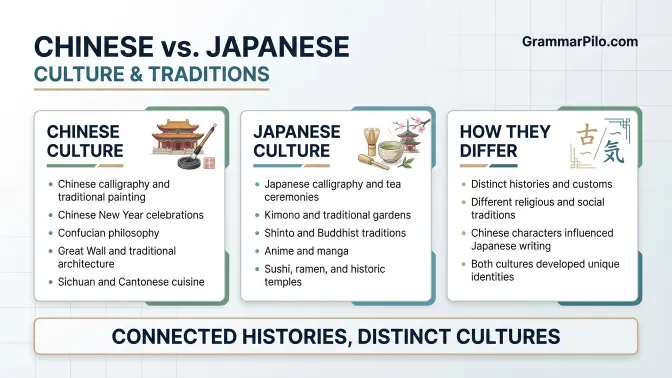
Language is only one part of the comparison. China and Japan also have distinct histories, customs, traditions, and cultural identities.
Chinese Culture
Chinese culture has a long and diverse history shaped by different dynasties, philosophical traditions, regional communities, and historical developments.
Some widely recognized elements include:
- Chinese calligraphy
- Traditional Chinese painting
- Chinese New Year celebrations
- Confucian philosophy
- Traditional Chinese architecture
- Regional cuisines such as Sichuan and Cantonese food
- Historical landmarks such as the Great Wall of China
China is a large and culturally diverse country, so traditions and customs vary considerably across regions.
Japanese Culture
Japanese culture has developed through its own historical traditions, religious influences, artistic practices, and modern social changes.
Some widely recognized elements include:
- Japanese calligraphy
- Tea ceremonies
- Traditional kimono clothing
- Shinto and Buddhist traditions
- Japanese gardens
- Anime and manga
- Traditional foods such as sushi, ramen, and tempura
- Historical architecture and temples
Japan also has regional cultural differences, and modern Japanese society includes a wide range of lifestyles and artistic influences.
Are Japanese and Chinese Traditions the Same?
No. The two cultures have influenced each other over time, but they have distinct customs, histories, and social traditions.
For example, Japanese writing developed partly through the adoption of Chinese characters, but Japanese literature and language evolved independently. Similarly, both countries have important Buddhist traditions, yet their religious practices and cultural expressions are not identical.
Which Language Should You Learn
The best language to learn depends on your personal interests, goals, career plans, and preferred learning experience.
Learn Chinese if You Are Interested in Mandarin and China
Mandarin Chinese may be a good choice if you want to:
- Communicate with Mandarin speakers.
- Explore Chinese history and literature.
- Work with Chinese speaking businesses.
- Travel throughout Mandarin speaking regions.
- Understand Chinese films, media, and entertainment.
One important challenge is learning Mandarin tones and recognizing a large number of Chinese characters.
Learn Japanese if You Are Interested in Japan
Japanese may be a good choice if you want to:
- Travel or live in Japan.
- Read Japanese manga and literature.
- Understand Japanese anime, films, and video games.
- Work with Japanese organizations.
- Explore Japanese history and culture.
Japanese learners need to study kanji, hiragana, katakana, particles, and different levels of polite speech.
Is Chinese or Japanese Easier to Learn?
Neither language is automatically easier for every learner. Their challenges are different.
Mandarin requires careful attention to tones and character recognition. Japanese requires learning three writing systems, grammatical particles, verb conjugations, and different politeness levels.
Your native language, previous language learning experience, study habits, and motivation can make a significant difference.
Google Trends and Modern Usage
Google Trends can help explore public interest in Chinese and Japanese as search topics. However, the results should be interpreted according to the selected location, time period, and search category.
Japanese vs. Chinese Search Interest
Search interest for Chinese and Japanese can vary across countries and regions. People may search for these terms because they want to learn a language, travel, explore culture, understand entertainment, or research a particular country.
A comparison may also be affected by the broad meaning of each word. For example, someone searching for Chinese might be interested in food, history, or language, while a search for Japanese could relate to anime, technology, or tourism.
Which Language Is More Popular?
There is no single Google Trends result that proves one language is universally more popular. Search interest depends on the audience, location, time range, and reason behind each search.
A more useful comparison would examine specific searches such as learn Mandarin and learn Japanese rather than relying only on the broad terms Chinese and Japanese.
Why Search Trends Matter
Search trends can help educators, publishers, and language learning websites understand what readers are interested in. However, search popularity does not determine a language’s value, importance, or difficulty.
Both Chinese and Japanese have major international learning communities and important roles in global communication.
Quick Comparison Table
| Feature | Chinese | Japanese |
| Main country | China | Japan |
| Language family | Sino Tibetan | Japonic |
| Main standard variety | Mandarin Chinese | Standard Japanese |
| Writing system | Chinese characters | Kanji, hiragana, katakana |
| Basic sentence order | SVO | SOV |
| Tones | Mandarin uses lexical tones | Uses pitch accent |
| Verb conjugation | Relatively limited | More extensive |
| Historical writing influence | Ancient Chinese writing tradition | Influenced by Chinese characters |
| Main learning challenge | Tones and characters | Three writing systems and grammar |
| Spoken mutual intelligibility | Not automatically understandable to Japanese speakers | Not automatically understandable to Chinese speakers |
Frequently Asked Questions
1. Is Chinese or Japanese the Same Language?
No. Chinese and Japanese are different languages with separate grammatical structures, pronunciation systems, and vocabulary. Japanese uses characters historically derived from Chinese writing, but it is not a form of Chinese.
2. Which Came First, Japanese or Chinese?
Written Chinese has a much earlier documented history than Japanese writing. Ancient Chinese inscriptions date back thousands of years, while the earliest extensive surviving written records of Japanese date from around the eighth century.
However, this does not mean Japanese as a spoken language began at that time.
3. Can Chinese People Understand Japanese?
Not automatically. Some Chinese speakers may recognize Japanese kanji because of shared character origins, but Japanese grammar, pronunciation, and vocabulary are different. Understanding written characters does not guarantee understanding the language.
4. Can Japanese People Understand Chinese?
Japanese speakers may recognize some Chinese characters, especially those with familiar meanings. However, spoken Chinese is different from Japanese, and understanding one does not automatically provide fluency in the other.
5. Is Japanese Based on Chinese?
Japanese is not based on Chinese as a spoken language. However, its writing system was strongly influenced by Chinese characters, and Japanese borrowed many words from Chinese over centuries of cultural contact.
6. Which Is Harder to Learn, Chinese or Japanese?
The difficulty depends on the learner. Mandarin requires learning tones and Chinese characters, while Japanese requires learning kanji, hiragana, katakana, grammar, and politeness levels. Each language presents different challenges.
7. Do Chinese and Japanese Use the Same Alphabet?
No. Chinese primarily uses characters rather than an alphabet. Japanese uses kanji alongside two phonetic syllabaries, hiragana and katakana. Neither language uses the English alphabet as its main writing system.
Conclusion
Chinese and Japanese are two distinct languages with different origins, grammar systems, pronunciation, vocabulary, and cultural backgrounds.
Their most noticeable connection is the historical influence of Chinese characters on Japanese writing. This shared feature explains why some written words look similar, but it does not make the languages the same.
Chinese belongs to the Sino Tibetan language family, while Japanese belongs to the Japonic language family. Mandarin Chinese uses lexical tones, whereas Japanese uses pitch accent.
Their basic sentence structures also differ, with Chinese generally following Subject Verb Object order and Japanese generally following Subject Object Verb order.
When comparing Chinese or Japanese, Chinese vs. Japanese, Japanese or Chinese, and Japanese vs. Chinese, remember that neither language is simply a variation of the other. Both have rich histories and unique writing traditions.
The right language to learn depends on your interests, communication goals, and reasons for exploring East Asian languages and cultures.
Explore More Articles

I’m Sloane Mercer, a U.S.-based English language writer focused on grammar, spelling, vocabulary, and everyday English usage. Through GrammarPilo, I provide clear and practical explanations to help readers choose the right words and communicate with confidence.







2 thoughts on “Chinese or Japanese: Differences in Language, Culture & Identity”