Indescribable is the standard and much more widely used word for something that is too extraordinary, intense, or unusual to be described adequately in words. Undescribable is also recorded in English, but it is much less common.
Both words can express the idea that something is difficult or impossible to describe, although indescribable is generally the better choice in everyday, academic, and professional writing.
People often search for indescribable or undescribable because the words look similar and share the same basic idea. Both contain the word describe, and both use a negative prefix to express the inability to describe something.
This similarity makes it difficult to know which form sounds natural and which one is preferred in standard English.
The easiest way to remember the difference is to use indescribable when you want to say that an experience, feeling, sight, or event cannot be adequately expressed in words.
For example, you might describe the beauty of a mountain landscape as indescribable or call the joy of reuniting with a loved one indescribable.
In this guide, you will learn the meanings, origins, spelling differences, grammatical uses, and common examples of indescribable and undescribable so you can choose the most appropriate word confidently.
Quick Answer: Indescribable or Undescribable?
Indescribable is the preferred word in standard modern English. Undescribable is a less common alternative that also appears in English usage.
| Word | Status | Meaning | Recommendation |
| Indescribable | Standard and widely used | Too difficult or impossible to describe adequately in words | Best choice in most situations |
| Undescribable | Recognized but uncommon | Difficult or impossible to describe in words | Use only when appropriate to your context |
| Describable | Standard word | Able to be described | Use for something that can be explained or portrayed |
| Indescribably | Standard adverb | In a way that cannot be adequately described | Use to modify an adjective or describe a feeling |
Examples:
- The view from the summit was indescribable.
- She felt an indescribable sense of relief.
- The beauty of the landscape was indescribable.
- The experience was so extraordinary that words could hardly explain it.
For most readers, indescribable is the clearest and most natural option.
Indescribable and Undescribable: Definition and Meaning
Although the two words are similar, their usage is not equally common.
What Does Indescribable Mean?
Indescribable is an adjective that describes something so remarkable, intense, unusual, or complex that words cannot adequately express it.
The word is frequently used for emotions, experiences, sights, sounds, beauty, pain, joy, and other things that are difficult to communicate fully through language.
For example, a person who witnesses a spectacular sunset may struggle to find words that capture its beauty. They might say the sunset was indescribable because ordinary descriptions do not seem sufficient.
Examples of indescribable in a sentence:
- The mountains looked indescribable in the golden evening light.
- She experienced indescribable happiness when she heard the news.
- The loss left him with an indescribable feeling of sadness.
- The concert created an indescribable atmosphere.
- Watching the northern lights was an indescribable experience.
The word does not always mean that something literally cannot be described at all. Often, it emphasizes that language cannot fully capture the experience.
What Does Undescribable Mean?
Undescribable is a less common adjective that expresses a similar idea: something is difficult or impossible to describe in words.
It follows a recognizable English word-building pattern, combining the negative prefix un- with describable. However, it is much less established in everyday usage than indescribable.
Readers may understand the intended meaning, but indescribable is usually the more natural and widely accepted choice.
Examples of undescribable in a sentence:
- The scene was so unusual that he called it undescribable.
- She struggled to explain an undescribable feeling.
- The experience seemed undescribable to those who had not witnessed it.
These examples demonstrate the intended meaning, but in ordinary editing, indescribable would generally be preferred.
What Is the Main Difference Between Indescribable and Undescribable?
The main difference is conventional usage rather than a clear difference in meaning.
Indescribable is the established, widely used form. Undescribable is a much rarer alternative with a similar meaning.
For example:
- Preferred: The view was indescribable.
- Less common: The view was undescribable.
Both sentences aim to express that the view was beyond adequate description, but the first sounds more natural to most English readers.
The Origin and History of Indescribable and Undescribable
The structure of these words explains why they look so similar.
Where Does the Word Indescribable Come From?
Indescribable is formed from the negative prefix in-, the word describe, and the suffix -able.
The prefix in- can mean “not,” while -able generally means “capable of being.” The word describable means capable of being described. Adding in- creates the opposite meaning: not capable of being adequately described.
The word describe entered English through French and ultimately comes from Latin describere, meaning to write down, represent, or describe.
Over time, indescribable became a common way to express experiences or qualities that seem to exceed the limits of ordinary language.
Today, it is widely used in literature, journalism, conversation, reviews, and personal writing.
Where Does the Word Undescribable Come From?
Undescribable is formed by adding the prefix un- to describable. The prefix un- commonly expresses negation in English, as in unusual, unfair, and unbelievable.
This construction makes undescribable understandable as a word. However, English does not use every grammatically possible word form equally often. Some forms become established through long-term usage, while others remain uncommon.
In this case, indescribable is the conventional choice and appears much more frequently in ordinary English.
Why Is Indescribable More Common?
Several factors help explain the preference for indescribable.
- Established usage: Indescribable has a long history as the conventional adjective.
- Familiarity: Readers are more accustomed to seeing indescribable in books, articles, and everyday writing.
- Natural expression: Phrases such as “indescribable beauty” and “indescribable joy” are well established.
- Editorial preference: Writers and editors generally choose the more familiar form to avoid distracting readers.
The important lesson is that a word can be understandable without being the most natural or preferred choice.
Why Is Indescribable Preferred Over Undescribable?
The preference for indescribable reflects standard usage. Although undescribable follows a recognizable pattern, it is much less common.
The Role of the Prefix In-
The prefix in- appears in many English adjectives that express a negative meaning.
Examples include:
- Inaccurate
- Incomplete
- Inconsistent
- Inappropriate
- Indescribable
In indescribable, the prefix indicates that something cannot be described adequately.
This does not mean that in- must always be used to make a negative adjective. English uses several negative prefixes, including un-, in-, im-, il-, and ir-.
The appropriate prefix often depends on the word’s history and established usage rather than a single rule that applies to every adjective.
Why Not Always Use Un-?
The prefix un- is common in English, but it cannot be added freely to every adjective and produce the most natural word.
For instance, English speakers normally say inaccurate, not unaccurate. They say incomplete, not usually uncomplete in standard writing. Similarly, indescribable is the established form for the meaning discussed here.
The fact that undescribable can be understood does not make it equally common or equally suitable in all contexts.
An Easy Way to Remember the Preferred Spelling
Remember this familiar phrase:
“The beauty was indescribable.”
If you are describing a feeling, experience, view, or event that words cannot fully capture, indescribable is the safest choice.
British English vs. American English: Indescribable or Undescribable
There is no major British English versus American English spelling difference between these words. Indescribable is the preferred form in both varieties.
| Feature | British English | American English |
| Preferred adjective | Indescribable | Indescribable |
| Less common alternative | Undescribable | Undescribable |
| Adverb | Indescribably | Indescribably |
| Example | The scenery was indescribable. | The scenery was indescribable. |
| Regional spelling difference | None | None |
Writers in the United Kingdom, United States, Canada, Australia, and other English-speaking regions can use indescribable without worrying about regional spelling conventions.
Is Indescribable British or American English?
It is used in both British and American English. It is not exclusive to one country, and the spelling remains the same.
Examples include:
- The experience was indescribable.
- The pain was indescribable.
- The city looked indescribable at night.
- The news brought indescribable relief.
These sentences are natural in both varieties of English.
Which Word Should You Use: Indescribable or Undescribable?
In most cases, use indescribable. It is the established form and is suitable for almost every ordinary context.
Use Indescribable for Emotions
Strong feelings can be difficult to express completely in words.
Examples:
- She felt indescribable joy after the reunion.
- The loss caused indescribable sadness.
- He experienced indescribable relief when the danger passed.
- The news filled the family with indescribable happiness.
The word works especially well when an emotion is so intense that a simple description seems insufficient.
Use Indescribable for Natural Beauty
The word is also common when describing impressive landscapes and natural phenomena.
Examples:
- The mountains offered indescribable views.
- The sunset created an indescribable display of color.
- The waterfall had an indescribable beauty.
- The desert sky looked indescribable beneath the stars.
These examples emphasize the difficulty of capturing a remarkable scene through language.
Use Indescribable for Unusual Experiences
An unusual, surprising, or overwhelming experience may also be called indescribable.
Examples:
- Seeing the spacecraft launch was an indescribable experience.
- The audience created an indescribable atmosphere.
- Traveling through the remote region was indescribable.
- The ceremony produced an indescribable sense of wonder.
Should You Use Undescribable in Formal Writing?
For formal writing, school assignments, professional articles, and published content, indescribable is the better choice.
Although undescribable may be understood, it can look unusual to readers because it is much less common. Unless you have a specific reason to use the rare form, choose indescribable.
Common Mistakes When Using Indescribable and Undescribable
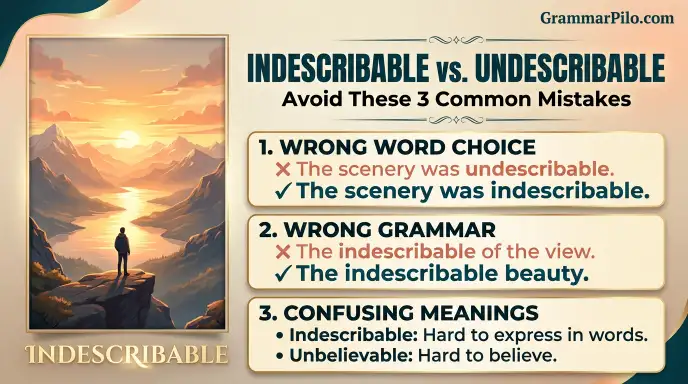
Knowing the most common mistakes can help you select the right word and write more naturally.
Mistake 1: Assuming Both Forms Are Equally Common
Less preferred: The scenery was undescribable.
Preferred: The scenery was indescribable.
Both forms aim to express the same idea, but indescribable is much more common and generally sounds more natural.
Mistake 2: Treating Indescribable as a Noun
Indescribable is an adjective, so it usually describes a noun.
Incorrect: The indescribable of the view amazed us.
Correct: The indescribable beauty of the view amazed us.
You can also use it after a linking verb.
Correct: The view was indescribable.
Mistake 3: Confusing Indescribable With Unbelievable
The words are related in tone but have different meanings.
- Indescribable: Too difficult to express adequately in words.
- Unbelievable: So surprising or extraordinary that it is difficult to believe.
For example, an experience may be indescribable because language cannot capture it fully, or unbelievable because it seems difficult to accept as true.
Mistake 4: Using Indescribable for Every Strong Feeling
The word is powerful, but repeating it too often can make writing less precise.
Instead of always writing “indescribable happiness,” you could use overwhelming joy, profound relief, or extraordinary delight, depending on the intended meaning.
Mistake 5: Assuming Every Word With Un- Is Incorrect
The prefix un- is perfectly standard in many words, including unusual, unfair, and unforgettable. The issue is not that un- is wrong. It is that indescribable is the established form for this particular meaning.
Everyday Examples of Indescribable and Undescribable
These examples show how the preferred word can be used naturally in different settings.
Some Examples in:
Everyday Conversation
- The view from the balcony was indescribable.
- I felt indescribable happiness when I saw my family.
- The atmosphere at the concert was indescribable.
- That was an indescribable experience.
- The beauty of the old city was indescribable.
Travel Writing
- The mountain sunrise offered indescribable beauty.
- Visitors often describe the northern lights as indescribable.
- The valley’s natural scenery was almost indescribable.
- The journey gave us an indescribable sense of freedom.
Literature and Creative Writing
- An indescribable silence settled over the room.
- She carried an indescribable sadness in her heart.
- The night sky filled him with indescribable wonder.
- An indescribable feeling passed through the crowd.
Professional and Educational Writing
- The witness described an indescribable sense of fear.
- The report explained how the disaster affected the local community.
- The artist attempted to portray an indescribable emotional experience.
- The writer used the word indescribable to emphasize the intensity of the scene.
In each case, indescribable communicates that ordinary language does not fully capture the experience or quality being discussed.
Google Trends and Modern Usage
People search for indescribable or undescribable because the words share a similar structure and meaning.
The difference is not always obvious to someone learning English, especially because both negative prefixes, in- and un-, appear in many English adjectives.
Why Do People Search for Indescribable or Undescribable?
Writers may be unsure which spelling is standard. Students may encounter one form in a text and want to confirm its correctness. Others may want to choose a natural adjective for describing beauty, emotions, experiences, or events.
Related searches include:
- indescribable or undescribable
- undescribable or indescribable
- indescribable vs. undescribable
- undescribable vs. indescribable
- indescribable and undescribable
- undescribable and indescribable
- meaning of indescribable
- how to spell indescribable
These searches reflect a common question about word formation and conventional English usage.
Which Word Is More Common Today?
Indescribable is the established and much more widely used form. Undescribable occurs less frequently and is generally not the preferred choice in edited English.
Exact search volumes and current popularity figures can change over time. Without a current Google Trends comparison, it would be misleading to provide specific numbers or claim an exact search ratio.
For everyday writing, the practical recommendation remains clear: use indescribable when you want to express that something cannot be adequately described in words.
Indescribable or Undescribable: Quick Comparison of Common Phrases
| Phrase | Meaning or Recommendation |
| Indescribable or undescribable | A comparison of the preferred word and a less common alternative |
| Undescribable or indescribable | The same comparison in reverse |
| Indescribable vs. undescribable | A spelling and usage comparison |
| Undescribable vs. indescribable | The same comparison in reverse |
| Indescribable and undescribable | Both forms discussed together |
| Undescribable and indescribable | Both forms discussed in reverse order |
| Indescribable beauty | A natural and common expression |
| Indescribable joy | A natural expression for overwhelming happiness |
| Indescribable experience | An experience difficult to express fully |
| Indescribably beautiful | Correct adverb + adjective construction |
| Describable or indescribable | A comparison between something that can and cannot be adequately described |
These phrases demonstrate that indescribable is the most useful form for ordinary writing. The rare alternative may be understood, but it is usually unnecessary.
Frequently Asked Questions
1. Is Indescribable or Undescribable Correct?
Indescribable is the standard and much more widely used form. Undescribable is also recorded as a less common alternative, but indescribable is generally preferred in modern English writing.
2. What Is the Difference Between Indescribable and Undescribable?
Both words express the idea that something is difficult or impossible to describe adequately. The main difference is usage: indescribable is the established, common form, while undescribable is much less common.
3. Is Undescribable a Real Word?
Undescribable appears in English usage as a rare alternative. However, its existence does not mean it is the preferred form. In most contexts, indescribable is the safer and more natural choice.
4. Is Indescribable British or American English?
Indescribable is standard in both British and American English. The spelling and meaning do not change between these varieties.
5. What Is an Example of Indescribable?
An example is, “The view from the mountain was indescribable.” The sentence means that the view was so impressive or beautiful that words could not fully express it.
6. What Is the Opposite of Indescribable?
Depending on the context, possible opposites include describable, explainable, or expressible. For example, something that is easily explained can be called describable.
7. How Do You Remember the Correct Spelling?
Remember the familiar word indescribable and the phrase “indescribable beauty.” It is the established form used for experiences, feelings, and sights that cannot be fully expressed in words.
Conclusion: Indescribable or Undescribable?
The best choice for almost every writing situation is indescribable. It is the standard, widely recognized adjective used for something that is too remarkable, intense, or unusual to be expressed adequately in words.
Undescribable is a much less common alternative that may be understood, but it is generally not the preferred form in edited English. The difference is mainly one of established usage rather than a major difference in meaning.
Use indescribable when describing overwhelming emotions, breathtaking scenery, extraordinary experiences, or feelings that are difficult to put into words. It works naturally in conversation, creative writing, travel descriptions, school assignments, and professional articles.
Remember that both British and American English use indescribable. You do not need to choose a different spelling based on your audience’s location.
When in doubt, choose the familiar and established form: indescribable. This simple choice will make your writing clearer, more natural, and easier for readers to understand.
Some Related articles

I’m Claire Morgan, the author behind Grammarpilo.com, where I write about English grammar, sentence structure, punctuation, and everyday language. My goal is to make grammar simple, clear, and practical, helping readers understand the rules and apply them with confidence in real-world writing.