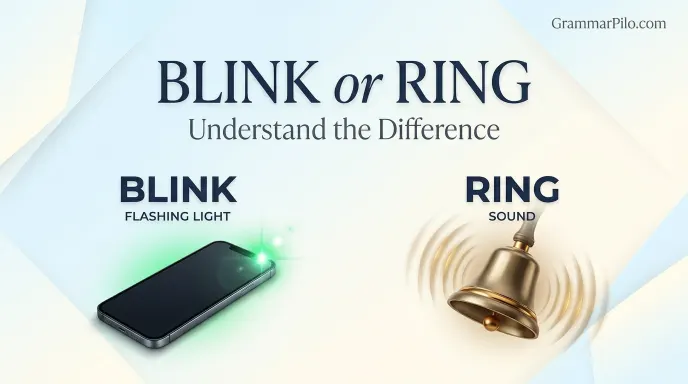
Blink and ring are two different English words with different meanings and uses. Blink usually means to close and open your eyes quickly, or to flash a light on and off.
Ring can mean to make a clear, resonant sound, such as a bell or telephone, or to form a circular shape around something. The correct word depends on the action or situation you want to describe.
These words can sometimes appear in similar everyday situations. For example, a device might blink when a notification arrives and ring when someone calls. However, blinking describes a visual action, while ringing generally describes a sound.
Understanding this distinction helps you choose the right word in conversation, emails, school assignments, and digital instructions.
In this guide, you will learn the meanings of blink and ring, explore their origins, compare their grammatical uses, and discover practical examples.
You will also see how these words work in technology, everyday communication, and common expressions, making it easier to understand when to use blink or ring.
Blink or Ring: Quick Answer
Blink means to close and open the eyes quickly or to flash a light briefly. Ring commonly means to produce a clear sound, such as a bell or phone, or to form a circle around something.
- Blink: A quick movement of the eyelids or a brief flash of light.
- Ring: A clear, resonant sound, a circular object, or the act of making a ringing sound.
- Main difference: Blink usually relates to sight or a brief visual action, while ring commonly relates to sound or circular shape.
Examples:
- She blinked when the bright light reached her eyes.
- The indicator light began to blink.
- The phone started to ring.
- A bell rang as the class ended.
In these examples, blink describes a visual or eye movement, while ring describes a sound.
What Does Blink Mean?
The word blink is commonly used as both a verb and a noun. As a verb, it means to close and reopen the eyes quickly or to flash briefly. As a noun, it can describe a single quick movement of the eyelids or a very short moment.
Blink as a Verb
When someone blinks, their eyelids close and open quickly. This action happens naturally and helps keep the eyes moist. The word can also describe a light or screen that switches on and off briefly.
Examples:
- She blinked several times after walking into the sunlight.
- He blinked in surprise when he heard the news.
- The warning light began to blink.
- The cursor continued to blink on the computer screen.
Blink as a Noun
As a noun, blink can refer to one quick movement of the eyes. It also appears in expressions that describe something happening extremely quickly.
Examples:
- He missed the movement in the blink of an eye.
- A single blink was enough to make him miss the signal.
- She gave a slow blink when she heard the unusual explanation.
Blink in Technology
In digital devices, blink often describes a light or indicator that flashes repeatedly. A blinking light can communicate that a device is active, waiting, charging, or experiencing a problem, depending on the device.
Examples:
- The router light began to blink.
- A notification icon blinked on the screen.
- The camera’s indicator blinked while recording.
The exact meaning of a blinking light depends on the device’s instructions.
What Does Ring Mean?
The word ring has several meanings. It can describe a clear sound, an object shaped like a circle, or the action of making a bell like sound. It can function as both a verb and a noun.
Ring as a Verb
As a verb, ring commonly means to produce a clear sound or cause a bell, telephone, or alarm to make a sound.
Examples:
- The telephone began to ring.
- The school bell rang at noon.
- She rang the doorbell before entering.
- The alarm rang early in the morning.
The verb is irregular. Its common forms are ring, rang, and rung.
Ring as a Noun
As a noun, ring can refer to the sound produced by a bell or telephone. It can also describe a circular piece of jewellery or another round object.
Examples:
- I heard the ring of the doorbell.
- She wore a gold ring on her finger.
- The phone gave one short ring.
- A metal ring hung from the gate.
The meaning depends on the surrounding sentence.
Ring in Everyday Communication
People often use ring when talking about phones, bells, alarms, and calling someone, particularly in British English.
Examples:
- My phone started to ring during the meeting.
- I’ll ring you after work.
- The bell rang to announce the beginning of the lesson.
- Someone rang the doorbell while we were eating.
In American English, call is often used instead of ring when referring to contacting someone by telephone, although ring is understood.
The Origin and History of Blink and Ring
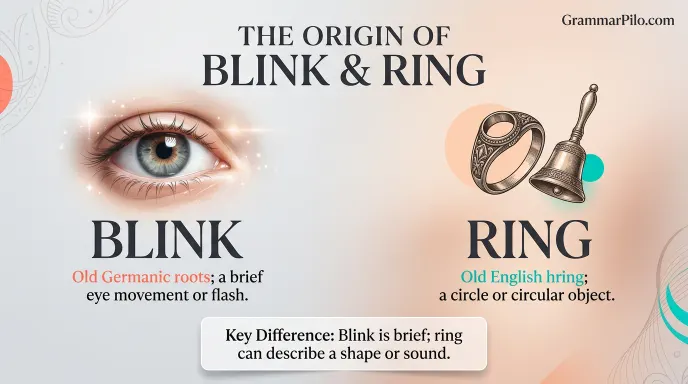
The two words have separate histories that help explain their different meanings.
Where Does Blink Come From?
The word blink has roots in older Germanic languages and has long been associated with quick eye movements and brief flashes. In modern English, it is used for the natural action of opening and closing the eyelids, as well as for lights that flash on and off.
The expression in the blink of an eye developed to describe something happening in an extremely short time.
Where Does Ring Come From?
The English word ring developed from Old English hring, meaning a circle, ring, or circular object. The verb meaning to produce a ringing sound has a related historical development in English and other Germanic languages.
Today, ring can refer to circular objects, resonant sounds, telephone calls, and several figurative expressions.
Why Are Blink and Ring Different?
Although both words can describe actions involving devices, they refer to different kinds of signals. A light can blink because it flashes, while a bell rings because it produces sound.
Examples:
- The light blinked, but the alarm remained silent.
- The telephone rang, but its screen did not blink.
Understanding the difference between visual and auditory actions is a simple way to remember the words.
Blink vs. Ring: Key Differences
| Feature | Blink | Ring |
| Main meaning | Close and open the eyes quickly or flash briefly | Produce a resonant sound or form a circular shape |
| Common use | Eyes, lights, screens, indicators | Bells, phones, alarms, circular objects |
| Part of speech | Verb and noun | Verb and noun |
| Verb forms | Blink, blinked, blinked | Ring, rang, rung |
| Main sensory association | Sight | Sound, though it can also describe shape |
| Example | The light began to blink. | The bell began to ring. |
Can Blink and Ring Be Used Interchangeably?
No, not in their ordinary meanings. A light can blink, while a bell can ring. Replacing one word with the other would usually change the meaning or make the sentence incorrect.
Incorrect for the intended meaning: The warning light began to ring.
Correct: The warning light began to blink.
Incorrect for the intended meaning: The telephone began to blink loudly.
Correct: The telephone began to ring loudly.
A phone’s screen or indicator might blink while the phone rings, but the two words describe separate actions.
Which Word Should You Use?
Choose the word that accurately describes what is happening.
Use Blink for Eyes and Lights
Use blink when describing a quick eye movement, a flashing light, or a visual indicator that switches on and off.
Examples:
- The baby blinked at the bright light.
- The cursor continued to blink.
- The warning indicator blinked twice.
- I blinked in disbelief.
Use Ring for Sounds and Circular Objects
Use ring when describing a bell, phone, alarm, or another source of a clear sound. And use it as a noun when referring to a circular object or a resonant sound.
Examples:
- The phone began to ring.
- The bell rang during the break.
- She bought a silver ring.
- I heard the ring of the alarm.
Use Ring for Telephone Calls
In British English, ring someone commonly means to telephone them. American English often prefers call someone, though both expressions are understood.
British English: I’ll ring you this evening.
American English: I’ll call you this evening.
The choice depends on the meaning and regional style.
Common Mistakes When Using Blink or Ring
Confusing Visual Signals With Sounds
A blinking light flashes, while a ringing alarm produces a sound. A device can do both, but the words describe different features.
Example: The security system’s red light blinked while the alarm rang.
Using the Wrong Verb Form of Ring
The verb ring is irregular, so its past tense and past participle forms are different.
- Present: The phone rings.
- Past: The phone rang.
- Past participle: The phone has rung.
Do not use ringed when you mean the usual past tense of the verb that describes making a sound. Ringed can be used in other contexts, such as describing something surrounded by a ring.
Forgetting That Ring Has Multiple Meanings
The word ring does not always describe a sound. It can also refer to jewellery, a circular shape, or a group arranged in a circle.
Examples:
- The bell rang. (Sound)
- She wore a ring. (Jewellery)
- A ring of trees surrounded the clearing. (Circular arrangement)
Treating Blink as Only an Eye Movement
Although blink often describes eyes, it also describes lights and visual indicators that flash.
Examples:
- The driver blinked in the sunlight.
- The router light blinked repeatedly.
- The cursor blinked beside the text.
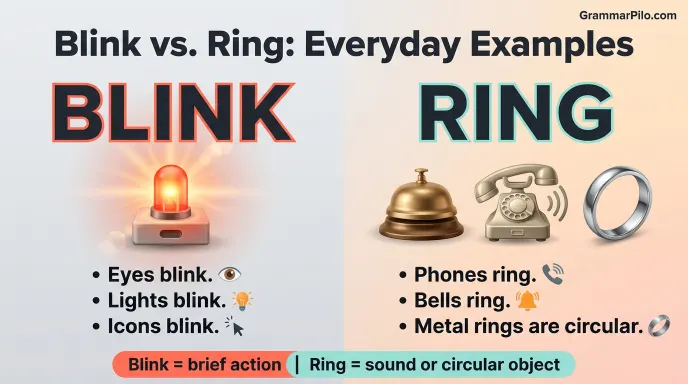
Everyday Examples of Blink and Ring
In Technology
- The router light began to blink after the connection dropped.
- The phone started to ring when the call came through.
- A notification icon blinked on the screen.
- The alarm rang when the timer reached zero.
At School or Work
- The student blinked in surprise at the difficult question.
- The bell rang at the end of the lesson.
- The projector light blinked before the presentation began.
- The office phone rang during the meeting.
At Home
- She blinked when the kitchen light turned on.
- The doorbell rang while dinner was being prepared.
- The digital clock’s indicator began to blink.
- The telephone rang twice before anyone answered.
In Stories and Descriptive Writing
- The traveller blinked as the bright sun appeared over the hills.
- A distant bell rang across the quiet village.
- The small light blinked in the darkness.
- The metal ring fell to the floor with a clatter.
These examples show that the words are useful in different contexts and should be selected according to the action being described.
Blink or Ring: Comparison Table
| Word or phrase | Meaning or usage |
| Blink or ring | Compare a visual action with a sound or circular object |
| Ring or blink | The same comparison in reverse |
| Blink vs. ring | Highlights the difference between flashing and ringing |
| Ring vs. blink | Highlights the difference in reverse order |
| Blink and ring | Two actions that can happen at the same time |
| Ring and blink | The same actions listed in reverse order |
| Blinking light | A light that flashes on and off |
| Ringing phone | A phone producing an audible ringing sound |
The phrases blink or ring, ring or blink, blink and ring, ring and blink, blink vs. ring, and ring vs. blink refer to different actions rather than alternative spellings of the same word.
Google Trends and Modern Usage
Why Do People Search for Blink or Ring?
People may search for blink or ring when trying to understand the meaning of the words, compare their uses, or describe what a device is doing. A blinking indicator and a ringing alarm may appear together, especially in phones, computers, routers, and security systems.
Others may be learning English and want to understand the difference between words related to sight and sound.
Modern Usage in Digital Content
Both words are common in everyday English and technology instructions. Blink is frequently used for lights, cursors, and indicators, while ring is common for phones, alarms, bells, and telephone calls.
Usage depends on context rather than regional spelling conventions. Unlike pairs such as traveler and traveller, blink and ring are different words with different meanings.
How to Choose the Right Word
Identify the action you want to describe. If something flashes or the eyes close and open quickly, use blink. If a bell, phone, or alarm makes a clear sound, use ring. When writing technical instructions, check the device manual to ensure the description matches the signal or sound.
Key Takeaways
- Blink commonly describes quick eye movements or flashing lights.
- Ring commonly describes a clear sound or a circular object.
- Both words can function as nouns and verbs.
- The past tense of blink is blinked.
- The past tense of ring is rang, and its past participle is rung.
- A device may blink and ring at the same time, but these actions are different.
- Use ring someone to mean telephone someone, especially in British English.
- Choose the word that matches the action and context.
Frequently Asked Questions
1. What is the difference between blink and ring?
Blink usually means to close and open the eyes quickly or flash a light. Ring usually means to produce a clear sound, such as a bell or telephone, or to refer to a circular object.
2. Can a phone blink and ring at the same time?
Yes. A phone’s screen or indicator light may blink while its speaker produces a ringing sound. The words describe separate visual and auditory actions.
3. Is blink a verb or a noun?
Blink can be both. As a verb, it describes a quick eye movement or flashing light. As a noun, it can refer to one such movement or a very short moment.
4. Is ring a verb or a noun?
Ring can be both. As a verb, it means to produce a sound or call someone by telephone. As a noun, it can refer to a sound, a circular object, or a piece of jewellery.
5. What is the past tense of blink?
The past tense of blink is blinked. For example, “She blinked when the bright light turned on.”
6. What is the past tense of ring?
The past tense of ring is rang. For example, “The telephone rang during the meeting.” The past participle is rung, as in “The telephone has rung three times.”
7. Does ring mean call someone?
Yes. In British English, ring someone commonly means to telephone them. In American English, call someone is often more common, although ring is understood.
8. What does a blinking light mean?
A blinking light flashes on and off. Depending on the device, it may indicate activity, a notification, a connection status, or a warning. Check the device’s instructions to determine its exact meaning.
9. Can blink and ring be used interchangeably?
No. They normally describe different actions. A light blinks, while a bell rings. Using one in place of the other may change the meaning of a sentence.
10. What does in the blink of an eye mean?
The expression in the blink of an eye means that something happens extremely quickly. For example, “The bird disappeared in the blink of an eye.”
Conclusion
Blink and ring are different words that describe different actions. Blink usually refers to closing and opening the eyes quickly or flashing a light, while ring commonly refers to a clear sound produced by a bell, telephone, or alarm. The word ring can also describe a circular object, such as a piece of jewellery.
Understanding the distinction helps you choose the right word in everyday conversation, school assignments, professional communication, and technical instructions.
A phone may blink with a visual notification while it rings to alert you to an incoming call. In that situation, both words are correct because they describe two different things happening at once.
Remember this simple rule: use blink for quick eye movements and flashing lights, and use ring for sounds or circular objects. Once you understand the main meanings and the different grammatical forms, choosing between blink or ring becomes straightforward.
Explore More Word Comparisons
- Racquet or Racket: British vs American Spelling Made Easy
- Truck or SUV: Which Vehicle Is Right for You? Key Differences
- Butt or Face: Very Quick Difference Between Two Everyday Words

I’m Sloane Mercer, a U.S.-based English language writer focused on grammar, spelling, vocabulary, and everyday English usage. Through GrammarPilo, I provide clear and practical explanations to help readers choose the right words and communicate with confidence.








1 thought on “Blink or Ring: Which Word Do You Mean? (They’re Totally Different)”