Polar and nonpolar describe how electrical charge is distributed within a molecule. A polar molecule has an uneven distribution of electrical charge, creating partial positive and negative ends.
A nonpolar molecule has an even or balanced charge distribution, so it does not have a permanent dipole. Understanding polar or nonpolar molecules is essential in chemistry because polarity affects how substances interact, dissolve, and behave.
The difference between polar and nonpolar substances often comes down to two factors: electronegativity and molecular shape. Electronegativity measures how strongly an atom attracts shared electrons, while molecular geometry determines how those electrical differences are arranged.
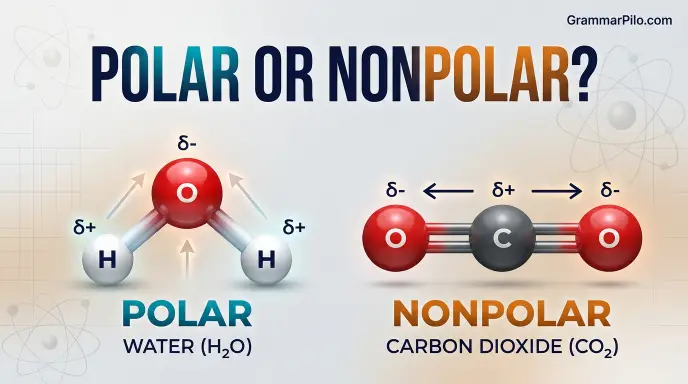
Water, for example, is polar because its bent shape creates an uneven charge distribution. Carbon dioxide contains polar bonds, but its linear shape makes the molecule nonpolar overall.
This guide explains polar and nonpolar molecules, their definitions, properties, examples, and practical differences. It also covers simple ways to identify molecular polarity and avoid common chemistry mistakes.
Polar or Nonpolar: Quick Answer
A polar molecule has an uneven distribution of electrical charge, giving it a positive end and a negative end. A nonpolar molecule has a balanced charge distribution without a permanent molecular dipole.
| Feature | Polar | Nonpolar |
| Charge distribution | Uneven | Balanced |
| Molecular dipole | Present | Absent |
| Electronegativity | Differences often create polar bonds | Bonds may be nonpolar or their dipoles cancel |
| Molecular shape | Often asymmetrical | Often symmetrical |
| Water solubility | Many dissolve well in water | Many dissolve poorly in water |
| Examples | Water, ammonia, hydrogen chloride | Oxygen, nitrogen, methane |
The key difference: Polar molecules have an overall dipole, while nonpolar molecules do not.
What Does Polar Mean in Chemistry?
In chemistry, polar describes a molecule with an uneven distribution of electrical charge. This happens when electrons are shared unequally between atoms or when the arrangement of polar bonds creates an overall molecular dipole.
How Do Polar Molecules Form?
Atoms attract shared electrons with different strengths. This attraction is called electronegativity.
When one atom attracts the shared electrons more strongly, the electrons spend more time near that atom. As a result, the atom develops a partial negative charge (δ−), while the other atom develops a partial positive charge (δ+).
For example, in a water molecule (H₂O), oxygen attracts shared electrons more strongly than hydrogen. Oxygen becomes partially negative, and the hydrogen atoms become partially positive.
Water also has a bent molecular shape. Because of this arrangement, the bond dipoles do not cancel, making the entire molecule polar.
Characteristics of Polar Molecules
Polar molecules commonly have these characteristics:
- Uneven distribution of electrical charge.
- A positive and negative region within the molecule.
- An overall molecular dipole.
- Attraction to other polar molecules through dipole related interactions.
- The ability to dissolve in many polar solvents, including water.
Examples include water (H₂O), ammonia (NH₃), and hydrogen chloride (HCl).
What Does Nonpolar Mean in Chemistry?
A nonpolar molecule has an even or balanced distribution of electrical charge. It does not have a permanent overall dipole.
Nonpolar molecules can form when atoms share electrons equally or when the individual bond dipoles cancel because of the molecule’s symmetrical shape.
How Do Nonpolar Molecules Form?
There are two common ways a molecule can be nonpolar.
First, two atoms with the same or very similar electronegativity values may share electrons equally. For example, oxygen gas (O₂) contains two identical oxygen atoms, so its electrons are shared equally.
Second, a molecule may contain polar bonds, but its symmetrical structure can cancel their individual dipoles.
Carbon dioxide (CO₂) is a useful example. Each carbon oxygen bond is polar because oxygen attracts electrons more strongly than carbon. However, the molecule has a linear shape, with the two bond dipoles pointing in opposite directions. They cancel, making the entire molecule nonpolar.
Characteristics of Nonpolar Molecules
Nonpolar molecules generally have the following properties:
- Balanced overall electrical charge distribution.
- No permanent molecular dipole.
- Often symmetrical molecular structures.
- Attraction through London dispersion forces.
- Better solubility in many nonpolar solvents than in water.
Common examples include oxygen (O₂), nitrogen (N₂), methane (CH₄), and carbon dioxide (CO₂).
The Main Differences Between Polar and Nonpolar Molecules
Polar and nonpolar molecules differ in their electrical properties, intermolecular attractions, and interactions with solvents.
1. Distribution of Electrical Charge
Polar molecules have an uneven charge distribution. One region becomes partially negative, while another becomes partially positive.
Nonpolar molecules have a balanced overall charge distribution. They may contain polar bonds, but the molecular structure can cancel their individual dipoles.
2. Molecular Shape
Molecular geometry plays an important role in determining polarity.
Many polar molecules have asymmetrical shapes that prevent bond dipoles from canceling. Water is a common example because its bent structure produces an overall dipole.
Nonpolar molecules often have symmetrical structures. Methane has a symmetrical tetrahedral arrangement, while carbon dioxide has a linear structure.
However, molecular shape alone does not determine polarity. The types of atoms and the direction of their bond dipoles also matter.
3. Solubility
A common chemistry principle is that like dissolves like.
Polar substances tend to dissolve in polar solvents because their molecules can form favorable interactions. Water is a polar solvent, so it dissolves many polar substances, such as sugar and certain alcohols.
Nonpolar substances tend to dissolve in nonpolar solvents. For example, oil does not mix easily with water, but it can dissolve in certain nonpolar organic solvents.
4. Intermolecular Forces
Polar molecules can experience dipole dipole attractions because their partial positive and negative regions attract one another. They can also experience London dispersion forces.
Some polar molecules, such as water and ammonia, can form hydrogen bonds when the required atoms and bonding conditions are present.
Nonpolar molecules primarily experience London dispersion forces. These attractions occur because electrons constantly move, creating temporary changes in charge distribution.
Examples of Polar and Nonpolar Molecules
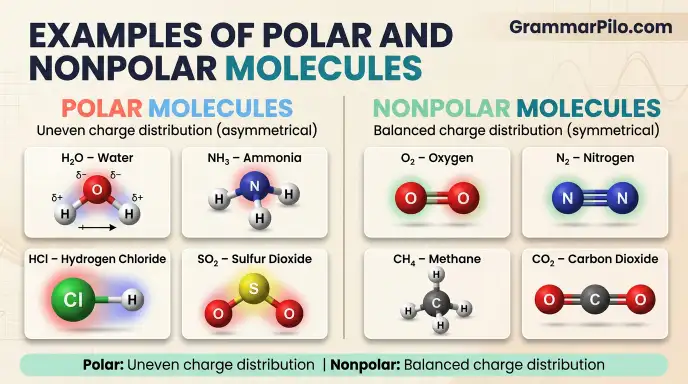
Looking at familiar chemical substances makes the difference easier to understand.
Examples of Polar Molecules
Water (H₂O): Water is polar because oxygen attracts electrons more strongly than hydrogen, and the molecule has a bent shape.
Ammonia (NH₃): Ammonia is polar because its trigonal pyramidal structure creates an uneven distribution of charge.
Hydrogen chloride (HCl): HCl is polar because chlorine attracts the shared electrons more strongly than hydrogen.
Sulfur dioxide (SO₂): Sulfur dioxide is polar because its bent molecular structure prevents the bond dipoles from canceling.
Examples of Nonpolar Molecules
Oxygen (O₂): Oxygen gas is nonpolar because both atoms have the same electronegativity.
Nitrogen (N₂): Nitrogen gas is nonpolar because its two identical nitrogen atoms share electrons equally.
Methane (CH₄): Methane is nonpolar because its symmetrical tetrahedral structure balances the bond dipoles.
Carbon dioxide (CO₂): Carbon dioxide is nonpolar because its linear shape causes the two polar carbon oxygen bond dipoles to cancel.
How to Tell If a Molecule Is Polar or Nonpolar
You can determine molecular polarity by examining electronegativity, bond polarity, and molecular geometry.
Step 1: Identify the Atoms
Start by identifying the elements present in the chemical formula. Different elements usually have different electronegativity values.
For example, water contains hydrogen and oxygen, while methane contains carbon and hydrogen.
Step 2: Compare Electronegativity
Check how strongly each bonded atom attracts electrons.
If the atoms have different electronegativities, the bond may be polar. If they have identical or very similar electronegativities, the bond is often nonpolar.
Electronegativity differences are useful, but they do not independently determine the polarity of an entire molecule.
Step 3: Examine Molecular Geometry
Determine the molecule’s three dimensional shape. Common shapes include linear, bent, trigonal planar, trigonal pyramidal, and tetrahedral.
The arrangement of atoms helps show how individual bond dipoles combine.
Step 4: Check If Bond Dipoles Cancel
If the bond dipoles cancel completely, the molecule is nonpolar overall.
If they do not cancel, the molecule has a net dipole and is polar.
For example, CO₂ has two polar bonds, but their dipoles cancel. H₂O also has polar bonds, but its bent shape prevents cancellation.
Step 5: Determine the Overall Polarity
Consider the entire molecule rather than examining only one bond. This final step is essential because a molecule can contain polar bonds and still be nonpolar overall.
Polar vs. Nonpolar Bonds: What Is the Difference?
Bond polarity and molecular polarity are related, but they are not the same thing.
A polar bond forms when bonded atoms share electrons unequally. A nonpolar bond forms when electrons are shared equally or nearly equally.
A molecule can contain several polar bonds and still be nonpolar if its molecular geometry causes the bond dipoles to cancel.
| Comparison | Polar Bond | Nonpolar Bond |
| Electron sharing | Unequal | Equal or nearly equal |
| Electronegativity | Noticeable difference | Little or no difference |
| Charge distribution | Partial charges develop | No significant bond dipole |
| Example | H Cl | O O |
Important: A polar bond does not automatically make an entire molecule polar. Molecular geometry determines how the bond dipoles combine.
Common Mistakes When Identifying Polar and Nonpolar Molecules
Students sometimes confuse bond polarity with molecular polarity. These mistakes can lead to incorrect answers in chemistry exercises.
Mistake 1: Assuming Every Molecule With Polar Bonds Is Polar
Incorrect: Carbon dioxide is polar because its carbon oxygen bonds are polar.
Correct: Carbon dioxide is nonpolar because its linear shape allows the two bond dipoles to cancel.
Mistake 2: Ignoring Molecular Geometry
Incorrect: A molecule’s polarity can be determined only by comparing electronegativity values.
Correct: Electronegativity helps identify polar bonds, but molecular geometry determines the overall molecular dipole.
Mistake 3: Assuming Symmetrical Molecules Are Always Nonpolar
Incorrect: Every symmetrical molecule must be nonpolar.
Correct: Symmetry often helps cancel bond dipoles, but the arrangement and identity of the surrounding atoms must also be considered.
Mistake 4: Confusing Partial Charges With Full Ionic Charges
Incorrect: Polar molecules contain completely positive and negative ions.
Correct: Polar covalent bonds involve partial charges, represented by δ+ and δ−. These are different from the full charges found in many ions.
Mistake 5: Assuming Nonpolar Means No Attraction
Incorrect: Nonpolar molecules do not attract one another.
Correct: Nonpolar molecules experience London dispersion forces, which are present in all atoms and molecules.
Everyday Uses and Importance of Molecular Polarity
Polarity is important beyond classroom chemistry. It helps explain how everyday substances mix, dissolve, and interact.
Water and Oil
Water is polar, while common cooking oils are largely nonpolar. Their different molecular properties explain why they separate into layers instead of mixing evenly.
Cleaning Products
Many cleaning products contain ingredients designed to interact with different types of substances. Some components help loosen oily dirt, while others interact with water so the dirt can be rinsed away.
Medicines and Pharmaceuticals
Molecular polarity influences how a substance dissolves, moves through biological environments, and interacts with other molecules. These properties are important when developing and formulating medicines.
Biological Systems
Water’s polarity helps it dissolve ions and many other polar substances. This makes water essential for transporting materials and supporting numerous chemical reactions in living organisms.
Paints, Coatings, and Solvents
The polarity of solvents affects which materials they can dissolve. Manufacturers consider these properties when selecting ingredients for paints, adhesives, coatings, and cleaning solutions.
Frequently Asked Questions About Nonpolar vs. Polar Molecules
1. What Is the Main Difference Between Nonpolar and Polar Molecules?
Polar molecules have an uneven electrical charge distribution and a permanent molecular dipole. Nonpolar molecules have a balanced charge distribution without a permanent overall dipole.
2. Is Water Polar or Nonpolar?
Water (H₂O) is polar. Oxygen attracts shared electrons more strongly than hydrogen, and the molecule’s bent shape prevents the bond dipoles from canceling.
3. Is Carbon Dioxide Polar or Nonpolar?
Carbon dioxide (CO₂) is nonpolar overall. Although its carbon oxygen bonds are polar, its linear structure causes the two bond dipoles to cancel.
4. Is Oil Nonpolar or Polar?
Most common cooking oils are largely nonpolar. This is why they do not mix evenly with polar water.
5. Is Methane Polar or Nonpolar?
Methane (CH₄) is nonpolar. Its symmetrical tetrahedral shape balances the small bond dipoles, leaving no overall molecular dipole.
6. Can a Molecule Have Polar Bonds but Be Nonpolar?
Yes. Carbon dioxide is a well known example. It contains polar carbon oxygen bonds, but the linear molecular structure causes their dipoles to cancel.
7. How Can I Remember the Difference Between Polar and Nonpolar?
Think of polar molecules as having an uneven electrical distribution, like water. Nonpolar molecules have a balanced overall distribution, like methane and oxygen gas.
Conclusion: Should You Choose Polar or Nonpolar?
The difference between polar and nonpolar molecules comes down to the distribution of electrical charge throughout a molecule. Polar molecules have an overall dipole because their charge distribution is uneven. Nonpolar molecules have no permanent overall dipole because their charge distribution is balanced.
Electronegativity helps explain how electrons are shared between atoms, while molecular geometry determines how individual bond dipoles combine. Water is a familiar polar example, whereas methane and carbon dioxide are nonpolar molecules.
Understanding polar or nonpolar properties makes it easier to predict solubility, intermolecular attractions, and chemical behavior. The most reliable approach is to examine both bond polarity and molecular shape rather than judging a molecule by its chemical formula alone.
Explore More Articles

I’m Sloane Mercer, a U.S.-based English language writer focused on grammar, spelling, vocabulary, and everyday English usage. Through GrammarPilo, I provide clear and practical explanations to help readers choose the right words and communicate with confidence.