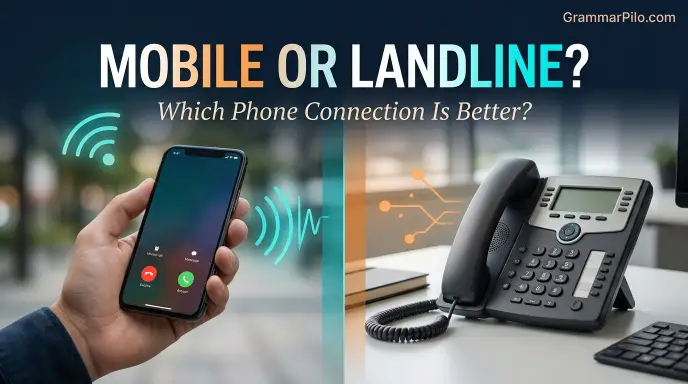
Are you searching for Mobile or Landline? Mobile phones and landlines are two important ways people communicate, but they work differently and serve different purposes.
A mobile phone is a portable communication device that connects through cellular networks, while a landline is a telephone connected to a fixed physical location through a wired or compatible fixed line network.
Both allow people to make and receive calls, but their features, convenience, reliability, and costs are quite different.
Mobile phones have become central to modern communication because they allow users to stay connected while traveling, working, or spending time away from home.
Landlines, on the other hand, remain useful in homes, offices, businesses, and locations where a dedicated fixed telephone connection is preferred.
Choosing mobile or landline depends on your communication needs, location, budget, and personal preferences.
This guide explains how both systems work and compares their advantages, disadvantages, costs, privacy considerations, emergency uses, and everyday applications.
Mobile vs. Landline: Quick Answer
A mobile phone is generally better for personal communication, portability, internet access, and staying connected while traveling.
A landline is useful for fixed location communication, business operations, and situations where a dedicated telephone connection is preferred.
Mobile phones offer more features, including messaging, video calls, navigation, and mobile internet. Traditional landlines generally focus on voice communication, although modern fixed line services can include additional features.
| Feature | Mobile Phone | Landline |
| Portability | Portable | Fixed to a location |
| Connection | Cellular network | Fixed line network or compatible internet service |
| Internet access | Mobile data and Wi Fi | Usually requires a separate internet service |
| Text messaging | Standard feature | Limited or service dependent |
| Video calling | Widely supported | Not a standard feature |
| Battery requirement | Yes | Traditional wired handsets may not need household power |
| Travel convenience | Excellent | Limited |
| Business use | Excellent | Useful for fixed business numbers |
| Emergency communication | Useful, subject to coverage and battery | Useful, depending on technology and power availability |
| Location association | Can move with the user | Usually associated with a fixed address |
Overall winner: Mobile phones are more versatile for most personal communication needs, while landlines remain useful for specific household and business requirements.
What Is a Mobile Phone?
A mobile phone is a portable electronic device that allows users to communicate through cellular networks. It connects to nearby mobile network infrastructure, enabling calls, text messages, and, on smartphones, internet based services.
Modern mobile phones are much more than devices for making calls. Smartphones combine communication, entertainment, photography, navigation, banking, productivity, and internet browsing in one device.
How Does a Mobile Phone Work?
A mobile phone communicates wirelessly with cellular network equipment, commonly called cell towers or base stations.
When someone makes a call, the phone sends signals through the cellular network. The network helps establish a connection with the recipient’s device or telephone service.
The exact technology depends on the network and device. Modern systems use digital cellular technologies such as 4G LTE and 5G.
Main Features of Mobile Phones
Modern smartphones offer a wide range of communication features:
- Voice calls and video calls.
- SMS and multimedia messaging.
- Mobile internet access.
- Email and social media applications.
- GPS navigation and location services.
- Digital photography and video recording.
- Mobile banking and payment services.
- Voice assistants and productivity tools.
Types of Mobile Phones
Mobile phones generally fall into two broad categories.
Basic mobile phones: These devices focus on calls and text messages. Some also offer simple internet access and basic applications.
Smartphones: These devices run mobile operating systems and support applications, internet browsing, video calls, advanced cameras, and many other functions.
What Is a Landline?
A landline is a telephone service associated with a fixed location rather than a device that moves freely between cellular network coverage areas.
Traditional landline telephones connect through physical telephone lines, often using copper wiring. Modern fixed telephone services may also use fiber networks, cable infrastructure, or internet based technology.
Landlines are commonly used in homes, offices, hospitals, hotels, and businesses.
How Does a Landline Work?
A traditional landline sends voice signals through a fixed telecommunications network.
When a person lifts the handset and dials a number, the telephone network establishes a connection with the recipient.
Older analog systems transmit voice signals through copper telephone wiring. Newer systems may convert voice into digital signals and carry it through broadband or other network infrastructure.
Main Features of Landlines
Depending on the provider and service, a landline may offer:
- Local and international voice calls.
- A fixed telephone number.
- Caller identification.
- Call waiting.
- Voicemail.
- Call forwarding.
- Conference calling.
- Business telephone system integration.
Some landline services also support digital calling features, although availability varies by provider.
Types of Landline Connections
Traditional copper landlines: These use physical copper telephone wires to connect a telephone to the telecommunications network.
Fiber based fixed telephone services: These use fiber optic infrastructure, with compatible equipment to provide voice communication.
Cable telephone services: Some cable providers deliver fixed telephone services through their cable networks.
VoIP landlines: Voice over Internet Protocol (VoIP) services use an internet connection to make and receive calls through compatible phones or adapters.
Landline or Mobile: Key Differences Explained
Although both systems support voice communication, their technology and everyday use are different.
1. Portability and Convenience
Portability is one of the biggest differences between mobile phones and landlines.
A mobile phone allows users to make calls from different locations, provided they have sufficient network coverage and a working battery.
A traditional landline is associated with a fixed location. Users generally need to be near the connected handset or use an additional compatible cordless handset.
Better choice: Mobile phones are the clear winner for portability.
2. Network and Connection
Mobile phones use cellular networks to communicate. Their performance depends on network coverage, signal strength, congestion, and the device.
Traditional landlines use fixed telephone infrastructure. Their connection is not dependent on cellular coverage, although modern fiber based and VoIP services may depend on electricity, broadband equipment, or provider infrastructure.
Better choice: A landline can be useful where cellular reception is weak, provided its fixed line infrastructure remains operational. Mobile phones are more convenient where cellular coverage is reliable.
3. Call Quality
Call quality depends on several factors.
Mobile calls can sound clear when cellular coverage is strong. However, weak signals, network congestion, interference, or device problems can affect call quality.
Traditional landlines have historically been valued for consistent voice quality. Modern fixed line digital services can also deliver clear calls, but performance depends on the network and equipment.
Better choice: Neither system always wins. A reliable fixed connection can provide consistent service, while a strong mobile network can deliver excellent call quality.
4. Internet and Digital Features
Smartphones provide direct access to mobile internet, applications, email, social media, video conferencing, and online services.
Traditional landline telephones are primarily designed for voice communication. Internet access generally requires a separate broadband service, although VoIP and combined telecommunications packages are available.
Better choice: Mobile phones offer more built in digital features.
5. Privacy and Security
Mobile phones and landlines have different security considerations.
Mobile phones can be affected by SIM swapping, malicious applications, phishing messages, stolen devices, and compromised accounts.
Landlines avoid some smartphone specific risks, but they are not automatically private or secure. Calls may still be subject to interception, unauthorized access, service provider practices, or weaknesses in connected digital systems.
For both types of telephone, users should avoid sharing sensitive information with unknown callers and should verify the identity of anyone requesting personal or financial details.
Better choice: Neither system is universally more secure. Good security practices matter more than the phone type alone.
Landline vs. Mobile: Advantages and Disadvantages
Understanding the strengths and limitations of both systems makes it easier to select the right option.
Advantages of Mobile Phones
1. Portability: Users can carry their phones almost anywhere and communicate while traveling.
2. Multiple communication options: Smartphones support calls, text messages, email, video calls, and messaging applications.
3. Internet access: Users can browse websites, access online services, and communicate through internet based platforms.
4. Emergency convenience: A charged mobile phone can help users contact emergency services while away from home, subject to network availability.
5. Everyday usefulness: Smartphones combine communication with cameras, navigation, entertainment, and productivity tools.
Disadvantages of Mobile Phones
1. Battery dependence: Most mobile phones need regular charging. A discharged battery can prevent normal use.
2. Coverage limitations: Mobile communication may become difficult in areas with weak or unavailable cellular service.
3. Distractions: Notifications, social media, and applications can interrupt work and everyday activities.
4. Security risks: Smartphones can be targeted by malicious software, scams, phishing, and account theft.
5. Ongoing expenses: Monthly plans, data packages, roaming, and device replacement can increase costs.
Advantages of Landlines
1. Fixed telephone number: A landline provides a number associated with a household, office, or business location.
2. Dedicated communication: A fixed telephone can serve as a shared contact point for a family or organization.
3. No cellular coverage requirement: Traditional landlines can operate independently of mobile network coverage.
4. Business suitability: Landlines can support reception desks, customer service, office telephone systems, and public contact numbers.
5. Simple operation: Basic landline handsets are often straightforward to use, particularly for people who prefer traditional telephone equipment.
Disadvantages of Landlines
1. Limited mobility: Traditional landlines cannot be carried around like mobile phones.
2. Infrastructure dependence: Service requires suitable fixed line infrastructure or a compatible alternative.
3. Limited built in features: Basic landline handsets do not offer the full range of smartphone applications and services.
4. Additional service costs: Installation, rental fees, calling packages, and equipment may increase expenses.
5. Technology changes: Some telecommunications providers are replacing older copper networks with digital alternatives, meaning traditional landline service may not remain available in every location.
Mobile or Landline for Home Use?
Many households now rely mainly on mobile phones, but a fixed telephone can still serve a useful purpose.
Why Mobile Phones Work Well at Home
A mobile phone gives every household member a personal communication device.
Family members can receive calls, send messages, access the internet, and communicate while away from home.
Smartphones also provide useful household tools such as online shopping, navigation, video calls, and banking applications.
Why Some Homes Still Use Landlines
A landline can provide a shared telephone number for the household.
It may be useful for older family members, children who need access to a simple telephone, or households that prefer a fixed contact number.
A fixed telephone can also be valuable in areas where cellular coverage is unreliable, provided the available landline technology has dependable backup arrangements.
Which Is Better for Home Use?
For most modern households, mobile phones provide greater flexibility and functionality.
However, a landline may be a useful additional communication option for families who prefer a shared home number or need an alternative to cellular service.
Mobile or Landline for Business Communication?
Businesses often use both mobile and fixed telephone services because they serve different purposes.
Why Businesses Use Mobile Phones
Mobile phones help employees communicate while traveling, working remotely, visiting clients, or handling field operations.
Business smartphones can also support email, messaging platforms, video meetings, scheduling, and customer management applications.
They are particularly useful for sales representatives, delivery teams, consultants, and mobile service providers.
Why Businesses Use Landlines
Landlines and fixed business telephone systems can provide a central contact number for customers.
A business telephone system may support multiple extensions, call routing, reception services, call queues, voicemail, and conference calling.
These functions can help organizations manage incoming calls professionally.
Which Is Better for Business?
Mobile phones are useful for employees who need flexible communication.
Landline based or hosted business telephone systems can be better for organizations that need a central customer contact number and structured call management.
Many businesses benefit from combining mobile communication with a fixed or VoIP telephone system.
Mobile vs. Landline: Cost and Monthly Expenses
The cost of mobile and landline services depends on the country, provider, calling habits, network technology, and selected package.
Mobile Phone Costs
Mobile phone expenses may include:
- Smartphone purchase or installment payments.
- Monthly cellular service.
- Mobile data packages.
- International roaming.
- Additional calling or messaging charges.
- Device repairs and replacement.
A basic mobile plan can be inexpensive, but premium devices and large data packages can increase the overall cost.
Landline Costs
Landline expenses may include:
- Installation charges.
- Monthly line rental.
- Local and international call charges.
- Broadband or VoIP subscription fees.
- Telephone equipment.
- Maintenance or service charges.
Some providers bundle fixed telephone services with broadband or television packages.
Which Is Cheaper?
A mobile plan may be more economical for people who mainly need calls and messaging.
A landline may be cost effective for businesses or households that make frequent calls under a suitable package.
The cheapest option depends on actual usage rather than the technology alone.
| Cost Factor | Mobile Phone | Landline |
| Initial equipment | Phone purchase | Handset or compatible equipment |
| Monthly subscription | Cellular plan | Line or voice service package |
| Internet | Often included as mobile data | Usually separate or bundled |
| International calls | Plan or app dependent | Provider dependent |
| Maintenance | Device repairs | Line and equipment support |
| Extra costs | Roaming and data | Installation and rental charges |
Mobile or Landline: Which Is Better for Emergency Calls?
Both mobile phones and landlines can play an important role during emergencies, but neither should be assumed to work in every situation.
Emergency Use of Mobile Phones
A charged mobile phone can allow users to contact emergency services from different locations.
This is particularly useful during road accidents, outdoor emergencies, medical incidents, and situations away from home.
However, access may be affected by weak coverage, network outages, battery failure, or device damage.
Emergency call routing and location information vary by country and network.
Emergency Use of Landlines
Traditional copper landlines have historically offered an advantage because some systems could operate without household electricity.
However, modern fiber based and VoIP telephone services generally depend on powered equipment. If the electricity supply fails and no backup power is available, the telephone may stop working.
A fixed telephone number may also help emergency services identify an associated service address in some systems, but this capability depends on the provider and local emergency infrastructure.
Which Is Better During Emergencies?
A working mobile phone is highly useful because it can be carried anywhere.
A traditional landline with suitable backup arrangements can provide an additional communication option at home.
For important emergency communication, keeping a charged mobile phone and understanding the limitations of any fixed telephone service is a sensible approach.
Mobile or Landline: Which Is Better for Older Adults?
Both options can be appropriate for older adults, depending on individual preferences, accessibility needs, and familiarity with technology.
Mobile Phones for Older Adults
Mobile phones provide independence and allow users to stay in contact with family members outside the home.
Some devices offer large displays, accessibility settings, emergency calling features, hearing aid compatibility, and simplified interfaces.
However, complicated menus, small buttons, and frequent notifications may be challenging for some users.
Landlines for Older Adults
A traditional landline can be easy to operate because it usually offers a straightforward calling experience.
Corded handsets, large button telephones, and cordless models with amplified sound are available.
A fixed telephone can also be useful for people who spend most of their time at home.
Which Is Better?
A simple landline may be more comfortable for someone who prefers traditional telephone equipment.
A mobile phone is more useful for someone who wants independence while traveling or communicating outside the home.
The best choice is the device that the person can operate confidently and reliably.
Mobile vs. Landline: Which Is More Reliable?
Reliability depends on network infrastructure, electricity, signal strength, equipment, and the location where the service is used.
Mobile Network Reliability
Mobile service can be affected by:
- Weak cellular signals.
- Network congestion.
- Tower outages.
- Extreme weather.
- Battery failure.
- Device damage.
In areas with strong cellular coverage and modern network infrastructure, mobile communication can be highly dependable.
Landline Reliability
Traditional copper landlines can remain useful during certain power outages because some telephone systems receive power through the telephone network.
However, this advantage does not apply to every modern fixed line service.
Fiber based and VoIP connections usually require electricity for the modem, router, or telephone adapter.
Landline reliability also depends on the condition of the physical network and the provider’s maintenance.
Which Is More Reliable?
A traditional copper landline may have an advantage in specific power outage situations, while mobile phones provide flexibility and access from multiple locations.
Modern fixed line and mobile services both depend on their respective network infrastructure. There is no universal reliability winner.
Google Trends and Modern Usage: Landline and Mobile
Mobile phones have become the dominant personal communication devices in many parts of the world. Smartphones support voice calls, messaging, internet browsing, video communication, and countless everyday applications.
Landlines remain relevant in offices, businesses, households, and organizations that need fixed telephone numbers or structured call management.
Search interest for mobile phone and landline can vary according to location, age group, technology adoption, and the subject being researched.
People may search for mobile phones when comparing devices, plans, mobile networks, or smartphone features. Searches for landlines may relate to home telephone services, business phone systems, traditional telephone technology, or differences between fixed and mobile communication.
Google Trends can help compare interest in these terms over a selected time period and region. However, search interest should not be treated as an exact measurement of telephone ownership or usage.
The broader communication trend is clear: mobile technology has expanded beyond traditional calling, while fixed telephone services continue to serve specific residential and business needs.
Mobile and Landline: Main Differences at a Glance
| Feature | Mobile | Landline |
| Meaning | Portable wireless telephone | Telephone service linked to a fixed location |
| Network | Cellular network | Fixed line or compatible digital network |
| Mobility | Can be carried anywhere with coverage | Usually restricted to one location |
| Calling | Yes | Yes |
| Text messaging | Standard on most mobile phones | Service dependent |
| Video calls | Common on smartphones | Not standard on traditional handsets |
| Internet | Mobile data and Wi Fi | Usually requires separate broadband |
| Battery | Usually required | Traditional wired handsets may not require local power |
| Business communication | Useful for mobile employees | Useful for central office numbers |
| Home communication | Personal and portable | Shared fixed contact point |
| Emergency use | Portable access | Useful as an additional fixed option |
| Modern technology | 4G, 5G, Wi Fi calling | Copper, fiber, cable, VoIP |
Which Should You Choose: Mobile or Landline?
The best choice depends on your communication habits and the features you need.
Choose a Mobile Phone If:
- You need to make calls while traveling.
- You want internet access and messaging applications.
- You prefer video calls and digital communication.
- You need navigation, photography, and other smartphone tools.
- You work remotely or frequently move between locations.
- You want one personal device for several everyday tasks.
Choose a Landline If:
- You need a fixed telephone number for your home or business.
- You prefer a simple telephone with basic calling features.
- Your location has unreliable cellular reception.
- You need a central contact number for an office or organization.
- You want a traditional wired telephone with suitable power outage arrangements.
- You prefer a shared telephone for household or workplace use.
Can You Use Both?
Yes. Many households and businesses use mobile phones alongside fixed telephone services.
For example, a business can use a landline or VoIP number for customer calls while employees use mobile phones for direct communication.
A household can also maintain a fixed telephone as an additional contact option while relying mainly on smartphones.
Combining both systems can provide flexibility and an alternative communication channel.
Frequently Asked Questions About Mobile or Landline
1. What is the main difference between a mobile phone and a landline?
A mobile phone is portable and connects through a cellular network, while a landline is associated with a fixed location and uses fixed telephone infrastructure or a compatible digital service.
2. Is a mobile phone better than a landline?
A mobile phone is generally more versatile because it supports portable calling, messaging, internet access, and applications. A landline can still be useful for fixed location communication and business purposes.
3. Do landlines work without electricity?
Some traditional copper landlines can work without household electricity because they may receive power through the telephone network. Modern fiber based and VoIP services generally require powered equipment unless backup power is available.
4. Can a landline connect to the internet?
A traditional telephone line may support broadband through compatible technology, while fiber, cable, and VoIP services can provide internet and voice services through modern networks. A basic landline handset does not automatically provide internet access.
5. Are landlines more secure than mobile phones?
Not necessarily. Mobile phones face risks such as SIM swapping, malicious applications, and phishing, while landlines can also be exposed to interception and unauthorized access. Security depends on the service, equipment, and safeguards used.
6. Which is cheaper, mobile or landline?
The cheaper option depends on calling habits, subscription prices, data requirements, installation costs, and provider packages. A basic mobile plan may be inexpensive, while a landline package may suit frequent callers or businesses.
7. Can you keep a landline number when switching providers?
In many countries, telephone number portability allows customers to transfer eligible numbers between providers. However, rules, availability, and restrictions depend on the country and type of telephone service.
8. Why do businesses still use landlines?
Businesses use fixed telephone numbers and compatible phone systems for customer service, reception desks, call routing, extensions, and centralized communication. Many modern business systems use VoIP rather than traditional copper wiring.
9. Can a mobile phone work without a SIM card?
A smartphone can perform many functions without a SIM card, including using Wi Fi, browsing the internet, and accessing applications. However, normal cellular calling and SMS generally require an active SIM or compatible eSIM service.
10. Are landlines becoming obsolete?
Traditional copper landlines are being replaced in many markets by fiber, cable, and internet based telephone services. Fixed telephone numbers and business phone systems remain useful, even as the underlying technology changes.
Conclusion: Mobile or Landline, Which Is the Better Choice?
Mobile phones and landlines both serve important communication needs, but mobile technology offers greater flexibility for most modern users.
Smartphones allow people to make calls, send messages, access the internet, attend video meetings, and use digital services from almost anywhere with suitable coverage.
Landlines remain valuable for fixed location communication, business telephone systems, and households that prefer a dedicated home number. Traditional copper services may also offer useful power outage characteristics, although modern digital landlines often need backup electricity.
If you need portability, internet access, and multiple communication features, a mobile phone is generally the better option. If you need a shared home or business number, a fixed telephone service may be more appropriate. Many people and organizations benefit from using both.
Ultimately, mobile or landline is not simply a choice between old and new technology. It is a decision about convenience, reliability, accessibility, and the way you communicate every day.
What to Read Next

I’m Sloane Mercer, a U.S.-based English language writer focused on grammar, spelling, vocabulary, and everyday English usage. Through GrammarPilo, I provide clear and practical explanations to help readers choose the right words and communicate with confidence.







1 thought on “Mobile or Landline: Which Is Better for Everyday Communication?”