Diesel and gas are two of the most widely used fuels for vehicles, but they differ in how they produce power, how efficiently they burn, and what they cost to use and maintain.
Diesel engines generally offer better fuel economy and stronger low speed torque, while gasoline engines often provide quieter operation, lower initial vehicle costs, and smoother acceleration.
The better choice depends on your driving habits, vehicle requirements, fuel prices, and long term ownership expenses.
When comparing diesel or gas, many drivers focus only on fuel economy. However, the decision involves much more than the number of miles or kilometers a vehicle can travel per liter.
Engine design, maintenance, emissions systems, driving conditions, resale value, and fuel availability can all influence the overall cost.
Diesel engines are common in heavy duty trucks, buses, commercial vehicles, and some passenger cars. Gasoline engines are widely used in everyday cars, SUVs, motorcycles, and light duty vehicles.
In this guide, you will learn how gasoline and diesel differ, which one offers better mileage, how their engines work, and what to consider before choosing a diesel or gas vehicle.
Diesel or Gas: Quick Answer
Diesel and gasoline both provide energy for internal combustion engines, but they work differently and offer different advantages.
- Diesel: Generally provides better fuel efficiency, stronger low end torque, and good performance under heavy loads.
- Gasoline: Often offers smoother acceleration, quieter operation, lower vehicle purchase prices, and simpler emissions systems in many applications.
| Comparison | Diesel | Gasoline |
| Fuel efficiency | Generally higher | Generally lower |
| Low speed torque | Usually stronger | Usually lower |
| Engine operation | Often louder | Usually quieter |
| Initial vehicle cost | Often higher | Often lower |
| Maintenance | Can be more expensive | Often less expensive |
| Heavy towing | Often well suited | Depends on engine |
| Short city trips | Not ideal for some modern diesels | Often more suitable |
| Cold weather starting | Can require additional attention | Generally easier |
| Common applications | Trucks, buses, commercial vehicles | Cars, SUVs, motorcycles |
| Fuel availability | Depends on location | Widely available in many markets |
Quick recommendation: Diesel may be a better choice for frequent long distance driving, heavy loads, and towing. Gasoline may be more practical for everyday commuting, shorter trips, and drivers who prioritize quieter operation and lower upfront costs.
What Is Diesel Fuel?
Diesel is a petroleum based fuel designed for compression ignition engines. It is generally heavier and less volatile than gasoline and contains more energy per liter.
Diesel engines are widely used in commercial transportation because they can produce substantial torque and operate efficiently under heavy loads.
How Does a Diesel Engine Work?
A diesel engine uses compression ignition rather than the spark ignition system found in conventional gasoline engines.
Its basic operating process involves four main stages:
- Intake: The engine draws air into the cylinder.
- Compression: The piston compresses the air, raising its temperature and pressure.
- Fuel injection: Diesel fuel is injected into the hot, compressed air.
- Combustion: The fuel ignites because of the high temperature, pushing the piston downward and producing power.
Unlike a conventional gasoline engine, a diesel engine does not require a spark plug to ignite the fuel air mixture.
Why Are Diesel Engines Fuel Efficient?
Diesel engines typically operate with higher compression ratios and are designed to extract more useful energy from each unit of fuel.
Diesel fuel also contains more energy per liter than gasoline. Together, these characteristics generally allow diesel vehicles to travel farther on a given volume of fuel.
However, actual fuel economy depends on the engine, vehicle weight, transmission, driving conditions, and maintenance.
Common Uses of Diesel
Diesel fuel is commonly used in:
- Heavy duty trucks.
- Buses and commercial vehicles.
- Agricultural machinery.
- Construction equipment.
- Some passenger cars and SUVs.
- Generators and industrial equipment.
- Ships and certain railway engines.
What Is Gasoline?
Gasoline, also called petrol in many countries, is a petroleum based fuel commonly used in spark ignition internal combustion engines.
It is generally more volatile than diesel and is widely used in passenger vehicles because of its performance characteristics, availability, and compatibility with different engine designs.
How Does a Gasoline Engine Work?
A conventional gasoline engine generally uses a spark ignition system.
Its basic operating process also involves four main stages:
- Intake: The engine draws an air fuel mixture or air into the cylinder, depending on the injection system.
- Compression: The piston compresses the contents of the cylinder.
- Ignition: A spark plug ignites the air fuel mixture.
- Power and exhaust: Combustion pushes the piston downward, and exhaust gases leave the cylinder.
The spark plug is a major difference between conventional gasoline and diesel engines.
Why Are Gasoline Engines Popular?
Gasoline engines are widely used because they can provide responsive acceleration, relatively quiet operation, and a broad range of vehicle designs.
They are also commonly less expensive to purchase than comparable diesel powered vehicles, although this depends on the vehicle and market.
Common Uses of Gasoline
Gasoline is commonly used in:
- Passenger cars.
- SUVs and crossovers.
- Motorcycles.
- Small trucks.
- Lawn equipment.
- Portable generators.
- Certain recreational vehicles.
Diesel vs. Gasoline: How Are They Different?
The biggest difference between gas and diesel is how the fuel ignites inside the engine.
Diesel engines use compressed air to create the heat needed for ignition, while conventional gasoline engines use spark plugs to ignite the fuel air mixture.
This difference affects engine design, fuel economy, torque, noise, and maintenance.
Ignition System
Diesel engines use compression ignition. They compress air until it becomes hot enough to ignite injected diesel fuel.
Gasoline engines generally use spark plugs to ignite the air fuel mixture.
Fuel Composition
Gasoline and Diesel are both refined from crude oil, but their chemical compositions and properties differ.
Diesel is generally less volatile and contains more energy per liter. Gasoline evaporates more easily and is designed for spark ignition engines.
Engine Design
Diesel engines are generally built to withstand higher compression pressures.
This can result in heavier engine components and a different maintenance profile.
Gasoline engines typically operate at lower compression ratios and often have lighter engine designs.
Performance Characteristics
Diesel engines commonly produce more torque at lower engine speeds, which is useful for towing and carrying heavy loads.
Gasoline engines often deliver responsive acceleration and can operate smoothly at higher engine speeds.
Diesel or Gas: Which Gets Better Mileage?
Fuel economy is one of the most important reasons drivers compare diesel and gasoline.
In many comparable vehicles, diesel engines consume less fuel per kilometer or mile than gasoline engines.
However, the actual difference depends on vehicle design and driving conditions.
Why Diesel Usually Gets Better Fuel Economy
Diesel engines generally benefit from higher thermal efficiency and the greater energy content of diesel fuel per liter.
They can also produce substantial pulling power without needing to operate at high engine speeds.
These characteristics make diesel engines particularly useful for vehicles that travel long distances or carry heavy loads.
Why Gasoline Vehicles May Still Cost Less to Operate
Better mileage does not automatically mean lower overall expenses.
Gasoline vehicles may have lower purchase prices, less expensive maintenance in some markets, and fewer costly diesel specific emissions components.
Drivers should compare the total cost of ownership rather than looking only at fuel consumption.
Gas vs. Diesel Mileage Comparison
| Factor | Diesel | Gasoline |
| Energy per liter | Higher | Lower |
| Typical fuel economy | Often better | Often lower |
| Long distance efficiency | Often advantageous | Depends on vehicle |
| City fuel economy | Can be efficient, but varies | Depends on engine and traffic |
| Heavy load efficiency | Often strong | Depends on engine design |
| Overall running cost | Depends on fuel and maintenance prices | Depends on fuel and maintenance prices |
Important: A small diesel car may use less fuel than a larger gasoline SUV, but comparing vehicles of different sizes does not establish that diesel is always more efficient.
Diesel vs. Gas: Power, Torque, and Acceleration
Power and torque describe different aspects of engine performance.
Torque measures rotational force, while horsepower describes the rate at which work is performed.
Both matter when evaluating a vehicle.
Diesel Engines and Low End Torque
Diesel engines are generally known for producing strong torque at relatively low engine speeds.
This makes them useful for:
- Towing trailers.
- Carrying heavy cargo.
- Driving commercial vehicles.
- Climbing steep roads.
- Moving heavy equipment.
A diesel truck can often pull a substantial load without needing to operate at very high engine speeds.
Gasoline Engines and Acceleration
Gasoline engines often provide responsive acceleration and can produce power at higher engine speeds.
Many performance cars use gasoline engines because they can deliver strong acceleration and a broad range of performance characteristics.
Modern turbocharged gasoline engines can also produce substantial low speed torque.
Which Has More Power?
Neither fuel type automatically produces more horsepower.
Engine size, turbocharging, tuning, fuel delivery, and overall design determine a vehicle’s power output.
Diesel engines often have an advantage in low speed pulling power, while gasoline engines can be designed for high revving performance.
Gasoline or Diesel: Which Is Cheaper?
The total cost of owning a gasoline or diesel vehicle includes more than the price of fuel.
Drivers should consider the initial purchase price, fuel expenses, servicing, repairs, insurance, and resale value.
Initial Purchase Price
Diesel vehicles often cost more than comparable gasoline versions.
Diesel engines generally require stronger components and specialized fuel injection systems, which can increase manufacturing costs.
However, this is not a universal rule. Vehicle pricing depends on the manufacturer, market, model, and available configurations.
Fuel Costs
The price of diesel and gasoline changes according to local taxes, refining costs, supply, and demand.
In some countries, diesel is cheaper than gasoline. In others, it costs more.
A diesel vehicle can still be economical when its improved fuel efficiency offsets a higher fuel price.
Maintenance Costs
Diesel engines may require specialized maintenance and more expensive repairs.
Some modern diesel vehicles use diesel particulate filters, selective catalytic reduction systems, and other emissions control equipment.
These systems can increase servicing costs.
Gasoline vehicles also require regular maintenance, including oil changes, filters, ignition components, and emissions system inspections.
Which Is More Affordable Overall?
The answer depends on how much you drive and what you pay for fuel and maintenance.
Drivers who cover many kilometers each year may benefit from diesel’s fuel efficiency.
People who drive relatively short distances may find a gasoline vehicle more economical because of its lower purchase price and potentially simpler maintenance.
Diesel vs. Gas: Maintenance and Reliability
Maintenance requirements can influence the long term ownership experience.
Both engine types can be reliable when properly designed, maintained, and operated.
However, their systems and common service requirements differ.
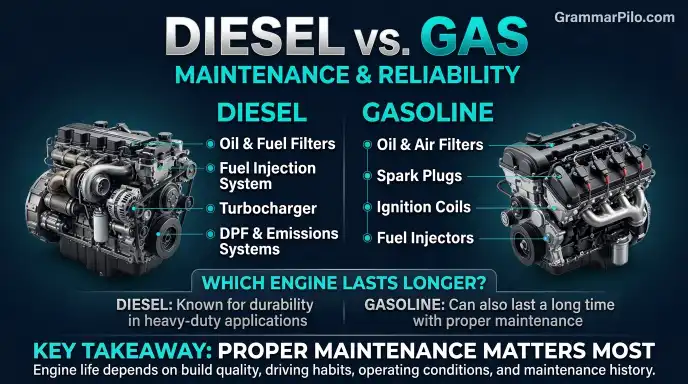
Diesel Engine Maintenance
Diesel vehicles commonly require attention to:
- Engine oil and oil filters.
- Fuel filters.
- Air filters.
- Fuel injection systems.
- Turbochargers, where fitted.
- Diesel particulate filters, where fitted.
- Exhaust fluid systems, where fitted.
Modern diesel engines use advanced emissions technology to reduce harmful pollutants. These systems are important for environmental compliance but can add complexity.
Gasoline Engine Maintenance
Gasoline vehicles commonly require attention to:
- Engine oil and oil filters.
- Air filters.
- Spark plugs.
- Ignition coils.
- Fuel injectors.
- Cooling systems.
- Emissions control components.
Maintenance costs vary by engine design. A modern turbocharged gasoline engine can also be technically complex and expensive to repair.
Which Engine Lasts Longer?
Diesel engines have a reputation for long service life, particularly in heavy duty applications.
Their robust construction can make them suitable for sustained workloads.
However, gasoline engines can also last a long time when maintained properly.
Actual engine life depends on manufacturing quality, operating conditions, maintenance history, driving habits, and repair quality.
A well maintained gasoline vehicle may outlast a poorly maintained diesel vehicle.
Diesel or Gas for City Driving?
Driving conditions play a major role in deciding which fuel type is more suitable.
City driving usually involves frequent stops, short trips, traffic congestion, and periods of idling.
Why Gasoline Can Be Better for Short Trips
Gasoline vehicles are often practical for city driving because they generally warm up quickly and do not have the same diesel particulate filter regeneration requirements found in many modern diesel vehicles.
A conventional gasoline car can be a convenient option for short commutes and regular urban use.
Challenges for Modern Diesel Vehicles
Many modern diesel vehicles use diesel particulate filters (DPFs) to capture soot from exhaust gases.
These filters periodically need to regenerate, which involves raising exhaust temperatures to burn accumulated soot.
Repeated short trips and low speed driving can prevent some DPF systems from completing regeneration properly.
This may eventually lead to warning lights, restricted performance, or expensive repairs if the issue is not addressed.
Not every diesel vehicle has the same emissions system, so check the specific model.
Which Is Better for City Use?
Gasoline is often a practical choice for drivers who mainly make short urban journeys.
Diesel may still make sense for people who regularly drive longer distances, even if they also use their vehicles in cities.
Diesel or Gas for Highway Driving?
Long distance driving can make diesel’s fuel efficiency especially attractive.
Why Diesel Can Be Better for Highway Travel
Diesel engines often deliver strong torque and efficient fuel consumption during sustained driving.
They can be particularly suitable for:
- Long distance commuting.
- Highway travel.
- Commercial transportation.
- Towing over extended distances.
- Vehicles carrying heavy loads.
Can Gasoline Vehicles Be Good for Long Trips?
Yes. Modern gasoline engines can also provide excellent highway fuel economy, especially when paired with efficient transmissions and aerodynamic vehicle designs.
A hybrid gasoline vehicle may offer particularly strong efficiency in mixed driving conditions.
Which Is Better for Long Distance Driving?
Diesel can be an excellent choice for drivers who regularly travel long distances and want strong fuel economy.
However, the best option depends on the vehicle’s efficiency, fuel prices, and expected maintenance costs.
Environmental Impact: Diesel vs. Gasoline
Both diesel and gasoline produce emissions when burned in internal combustion engines.
However, they have different emissions profiles.
Carbon Dioxide Emissions
Diesel fuel contains more carbon per liter than gasoline, so burning a liter of diesel generally produces more carbon dioxide.
However, diesel engines often consume less fuel for the same distance, which can reduce carbon dioxide emissions per kilometer in some comparable vehicles.
The actual result depends on vehicle efficiency and operating conditions.
Nitrogen Oxides
Diesel engines can produce significant nitrogen oxide emissions, commonly abbreviated as NOx.
These pollutants contribute to air quality problems and can affect human health.
Modern diesel vehicles use emissions control systems to reduce these emissions.
Particulate Matter
Diesel combustion can produce fine particles, especially soot.
Diesel particulate filters are designed to capture much of this material before it leaves the exhaust system.
Gasoline Emissions
Gasoline engines also produce harmful emissions, including carbon monoxide, hydrocarbons, nitrogen oxides, and carbon dioxide.
Modern vehicles use catalytic converters and other emissions control technologies to reduce pollution.
Which Is Better for the Environment?
Neither diesel nor gasoline is automatically the environmentally better option in every situation.
The comparison depends on vehicle efficiency, emissions control technology, fuel production, driving conditions, and the pollutants being measured.
Hybrid and fully electric vehicles provide additional alternatives for drivers looking to reduce tailpipe emissions.
Diesel or Gas: Which Is Better for Trucks and SUVs?
Trucks and SUVs are available with different engine types, and the best option depends on how the vehicle will be used.
Diesel for Trucks
Diesel engines are common in heavy duty trucks because they provide strong torque and are well suited to towing and hauling.
They can also offer favorable fuel economy during long distance commercial operations.
For drivers who regularly carry heavy loads, a diesel truck may be a practical choice.
Gasoline for Trucks
Gasoline trucks can be more affordable to purchase and maintain in some markets.
They are often suitable for drivers who use their trucks for light hauling, occasional towing, commuting, and everyday transportation.
Diesel for SUVs
Diesel SUVs can offer good fuel efficiency and strong torque.
They may be attractive for long road trips, towing, and drivers who cover substantial distances.
Gasoline for SUVs
Gasoline SUVs are widely available and can provide responsive performance, quiet operation, and convenient everyday driving.
They are often suitable for families and drivers who spend most of their time in urban environments.
Which Fuel Should You Choose?
The best choice depends on your driving habits, vehicle requirements, and budget.
Choose Diesel If:
- You regularly travel long distances.
- You frequently tow trailers or carry heavy loads.
- You drive a commercial vehicle.
- You want strong low speed torque.
- Diesel fuel is competitively priced in your area.
- You can access qualified diesel maintenance services.
Choose Gasoline If:
- You mainly drive in cities.
- Most of your trips are short.
- You want a quieter driving experience.
- You prefer a lower initial purchase price.
- You do not regularly tow heavy loads.
- Gasoline vehicles and maintenance are more convenient in your area.
What About Hybrid and Electric Vehicles?
Diesel and gasoline are not the only choices available.
Hybrid vehicles combine an internal combustion engine with an electric motor to improve efficiency.
Plug in hybrids can travel some distance using electricity before relying on their combustion engine.
Fully electric vehicles use rechargeable batteries instead of gasoline or diesel for propulsion.
These options may be worth considering if your main priorities are fuel savings, reduced local exhaust emissions, or lower dependence on conventional fuels.
Common Mistakes When Comparing Diesel and Gasoline
Drivers sometimes make incorrect assumptions when choosing between these fuel types.
Mistake 1: Assuming Diesel Is Always Cheaper
Diesel vehicles often achieve better fuel economy, but diesel fuel may cost more than gasoline in some markets.
The total cost depends on purchase price, fuel consumption, maintenance, and annual driving distance.
Mistake 2: Believing Every Diesel Engine Lasts Longer
Diesel engines can be durable, but longevity depends on design, maintenance, and operating conditions.
A neglected diesel engine may develop expensive problems, just like a neglected gasoline engine.
Mistake 3: Ignoring Short Trip Driving Conditions
Some modern diesel engines are poorly suited to repeated short trips because their emissions systems need suitable operating conditions.
Consider your daily driving pattern before choosing a diesel vehicle.
Mistake 4: Comparing Different Vehicle Sizes
A diesel pickup truck should not be compared directly with a small gasoline sedan to determine which fuel type is more efficient.
Compare vehicles with similar sizes, weight, performance, and intended uses.
Mistake 5: Focusing Only on Fuel Mileage
Fuel economy is important, but it does not tell you the entire ownership cost.
Include maintenance, insurance, repairs, depreciation, and purchase price in your calculation.
Google Trends and Modern Usage: Diesel vs. Gas
Diesel and gas are commonly used search terms in automotive discussions, fuel comparisons, and vehicle buying research.
In the United States, gasoline is often called gas, while many other English speaking countries use the term petrol. Diesel generally retains the same name across these markets.
The search phrase diesel or gas often reflects practical questions about vehicle performance, fuel economy, and ownership costs.
Search interest can change because of:
- Changes in diesel and gasoline prices.
- New vehicle launches.
- Fuel economy concerns.
- Emissions regulations.
- Interest in trucks and SUVs.
- Developments in hybrid and electric vehicles.
- Local fuel availability.
More specific searches often include diesel vs. gas mileage, diesel or gas for trucks, gasoline vs. diesel maintenance, and diesel vs. gas for highway driving.
Google Trends can help compare search interest over time and across locations, but it does not measure engine performance or prove that one fuel type is better.
For an accurate comparison, drivers should examine real world vehicle specifications, local fuel prices, and their own driving requirements.
Diesel vs. Gas: Comparison at a Glance
| Feature | Diesel | Gasoline |
| Engine ignition | Compression ignition | Spark ignition in conventional engines |
| Fuel energy per liter | Higher | Lower |
| Typical fuel economy | Often better | Often lower |
| Low speed torque | Usually stronger | Depends on engine |
| High speed performance | Depends on engine | Often suited to high revving designs |
| Noise | Often louder | Usually quieter |
| Initial vehicle price | Often higher | Often lower |
| Maintenance | Can be more expensive | Often less expensive |
| Heavy towing | Often advantageous | Depends on vehicle |
| Short urban trips | Can be less suitable for some modern models | Often practical |
| Long highway trips | Often efficient | Can also be efficient |
| Emissions concerns | NOx and particulate matter | CO2, NOx, and other pollutants |
| Common applications | Commercial vehicles and trucks | Passenger cars and light vehicles |
Frequently Asked Questions
1. Is diesel better than gas?
Diesel can be better for fuel economy, heavy towing, and long distance driving. Gasoline is often better for short city trips, quieter operation, and lower initial vehicle costs. The best option depends on your driving needs and local expenses.
2. Does diesel get better mileage than gasoline?
Diesel vehicles generally achieve better fuel economy than comparable gasoline vehicles. Diesel fuel also contains more energy per liter. However, actual mileage depends on the vehicle, engine, driving conditions, and maintenance.
3. Is diesel more powerful than gasoline?
Diesel engines often produce more low speed torque, which makes them useful for towing and carrying heavy loads. Gasoline engines can produce higher horsepower and strong acceleration, depending on their design. Neither fuel type automatically produces more total power.
4. Which is cheaper to maintain, diesel or gas?
Gasoline vehicles are often less expensive to maintain in many markets, but costs vary by model and engine design. Modern diesel vehicles may require specialized servicing for fuel injection and emissions control systems.
5. Is diesel better for highway driving?
Diesel can be an excellent choice for frequent highway driving because many diesel engines offer strong fuel economy and low speed torque. However, modern gasoline vehicles can also deliver impressive highway efficiency.
6. Is gasoline better for city driving?
Gasoline is often practical for city driving, particularly when trips are short and traffic is frequent. Some modern diesel vehicles need suitable driving conditions to complete diesel particulate filter regeneration, which can make repeated short journeys less suitable.
7. Why do diesel engines have more torque?
Diesel engines commonly operate with high compression ratios and are designed to produce strong cylinder pressure. Their engine characteristics often allow them to deliver substantial torque at relatively low engine speeds.
8. Does diesel fuel last longer than gasoline?
Diesel fuel and gasoline have different storage characteristics, and neither should be assumed to remain usable indefinitely. Storage life depends on fuel quality, temperature, moisture, contamination, and storage conditions. Follow the manufacturer’s fuel storage guidance.
9. Can you put diesel in a gasoline car?
No. Diesel fuel is not suitable for a gasoline engine. Putting the wrong fuel into a vehicle can cause starting problems and damage. If you accidentally use the wrong fuel, do not start the engine. Contact roadside assistance or a qualified mechanic.
10. Which is better for a pickup truck, diesel or gas?
Diesel is often a good choice for heavy towing, hauling, and commercial work. Gasoline may be more economical for lighter everyday use and occasional towing. Compare the truck’s towing capacity, purchase price, fuel economy, and maintenance requirements.
Conclusion: Diesel or Gas Depends on How You Drive
Choosing between diesel or gas requires looking beyond fuel economy. Diesel engines generally offer better efficiency and stronger low speed torque, making them attractive for heavy duty work, towing, and frequent highway travel. Gasoline engines often provide quieter operation, responsive acceleration, and lower initial purchase costs, making them practical for everyday passenger vehicles and shorter trips.
Neither fuel type is automatically better for every driver. A diesel vehicle may save money through improved fuel efficiency, but its higher purchase price and specialized maintenance can reduce those savings. A gasoline vehicle may cost less initially, but it could consume more fuel over long distances.
Before making a decision, compare the exact vehicles, calculate expected fuel expenses, consider local maintenance availability, and evaluate how far you drive each year.
Ultimately, diesel is often the stronger choice for heavy workloads and long distance efficiency, while gasoline is frequently the practical option for everyday driving. The best fuel is the one that meets your needs at a reasonable total cost.
Discover More Articles

I’m Sloane Mercer, a U.S.-based English language writer focused on grammar, spelling, vocabulary, and everyday English usage. Through GrammarPilo, I provide clear and practical explanations to help readers choose the right words and communicate with confidence.







3 thoughts on “Diesel or Gas: Which Fuel Is Better for Your Vehicle?”