Bitcoin and Ethereum are two of the most recognized cryptocurrencies, but they serve different purposes in the digital economy.
Bitcoin is primarily designed as decentralized digital money and a potential store of value, while Ethereum is a programmable blockchain that supports smart contracts, decentralized applications, and digital assets.
Both use blockchain technology, but their operating systems, monetary policies, security mechanisms, and practical uses are different.
Choosing between Bitcoin or Ethereum depends on what you want to understand or use. Bitcoin appeals to people interested in a limited supply digital asset that operates without a central authority.
Ethereum attracts developers, businesses, and users who need a blockchain capable of running applications and executing complex transactions.
The comparison of Ethereum and Bitcoin is not simply about deciding which cryptocurrency is better. It is about understanding their different goals, advantages, limitations, and risks.
This guide explains how BTC and ETH work, how their networks differ, and what beginners should consider before choosing between them.
Ethereum vs. Bitcoin: Quick Answer
Bitcoin and Ethereum are both decentralized blockchain networks, but their primary functions are different.
Bitcoin (BTC) is a cryptocurrency designed for peer to peer payments and long term value storage. Its supply is limited to 21 million coins, and its network uses proof of work to validate transactions.
Ethereum (ETH) is the native cryptocurrency of the Ethereum blockchain, a network designed to support smart contracts and decentralized applications. It uses proof of stake, and its native currency helps pay transaction fees and supports network security.
The main difference: Bitcoin focuses on decentralized money, while Ethereum provides programmable blockchain infrastructure.
Neither is automatically the better choice. Bitcoin may appeal to people who prioritize monetary scarcity, while Ethereum may interest those who value blockchain applications and programmable financial services.
What Is Bitcoin (BTC)?
Bitcoin is a decentralized digital currency introduced in 2009 under the name Satoshi Nakamoto. Its original purpose was to enable people to transfer value electronically without depending on banks, payment companies, or other centralized intermediaries.
Unlike traditional currencies, Bitcoin does not have a central bank responsible for issuing money or controlling its network. Instead, transactions are recorded on a public blockchain maintained by a distributed network of computers.
How Bitcoin Works
Bitcoin uses blockchain technology to record transactions in a shared digital ledger.
When someone sends bitcoin to another person, the transaction is broadcast to the network. Miners use specialized computing equipment to compete in a process called proof of work.
Once a valid block is added to the blockchain, the included transactions become part of the public transaction history.
The system uses cryptographic techniques to protect transactions and prevent users from spending the same bitcoin more than once.
Why Bitcoin Was Created
Bitcoin was developed as an alternative to traditional financial systems. It allows individuals to transfer digital value without requiring a bank to approve every transaction.
Its design emphasizes:
- Decentralized ownership and transaction verification.
- A transparent public transaction record.
- A limited maximum supply of 21 million BTC.
- Resistance to centralized control.
- Peer to peer digital payments.
Common Uses of Bitcoin
Bitcoin is commonly used for:
- Holding digital assets as a potential store of value.
- Sending and receiving cryptocurrency.
- Transferring money internationally.
- Making payments through businesses that accept BTC.
- Accessing financial services that support Bitcoin.
Bitcoin is often called digital gold because of its limited supply and its popularity among people who view it as a long term monetary asset. However, its market price can fluctuate significantly, so it should not be treated as a guaranteed store of value.
What Is Ethereum (ETH)?
Ethereum is a decentralized blockchain platform launched in 2015. It was developed to expand blockchain technology beyond simple cryptocurrency transfers.
While Bitcoin focuses mainly on recording and verifying payments, Ethereum allows developers to create programs that operate directly on its blockchain. These programs are called smart contracts.
Ethereum’s native cryptocurrency is called ether, commonly identified by the ticker symbol ETH.
How Ethereum Works
Ethereum operates through a distributed network of computers called nodes. These nodes maintain the blockchain and help verify transactions.
The network uses proof of stake to reach agreement about valid transactions and new blocks.
Participants called validators stake ETH to participate in network validation. Validators that follow the protocol can earn rewards, while certain dishonest actions can result in penalties.
Ethereum also supports smart contracts, which are programs that execute according to predefined conditions.
For example, a smart contract can automatically transfer digital assets when specific requirements are met.
Why Ethereum Was Created
Ethereum was designed to make blockchain technology programmable.
Its developers wanted to create a decentralized platform where people could build applications without relying entirely on traditional companies or centralized servers.
Its main capabilities include:
- Executing smart contracts.
- Supporting decentralized applications.
- Creating digital tokens.
- Operating decentralized finance services.
- Supporting digital collectibles and NFTs.
- Enabling blockchain based financial tools.
Common Uses of Ethereum
Ethereum is used for several purposes, including:
- Decentralized finance applications.
- Cryptocurrency exchanges and lending platforms.
- Digital collectibles and NFTs.
- Stablecoin transactions.
- Token creation and management.
- Blockchain based games and applications.
ETH is also used to pay transaction fees, commonly called gas fees, when interacting with the Ethereum network.
Bitcoin vs. Ether: Are They the Same?
No. Bitcoin and Ether are different cryptocurrencies that operate on different blockchain networks.
Bitcoin is the native currency of the Bitcoin network. Ether is the native currency of Ethereum.
Ethereum is the name of the network, while Ether is the asset used within it. This distinction matters when discussing technology, transactions, and investment.
Bitcoin vs. Ethereum: Key Differences
Although Bitcoin and Ethereum share blockchain technology, their technical structures and goals are not identical.
| Feature | Bitcoin (BTC) | Ethereum (ETH) |
| Launch year | 2009 | 2015 |
| Primary purpose | Digital money and value storage | Programmable blockchain platform |
| Native cryptocurrency | BTC | ETH |
| Consensus mechanism | Proof of work | Proof of stake |
| Maximum supply | 21 million BTC | No fixed maximum supply |
| Smart contracts | Limited scripting capabilities | Core network functionality |
| Energy consumption | Higher due to mining | Much lower after moving to proof of stake |
| Main applications | Payments and value storage | DeFi, tokens, NFTs, and applications |
| Transaction fees | Bitcoin network fees | Ethereum gas fees |
| Network participants | Miners and node operators | Validators and node operators |
| Scaling approach | Includes solutions such as Lightning Network | Includes rollups and Layer 2 networks |
The most important distinction is that Bitcoin is primarily a monetary network, whereas Ethereum is a general purpose platform for decentralized applications.
The Origin and History of Bitcoin and Ethereum
Ethereum and Bitcoin have different histories and were created to solve different problems in digital technology.
The Origin of Bitcoin
Bitcoin was introduced in 2008 through a white paper titled Bitcoin: A Peer to-Peer Electronic Cash System. It was published under the name Satoshi Nakamoto, an identity whose real world owner remains unknown.
The Bitcoin network went live on January 3, 2009, when its first block, known as the Genesis Block, was created.
Bitcoin was designed to allow people to transfer digital value without needing a central financial institution to approve every transaction.
Its development introduced a practical system that combined cryptography, distributed computing, and a public transaction record.
The network also introduced a predetermined supply limit of 21 million bitcoins, making scarcity an important part of its design.
The Origin of Ethereum
Ethereum was proposed by Vitalik Buterin in 2013. The idea was to build a blockchain that could do more than transfer digital money.
Its development involved several co-founders and a community of programmers. The Ethereum network officially launched on July 30, 2015.
Ethereum introduced a system that allows developers to create smart contracts and decentralized applications.
This expanded the possible uses of blockchain technology beyond simple payments.
Why Were Bitcoin and Ethereum Created?
Bitcoin focused on decentralized digital money and a limited supply.
Ethereum aimed to make blockchain technology programmable so developers could build applications that operate without relying on a single central authority.
Their different goals explain why the two networks have different technical designs.
Important historical milestones:
| Year | Bitcoin | Ethereum |
| 2008 | Bitcoin white paper published | Not yet launched |
| 2009 | Bitcoin network goes live | Not yet launched |
| 2013 | Bitcoin ecosystem continues growing | Ethereum proposed |
| 2014 | Bitcoin adoption expands | Ethereum development and funding |
| 2015 | Bitcoin network continues operating | Ethereum officially launches |
| 2022 | Bitcoin continues using proof of work | Ethereum moves to proof of stake |
Sources: Bitcoin history and supply information are documented in public regulatory filings; Ethereum’s official history provides its development and launch timeline.
Ethereum vs. Bitcoin: Consensus Mechanisms
A consensus mechanism allows a decentralized blockchain network to agree on which transactions are valid and which blocks should be added to its transaction history.
Ethereum and Bitcoin use different approaches.
Bitcoin Uses Proof of Work
Bitcoin relies on proof of work, a system in which miners use computing power to compete to add new blocks.
Mining requires specialized hardware and electricity. Successful miners receive block rewards and transaction fees.
This mechanism helps protect the Bitcoin network against fraudulent transactions and unauthorized changes.
Its advantages include:
- A long operating history.
- Strong security through computational work.
- An established mining ecosystem.
- No requirement for validators to lock up BTC.
However, proof of work consumes substantial electricity and requires specialized mining equipment.
Ethereum Uses Proof of Stake
Ethereum changed from proof of work to proof of stake in September 2022 through an upgrade commonly known as The Merge.
Instead of relying on miners competing with computing power, Ethereum uses validators who stake ETH to participate in network security.
Validators propose and attest to blocks according to the protocol’s rules. Dishonest behavior can lead to financial penalties.
Benefits include:
- Much lower energy consumption.
- No traditional cryptocurrency mining.
- A staking based security model.
- Support for Ethereum’s programmable applications.
Proof of stake has different security and participation requirements from proof of work, but both systems aim to maintain a decentralized and reliable blockchain.
Bitcoin vs. Ethereum: Supply and Monetary Policy
The supply of a cryptocurrency can influence how people understand its long term economic design.
Ethereum and Bitcoin follow different monetary policies.
Bitcoin Has a Fixed Supply Limit
Bitcoin has a maximum supply of 21 million coins.
New bitcoin enter circulation through mining rewards. These rewards decrease through scheduled events called halvings.
A Bitcoin halving reduces the number of new BTC awarded to miners for adding blocks. This happens approximately every four years, although the exact timing depends on block production.
The fixed supply limit is one reason Bitcoin is frequently compared with gold.
However, scarcity alone does not guarantee that its market price will increase. Demand, market conditions, regulations, and investor behavior also influence its value.
Ethereum Has No Fixed Maximum Supply
Ethereum does not have the same fixed supply limit as Bitcoin.
New ETH is issued to reward validators who help secure the network. At the same time, a portion of transaction fees is burned, meaning those coins are permanently removed from circulation.
The relationship between issuance and fee burning affects the overall supply of ETH.
During periods of high network activity, the amount of ETH burned can exceed the amount issued. During other periods, total supply can increase.
This makes Ethereum’s monetary policy different from Bitcoin’s predetermined supply cap.
Bitcoin vs. Ethereum: Transaction Speed and Fees
Transaction speed and network fees matter when sending cryptocurrency or using blockchain applications.
However, comparing these features requires more than looking at how quickly a blockchain creates a block.
Bitcoin Transaction Speed
Bitcoin produces a new block approximately every 10 minutes on average.
A transaction may appear in a block before it receives additional confirmations. Many services wait for multiple confirmations before treating a payment as sufficiently secure.
The number of confirmations required depends on the transaction amount and the receiving service’s risk policy.
Bitcoin transaction fees depend on factors such as transaction size and demand for block space.
The Lightning Network offers an additional payment layer designed to support faster and potentially cheaper Bitcoin transactions.
Ethereum Transaction Speed
Ethereum’s main network generally produces blocks approximately every 12 seconds.
Its proof of stake system also includes a finality mechanism that makes finalized transactions extremely difficult to reverse.
Ethereum transaction fees are called gas fees. They depend on network demand and the computational resources required to complete an operation.
Simple transfers and complex smart contract interactions can have different costs.
Ethereum Layer 2 networks can help users access faster and less expensive transactions by processing activity outside the main Ethereum execution layer while using Ethereum for settlement or security.
Which Network Is Faster?
Ethereum produces blocks more frequently than Bitcoin, but block time alone does not determine the complete user experience.
Bitcoin’s Lightning Network and Ethereum’s Layer 2 ecosystem also affect transaction speed and cost.
The best option depends on the transaction type, network congestion, fees, and the service being used.
Bitcoin vs. Ethereum: Energy Consumption
Energy consumption is another important difference between these two blockchain networks.
Bitcoin’s Energy Requirements
Bitcoin uses proof of work mining, which requires computers to perform large numbers of cryptographic calculations.
Mining operations consume electricity, and their energy requirements depend on factors such as mining hardware, electricity prices, and network competition.
Supporters argue that mining provides a decentralized method of securing the network. Critics raise concerns about electricity consumption and environmental effects.
Ethereum’s Energy Requirements
Ethereum uses proof of stake rather than proof of work.
Validators do not compete through energy intensive mining calculations. Instead, they stake ETH and participate in transaction validation.
As a result, Ethereum’s transition to proof of stake dramatically reduced its energy consumption.
Which Is More Energy Efficient?
Ethereum uses considerably less energy at the network consensus level because it no longer relies on proof of work mining.
Bitcoin continues to use proof of work, which requires substantially more electricity.
This difference does not automatically make one network better in every category. Security design, decentralization, monetary policy, and application requirements also matter.
Bitcoin vs. Ethereum: Smart Contracts and Applications
One of the most significant differences between Ethereum and Bitcoin is their ability to support programmable applications.
Bitcoin’s Smart Contract Capabilities
Bitcoin supports scripting that enables certain conditions and spending rules to be attached to transactions.
However, its scripting system is intentionally more limited than Ethereum’s general purpose smart contract environment.
This approach supports Bitcoin’s relatively focused design.
Developers have also created additional technologies, including the Lightning Network, to expand Bitcoin’s practical capabilities.
Ethereum’s Smart Contract Capabilities
Ethereum was designed to support programmable smart contracts.
These contracts can automatically execute actions when predefined conditions are satisfied.
For example, a decentralized lending application can use smart contracts to manage deposits, loans, collateral, and repayments.
Ethereum also supports token standards that allow developers to create different types of digital assets.
Common examples include:
- ERC 20 for fungible tokens.
- ERC 721 for non fungible tokens.
- ERC 1155 for multiple types of digital assets.
Which Is Better for Blockchain Applications?
Ethereum is generally more suitable for developers who want to create decentralized applications and complex smart contracts.
Bitcoin is better known for its focused monetary function, although its broader ecosystem also includes additional technologies and development projects.
Bitcoin vs. Ethereum: Advantages and Disadvantages
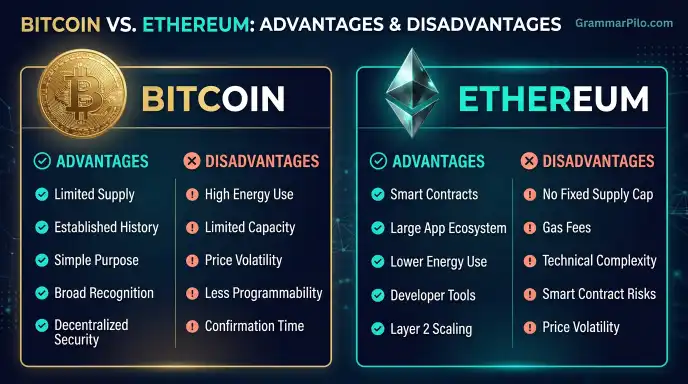
Both cryptocurrencies have strengths and limitations. Understanding these differences can help beginners make more informed decisions.
Advantages of Bitcoin
- Limited supply: Its maximum supply of 21 million BTC is built into the protocol.
- Established history: Bitcoin has operated since 2009.
- Simple primary purpose: Its main focus is decentralized digital money.
- Broad recognition: It is widely recognized in the cryptocurrency market.
- Decentralized security: Its proof of work system is supported by a distributed mining network.
Disadvantages of Bitcoin
- Energy consumption: Proof of work mining requires substantial electricity.
- Transaction limitations: The base network has limited transaction capacity.
- Price volatility: Bitcoin’s market value can change sharply.
- Limited programmability: Its scripting system is less flexible than Ethereum’s smart contract environment.
- Confirmation time: Payments may require additional confirmations before recipients consider them final enough.
Advantages of Ethereum
- Smart contracts: Developers can create programmable blockchain applications.
- Large application ecosystem: Ethereum supports decentralized finance, NFTs, tokens, and other services.
- Proof of stake: Its consensus mechanism uses significantly less energy than proof of work mining.
- Developer tools: A broad ecosystem supports blockchain development.
- Layer 2 scaling: Additional networks can improve transaction capacity and reduce costs.
Disadvantages of Ethereum
- No fixed supply cap: ETH does not have Bitcoin’s predetermined maximum supply.
- Gas fees: Mainnet transactions can become expensive during periods of high demand.
- Technical complexity: Smart contracts and decentralized applications can be difficult for beginners to understand.
- Application risks: Smart contract bugs and security vulnerabilities can result in financial losses.
- Market volatility: ETH prices can fluctuate significantly.
Bitcoin or Ethereum: Which Is Better for Different Uses?
The right cryptocurrency depends on the purpose behind using it. Bitcoin and Ethereum are designed for different types of blockchain activity.
For Long Term Value Storage
Bitcoin is often preferred by people who value a cryptocurrency with a predetermined maximum supply.
Its limited issuance and long operating history make it popular among investors who view it as a potential long term store of value.
However, Bitcoin is volatile and can lose substantial market value. Its limited supply does not guarantee investment returns.
For Decentralized Applications
Ethereum is generally the stronger choice for people interested in decentralized applications.
Its smart contract system allows developers to build financial tools, digital marketplaces, token platforms, and other blockchain based services.
Bitcoin does not provide the same general purpose application environment on its base layer.
For Digital Payments
Both networks can support cryptocurrency payments.
Bitcoin is designed around peer to peer value transfers, while Ethereum can transfer ETH and support payments involving tokens built on its network.
Bitcoin’s Lightning Network and Ethereum’s Layer 2 networks offer additional payment options.
The practical choice depends on transaction costs, supported wallets, network availability, and the recipient’s requirements.
For Decentralized Finance
Ethereum has a much broader role in decentralized finance.
Its smart contracts support lending, borrowing, decentralized exchanges, liquidity pools, and other financial applications.
Bitcoin can participate in some decentralized financial services through additional technologies and representations of BTC, but Ethereum has a more established general purpose smart contract ecosystem.
For Blockchain Development
Ethereum is usually more suitable for developers who want to build applications directly on a programmable blockchain.
Bitcoin development is more focused on payments, protocol improvements, and technologies that extend the Bitcoin ecosystem.
Bitcoin vs. Ethereum: Investment Considerations
People comparing BTC and ETH often want to know which cryptocurrency may be a better investment.
There is no guaranteed answer. Both assets involve substantial risk, and their market prices can move unpredictably.
Why Some Investors Prefer Bitcoin
Bitcoin attracts investors who are interested in:
- A fixed maximum supply.
- A relatively focused monetary design.
- Long term recognition in the cryptocurrency market.
- Decentralized ownership and transfer of value.
Some investors view BTC as a digital alternative to gold, although its volatility makes it different from traditional safe haven assets.
Why Some Investors Prefer Ethereum
Ethereum attracts investors who are interested in:
- Smart contract adoption.
- Decentralized finance.
- Blockchain applications.
- Tokenization and digital assets.
- The potential utility of ETH within its network.
ETH has a different economic role because it is used to pay network fees and support proof of stake security.
Important Risks to Understand
Before buying Ethereum or Bitcoin, consider the following risks:
- Market volatility: Both cryptocurrencies can experience significant price declines.
- Regulatory uncertainty: Cryptocurrency laws and policies vary across countries and can change.
- Security risks: Exchanges, wallets, and smart contracts can be vulnerable to attacks.
- Custody risks: Losing private keys or recovery information can result in permanent loss of access.
- Liquidity risks: Market conditions can affect the ability to buy or sell at a desired price.
Cryptocurrency investments are not guaranteed to produce profits. Beginners should understand the technology, assess their financial circumstances, and avoid investing money they cannot afford to lose.
Common Mistakes When Comparing Ethereum and Bitcoin
People often misunderstand the differences between these cryptocurrencies. The following mistakes can lead to inaccurate information and poor decisions.
Mistake 1: Thinking Ethereum and Ether Are the Same Name
Ethereum is the blockchain network, while Ether is its native cryptocurrency.
Incorrect: I transferred Ethereum coins to my wallet.
Better: I transferred Ether (ETH) to my wallet using the Ethereum network.
Mistake 2: Assuming Bitcoin and Ethereum Have the Same Purpose
Both use blockchain technology, but Bitcoin focuses on digital currency while Ethereum supports programmable applications.
They should not be described as identical payment systems.
Mistake 3: Believing Ethereum Has a 21 Million Supply Limit
Bitcoin has a fixed maximum supply of 21 million coins.
Ethereum does not have the same fixed maximum supply. Its issuance and supply changes are governed by network rules, including staking rewards and the burning of some transaction fees.
Mistake 4: Assuming Ethereum Uses Bitcoin’s Mining System
Bitcoin uses proof of work, which relies on computational work by miners.
Ethereum moved to proof of stake in September 2022. Its network uses validators who stake ETH to participate in transaction validation and block production.
Mistake 5: Choosing Based Only on Price
A lower price per coin does not automatically mean a cryptocurrency is cheaper or has greater potential.
The number of coins in circulation, total market value, supply model, and actual use cases all matter.
Mistake 6: Assuming Either Cryptocurrency Is Risk Free
Both assets can experience large price changes. They also face regulatory, technical, security, and market risks.
No cryptocurrency offers guaranteed profits.
Bitcoin vs. Ethereum: Google Trends and Modern Usage

Bitcoin and Ethereum remain two major subjects of interest in cryptocurrency discussions.
Ethereum is frequently discussed in connection with smart contracts, decentralized finance, stablecoins, tokenization, and blockchain applications. Bitcoin is commonly associated with digital money, limited supply, mining, and the idea of digital gold.
Search interest can change significantly during cryptocurrency market rallies, major network upgrades, regulatory announcements, and periods of economic uncertainty.
Google Trends can help compare public search interest for terms such as Bitcoin, BTC, Ethereum, and ETH over a selected period and region.
However, Google Trends measures relative search interest rather than actual cryptocurrency ownership, trading volume, or investment performance. Its normalized scores should not be interpreted as market share or proof that one cryptocurrency is more valuable.
For a meaningful comparison, examine the same date range, geographic region, and search category. Also remember that search popularity does not establish which cryptocurrency is the better investment.
Bitcoin vs. Ethereum: Comparison Table
| Category | Bitcoin | Ethereum |
| Full name | Bitcoin | Ethereum |
| Cryptocurrency | Bitcoin (BTC) | Ether (ETH) |
| Launched | 2009 | 2015 |
| Main purpose | Decentralized digital money | Decentralized application platform |
| Founder | Satoshi Nakamoto | Vitalik Buterin and other co founders |
| Consensus | Proof of work | Proof of stake |
| Supply policy | Maximum 21 million BTC | No fixed maximum supply |
| Mining | Yes | No traditional mining |
| Staking | Not part of Bitcoin’s base consensus | Supported |
| Smart contracts | Limited scripting | Extensive smart contract functionality |
| Energy use | Higher | Much lower |
| Main use cases | Payments and value storage | Applications, DeFi, tokens, and payments |
| Transaction fees | Bitcoin network fees | Ethereum gas fees |
| Popular comparison | Digital gold | Programmable blockchain infrastructure |
Frequently Asked Questions
1. Is Bitcoin better than Ethereum?
Bitcoin may be better for people who prioritize a limited supply digital currency, while Ethereum may be better for those interested in smart contracts and decentralized applications. The better option depends on the intended use.
2. What is the main difference between BTC and ETH?
BTC is the cryptocurrency of the Bitcoin network, which focuses on decentralized payments and value storage. ETH is the native cryptocurrency of Ethereum, a programmable blockchain that supports smart contracts and applications.
3. Is Ethereum more advanced than Bitcoin?
Ethereum offers more general purpose programmability and supports a wider range of decentralized applications. Bitcoin has a more focused design centered on digital money. More features do not automatically mean a network is better in every respect.
4. Can Ethereum replace Bitcoin?
Ethereum is not designed to replace Bitcoin directly. The networks serve different purposes and can coexist within the broader cryptocurrency ecosystem.
5. Does Ethereum have a maximum supply like Bitcoin?
No. Bitcoin has a maximum supply of 21 million BTC, while Ethereum does not have a fixed maximum supply of ETH. Ethereum’s issuance and fee burning mechanisms influence its circulating supply.
6. Why does Ethereum use less energy than Bitcoin?
Ethereum uses proof of stake, where validators stake ETH to participate in network security. Bitcoin uses proof of work mining, which requires specialized computers to perform energy intensive calculations.
7. Can I use Bitcoin on Ethereum?
Bitcoin does not operate natively on Ethereum. However, tokenized or wrapped representations of BTC can be created for use in certain Ethereum applications. These representations introduce additional custody, smart contract, and issuer related risks.
8. Are BTC and ETH the same type of cryptocurrency?
Both are cryptocurrencies, but they have different roles. BTC primarily represents decentralized digital money, while ETH is used for payments, transaction fees, staking, and interactions with applications on Ethereum.
9. Which is better for beginners, Bitcoin or Ethereum?
Bitcoin may be easier for beginners to understand because its primary purpose is relatively straightforward. Ethereum offers more functionality but can involve additional concepts such as smart contracts, gas fees, staking, and decentralized applications.
10. Can Bitcoin and Ethereum both be used for payments?
Yes. Bitcoin supports direct cryptocurrency payments, while Ethereum supports ETH transfers and transactions involving compatible tokens. Both networks have additional scaling solutions that can affect payment speed and cost.
Conclusion: Bitcoin or Ethereum?
Bitcoin and Ethereum are two important blockchain networks, but they solve different problems. Bitcoin focuses on decentralized digital money, a transparent transaction system, and a maximum supply of 21 million coins. Ethereum provides programmable blockchain infrastructure that supports smart contracts, decentralized finance, tokens, and a wide range of applications.
Choosing Bitcoin or Ethereum depends on what matters most to you. BTC may be more appealing if you are interested in monetary scarcity and a focused digital currency. ETH may be more suitable if you want to understand or use decentralized applications and blockchain based financial services.
Neither cryptocurrency is risk free, and neither guarantees investment profits. Their prices can fluctuate significantly, and users should understand the technology and risks before buying or transferring digital assets.
Ultimately, Bitcoin and Ethereum are not simply two versions of the same idea. They represent different approaches to decentralized technology, and both have important roles in the wider cryptocurrency ecosystem.
Discover More Articles

I’m Sloane Mercer, a U.S.-based English language writer focused on grammar, spelling, vocabulary, and everyday English usage. Through GrammarPilo, I provide clear and practical explanations to help readers choose the right words and communicate with confidence.