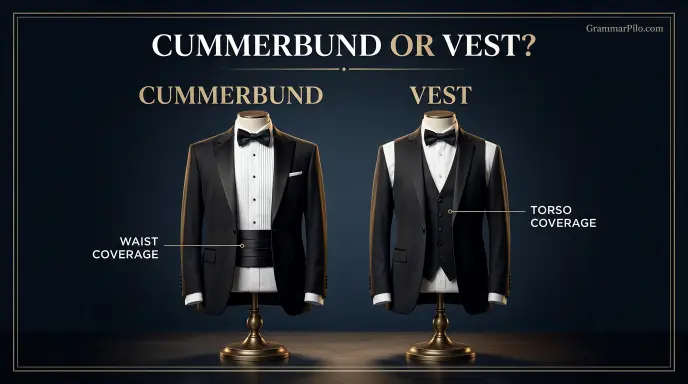
A cummerbund and a vest are both traditional formalwear accessories, but they serve different purposes and create different looks.
A cummerbund is a wide pleated waistband worn around the waist, usually with a tuxedo and a bow tie. A vest, also called a waistcoat in British English, is a sleeveless garment worn over a dress shirt and beneath a jacket or sometimes on its own.
The choice between a cummerbund or vest depends on the event, your outfit, and the style you want to achieve. A cummerbund creates a classic black tie appearance and covers the waistband of formal trousers.
A vest adds another layer to an outfit and can create a traditional, structured, or more personalized look.
Although people sometimes use these accessories interchangeably when planning formal outfits, they are not the same garment. Each has a distinct shape, fit, and place in men’s formalwear.
In this guide, you will learn the meaning of cummerbund and vest, explore the differences between them, compare their use with tuxedos and suits, and discover how to choose the right accessory for weddings, black tie events, and other special occasions.
Quick Answer: Cummerbund or Vest?
A cummerbund is a pleated band worn around the waist, traditionally with a tuxedo and bow tie at black tie events. A vest is a sleeveless garment worn over a shirt, often beneath a suit or tuxedo jacket.
Choose a cummerbund for a classic black tie look, or choose a vest when you want additional coverage, a layered appearance, or a more traditional three piece suit style. Both can work with formal clothing, but the event’s dress code should guide your choice.
What Is a Cummerbund?
A cummerbund is a broad waistband traditionally worn with a dinner jacket, formal trousers, and a bow tie. It is usually made from satin, silk, or another formal fabric and is commonly black, although other colors are available.
The cummerbund originated from a sash like garment associated with South Asian dress and became part of Western evening formalwear. Today, it is most closely associated with traditional black tie attire.
Key Features of a Cummerbund
A cummerbund has several recognizable characteristics:
- Shape: A wide band that wraps around the waist.
- Design: Often pleated across the front.
- Coverage: Conceals the waistband and the shirt trouser junction.
- Typical material: Satin, silk, or a similar dress fabric.
- Common setting: Black tie dinners, formal weddings, galas, and evening celebrations.
- Typical pairing: A tuxedo or dinner jacket, formal trousers, a dress shirt, and a bow tie.
The pleats of a traditional cummerbund generally face upward. This detail is associated with its historical role as a practical accessory, although modern versions are also chosen for their appearance.
How to Wear a Cummerbund
A cummerbund should sit neatly around the natural waist, covering the waistband of the trousers without bunching the shirt.
For a traditional black tie outfit, coordinate it with the rest of your formal accessories. A black cummerbund paired with a black bow tie is a classic choice.
Example: He wore a black tuxedo, a white dress shirt, a black bow tie, and a matching cummerbund to the gala.
Example: The groom selected a burgundy cummerbund to complement the wedding’s color scheme.
A cummerbund is an accessory rather than a complete upper body garment. It does not replace a vest or cover the chest.
What Is a Vest?
A vest is a sleeveless garment worn over a shirt. In British English, the formal garment commonly called a vest in American English is usually known as a waistcoat. In British usage, the word vest more commonly refers to an undershirt.
And in American English, a formal vest is a familiar part of a three piece suit. It can be made from wool, cotton, linen, satin, or other fabrics, depending on the outfit and occasion.
Key Features of a Vest
A formal vest typically has the following features:
- Shape: A sleeveless garment covering the torso.
- Front: Usually has buttons and may feature pockets.
- Coverage: Extends from the chest toward the waist.
- Fit: Designed to sit neatly over a dress shirt.
- Common setting: Weddings, business events, formal dinners, and three piece suit occasions.
- Typical pairing: A dress shirt and suit trousers, often with a matching jacket.
Some vests are tailored to match the suit, while others use a contrasting color or texture to create a distinctive look.
How to Wear a Vest
A formal vest should fit close to the body without pulling at the buttons. It should cover the waistband of the trousers, and the shirt should remain neatly tucked in.
Traditional waistcoats are often worn with the bottom button left undone, although styling conventions can vary by garment and personal preference.
Example: The groom wore a navy vest with matching suit trousers and a white dress shirt.
Example: He chose a patterned vest to add personality to his wedding outfit.
A vest offers more torso coverage than a cummerbund and can be worn as part of a coordinated three piece suit.
Cummerbund vs. Vest: Main Differences
The primary difference between a cummerbund and a vest is their shape and coverage. A cummerbund wraps around the waist, while a vest covers the torso.
| Feature | Cummerbund | Vest |
| Basic design | Wide waistband | Sleeveless upper body garment |
| Coverage | Waist only | Chest and torso |
| Typical purpose | Traditional black tie accessory | Adds a layer to formal or smart clothing |
| Common fabric | Satin or silk | Wool, cotton, linen, satin, or blends |
| Typical pairing | Tuxedo and bow tie | Suit, dress shirt, or some tuxedo outfits |
| Buttons | Usually none across the front | Usually has front buttons |
| Pockets | Generally absent | May include pockets |
| Formal appearance | Classic evening elegance | Traditional, tailored, or layered elegance |
| British terminology | Cummerbund | Waistcoat is the usual formalwear term |
| American terminology | Cummerbund | Vest |
Neither accessory is universally better. The best option depends on the dress code, the suit or tuxedo, and the appearance you want.
Cummerbund or Vest With a Tuxedo?
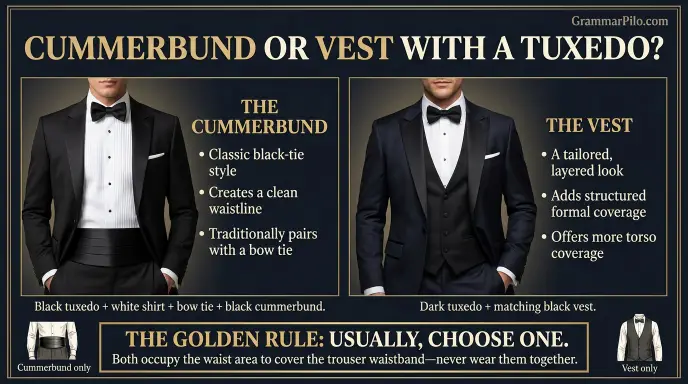
Both accessories can appear with formal eveningwear, but they create different results.
When to Choose a Cummerbund
A cummerbund is a traditional choice for a classic black tie outfit. It works particularly well when the dress code calls for a tuxedo, a white dress shirt, and a bow tie.
Choose a cummerbund if you want to:
- Follow traditional black tie styling.
- Keep the waist area visually clean.
- Coordinate with a matching bow tie.
- Avoid adding another layer over your shirt.
- Create a classic eveningwear silhouette.
Example: A black tuxedo, white dress shirt, black bow tie, and black cummerbund create a timeless black tie combination.
When to Choose a Vest
A formal vest can work with some tuxedo outfits, although it is less associated with the most traditional cummerbund based black tie look.
Choose a vest if you want to:
- Add a tailored layer over your shirt.
- Create a more structured appearance.
- Coordinate with a three piece formal outfit.
- Introduce a subtle color or texture.
- Wear an accessory that provides more torso coverage.
Example: A dark tuxedo with a matching black vest creates a coordinated, layered formal look.
Can You Wear Both Together?
You generally should not wear a cummerbund and a vest together. Both occupy the waist area, and using them at the same time can create unnecessary bulk and visual competition.
For a conventional formal outfit, select one if the styling calls for either accessory. Some outfits may use neither, depending on the design and dress code.
Cummerbund and Vest in American and British English
The words vest and cummerbund can be understood across English speaking regions, but vest has an important regional difference.
| Term | American English | British English |
| Cummerbund | A formal waistband | A formal waistband |
| Vest | A sleeveless garment worn over a shirt | Often an undershirt |
| Waistcoat | A sleeveless formal garment | A sleeveless formal garment |
| Three piece suit | Suit with jacket, trousers, and vest | Suit with jacket, trousers, and waistcoat |
| Black tie accessory | Cummerbund | Cummerbund |
Which Term Should You Use?
For an American audience, vest is a natural term for the sleeveless formal garment. For a British audience, waistcoat is usually clearer when discussing formal clothing.
The word cummerbund has essentially the same meaning in both varieties of English.
If you are writing for an international audience, you can use the phrase vest (waistcoat) on the first mention to make the meaning clear.
Cummerbund vs. Vest for Weddings
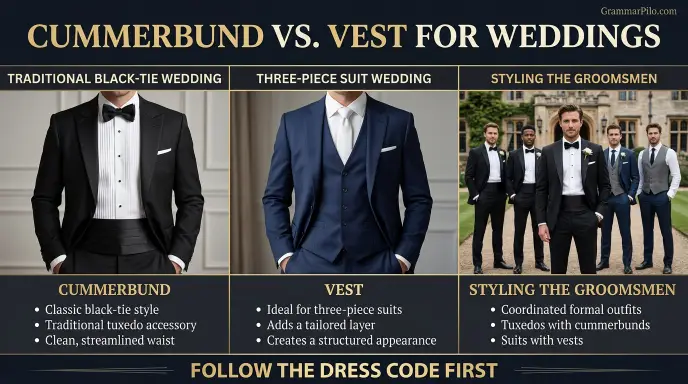
Weddings are one of the most common occasions for choosing between a cummerbund and a vest. The right option depends on the wedding’s formality, the groom’s outfit, and the overall styling.
For a Traditional Black Tie Wedding
A cummerbund is a strong choice for a traditional tuxedo. Black is the classic option, but a coordinated color may be appropriate when the couple has selected a specific formal palette.
For a Three Piece Suit Wedding
A vest is a natural choice for a groom wearing a three piece suit. It can match the jacket and trousers or provide a subtle contrast.
For example, a navy suit with a matching vest creates a coordinated look, while a charcoal suit with a light gray vest offers a more noticeable contrast.
For Groomsmen
Matching accessories can help create a consistent appearance across a wedding party.
- Cummerbunds: Suitable for a coordinated black tie wedding party.
- Vests: Suitable for three piece suits or a more layered wedding style.
- Matching bow ties: Can complement either accessory.
- Color coordination: Should follow the wedding’s overall styling rather than rely on identical colors for every item.
For formal weddings, follow the invitation’s dress code first. A black tie invitation usually calls for a tuxedo, while a cocktail or semi formal dress code may allow a broader range of suit combinations.
Common Mistakes When Choosing a Vest or Cummerbund
Understanding a few common styling mistakes can help you create a more polished formal outfit.
Mistake 1: Treating a Cummerbund and Vest as the Same Garment
Incorrect assumption: A cummerbund and a vest are interchangeable names for the same accessory.
Correct explanation: A cummerbund covers the waist, while a vest covers the torso.
Mistake 2: Wearing Both Without Considering the Outfit
Poor styling choice: Wearing a cummerbund and a vest together simply because both are formal accessories.
Better approach: Choose the accessory that suits the outfit and dress code. Traditional black tie styling generally uses a cummerbund or a waist covering alternative, not both.
Mistake 3: Choosing a Cummerbund for Every Suit
A cummerbund is especially associated with tuxedos and black tie eveningwear. It is not usually the most natural choice for a standard business suit.
Better approach: Use a vest or waistcoat for a three piece suit, and reserve the cummerbund for an appropriate formal ensemble.
Mistake 4: Using the Wrong Regional Meaning of Vest
In American English, a vest can mean a sleeveless formal garment. In British English, it often means an undershirt.
Better approach: Use waistcoat when writing for a British audience if you want to avoid confusion.
Mistake 5: Ignoring Fit
A cummerbund that is too loose can slip or bunch up. A vest that is too tight can pull at the buttons and distort the shirt underneath.
Better approach: Check the fit while standing and sitting. The accessory should remain comfortable and look neat throughout the event.
Cummerbund or Vest in Everyday Examples
These examples demonstrate how the terms can be used naturally in conversations, shopping, formal invitations, and fashion writing.
In Shopping and Clothing Stores
Cummerbund: Do you have a black cummerbund to match this tuxedo?
Vest: I need a navy vest to complete my three piece suit.
Cummerbund: The store sells cummerbunds in several colors.
Vest: This vest has a subtle pattern that complements the jacket.
In Wedding Planning
Cummerbund: The groom chose a black cummerbund for the evening ceremony.
Vest: The groomsmen will wear matching gray vests.
Cummerbund: The wedding invitation specifies traditional black tie attire.
Vest: The groom’s vest matches his trousers and jacket.
In Emails and Workplace Communication
Cummerbund: Please confirm that the formalwear order includes the cummerbunds.
Vest: The tailor has finished adjusting the vest for the event.
Cummerbund: The stylist recommended a black cummerbund for the dinner jacket.
Vest: The team selected matching vests for the promotional photos.
In Fashion Articles
Cummerbund: A cummerbund can create a traditional black tie appearance.
Vest: A fitted vest adds structure to a three piece suit.
Cummerbund: The accessory should coordinate with the bow tie and formal trousers.
Vest: A contrasting vest can add texture without changing the suit’s overall formality.
Cummerbund or Vest: Google Trends and Modern Usage
Vest and Cummerbund are both established clothing terms, but they are used in different contexts. The word vest has a much broader range of meanings, including formalwear, casual clothing, and protective garments. In British English, it also commonly refers to an undershirt.
Cummerbund is more closely associated with tuxedos, black tie events, formal weddings, and eveningwear. It often appears in discussions about traditional men’s formal accessories.
Modern formalwear offers more flexibility than some older dress conventions. Depending on the event and the cut of the jacket, men may wear a cummerbund, a formal vest, or neither. However, traditional black tie guidance still favors a coordinated and restrained look.
No verified, current Google Trends figures are included here, so exact search volume comparisons should not be assumed. To compare the terms using Google Trends, use the same region and time period and consider that the broad meaning of vest can influence its search interest.
For practical outfit decisions, the distinction is more useful than popularity data. A cummerbund is a waist accessory associated with classic black tie styling, while a vest is a sleeveless garment that creates a more layered appearance.
Vest vs. Cummerbund: Quick Outfit Guide
Use this reference table when choosing an accessory for a particular occasion.
| Occasion or outfit | Recommended option | Why |
| Traditional black tie event | Cummerbund | Classic tuxedo accessory |
| Three piece business suit | Vest | Designed to complement the suit |
| Formal wedding with tuxedos | Cummerbund or suitable formal vest | Depends on the chosen black tie styling |
| Casual office outfit | Usually neither | Both may be too formal for everyday casual clothing |
| Groom wearing a three piece suit | Vest | Creates a coordinated, tailored look |
| Classic dinner jacket with bow tie | Cummerbund | Traditional eveningwear combination |
| Modern formal outfit with a matching sleeveless layer | Vest | Provides torso coverage and a layered silhouette |
| Outfit with a simple, clean waistline | Cummerbund | Covers the trouser waistband without adding a full upper body layer |
A Simple Trick to Remember Vest vs. Cummerbund
Think of the area each accessory covers.
Cummerbund covers the waist: It wraps around the middle of the body and is commonly worn with a tuxedo.
Vest covers the torso: It sits over the shirt and covers the chest and waist.
Imagine getting ready for a formal event. If you want a wide band around your waist, choose a cummerbund. If you want a sleeveless garment over your shirt, choose a vest.
This simple visual distinction helps you remember the difference even when both accessories appear in formalwear guides.
Frequently Asked Questions
1. What is the difference between a cummerbund and a vest?
A cummerbund is a wide waistband worn around the waist, traditionally with a tuxedo. A vest is a sleeveless garment worn over a shirt and generally covers the torso. The two accessories have different shapes and functions.
2. Is a cummerbund better than a vest with a tuxedo?
A cummerbund is the traditional choice for classic black tie attire. A vest can also work with certain tuxedo outfits, especially when the styling calls for a matching or coordinated waistcoat. The event’s dress code and the design of the outfit should guide your decision.
3. Can you wear a vest instead of a cummerbund?
Yes, a formal vest can be used in some tuxedo outfits, although it creates a different appearance from a traditional cummerbund. If you are following a strict black tie dress code, check the event’s expectations and choose a coordinated formal look.
4. Should you wear a cummerbund and a vest together?
Usually not. Both accessories occupy the waist area, and wearing them together can create unnecessary bulk. For a traditional formal outfit, choose the accessory that best suits the dress code and the rest of your clothing.
5. Is a cummerbund only for black tie events?
A cummerbund is most strongly associated with black tie attire and formal eveningwear. It may appear in other coordinated outfits, but a standard business suit or casual outfit generally does not require one.
6. Is a vest the same as a waistcoat?
In American English, vest commonly refers to the sleeveless garment worn over a shirt. In British English, the equivalent formal garment is usually called a waistcoat. And in British usage, vest often refers to an undershirt.
7. What color cummerbund should you wear with a black tuxedo?
Black is the classic choice for a traditional black tuxedo and black bow tie. Other colors may work for themed events or coordinated weddings, but they should complement the outfit and suit the dress code.
8. Do you need a cummerbund with every tuxedo?
No. A cummerbund is a traditional option, not a universal requirement for every modern tuxedo outfit. Some formal ensembles use a vest, while others are designed without either accessory. Follow the dress code and the outfit’s intended styling.
9. Is a vest appropriate for a wedding?
Yes. A vest is a popular choice for weddings, particularly when the groom or wedding party is wearing three piece suits. It can match the suit or provide a coordinated contrast with the other clothing.
10. Which is more formal, a cummerbund or a vest?
Neither is automatically more formal in every situation. A cummerbund is strongly associated with traditional black tie eveningwear, while a vest is common in formal suits and some tuxedo ensembles. The formality depends on the fabric, fit, outfit, and event dress code.
Conclusion: Cummerbund or Vest?
Choosing between a vest or cummerbund is easier once you understand how each accessory works. A cummerbund is a wide band worn around the waist and is traditionally associated with tuxedos, bow ties, and black tie events.
A vest is a sleeveless garment worn over a shirt that adds coverage and creates a layered, tailored appearance.
For a classic black tie outfit, a cummerbund is an excellent traditional choice. For a three piece suit, a vest or waistcoat is usually the more natural option. Both can work in selected formal settings, but wearing them together is generally unnecessary.
Before choosing, consider the event’s dress code, the design of your suit or tuxedo, and the look you want to achieve. Pay attention to fit, fabric, and coordination so the accessory complements rather than distracts from your outfit.
Remember the simplest distinction. A cummerbund covers the waist, while a vest covers the torso. Once you know that, you can confidently choose the right accessory for weddings, galas, formal dinners, and other special occasions.
Other Tricky Words Explained
- Nickle or Nickel: The One Letter Spelling Mistake Explained
- Devine or Divine: The Spelling Detail That Makes All the Difference
- Wack or Whack: One Letter Changes the Meaning of These Words

I’m Sloane Mercer, a U.S.-based English language writer focused on grammar, spelling, vocabulary, and everyday English usage. Through GrammarPilo, I provide clear and practical explanations to help readers choose the right words and communicate with confidence.






3 thoughts on “Cummerbund or Vest: Which One Belongs With Your Formal Outfit?”