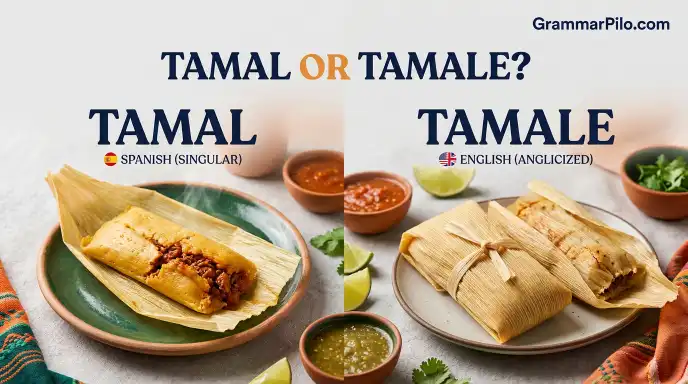
Are you looking for tamal or tamale? Tamale is the standard English spelling for the popular Mexican dish made from masa dough, filled with ingredients such as meat, cheese, or vegetables, wrapped in corn husks or banana leaves, and steamed.
Tamal is also a correct word, particularly in Spanish, where it is the singular form of the dish. The difference between tamal or tamale mainly comes down to language, regional usage, and spelling conventions.
If you have seen both words on restaurant menus, food blogs, or recipes, you may wonder which one you should use. The answer depends on your audience and the context of your writing. In English, tamale is widely recognized and commonly used as both the singular and plural form in everyday conversation. In Spanish, tamal is singular, while tamales is plural.
This guide explains the meaning, origin, spelling, pronunciation, and correct usage of tamal and tamale. You will also discover how the terms differ in English and Spanish, common mistakes to avoid, and examples that show how to use each word naturally.
Tamale vs. Tamal: Quick Answer
Both tamale and tamal are correct spellings, but their usage differs by language.
- Tamale: The standard and widely used English spelling for the Mexican food.
- Tamal: The Spanish singular form of the dish, also used in some English language contexts, particularly when referring to Spanish language traditions or regional terminology.
- Tamales: The Spanish plural form and the commonly used English plural spelling.
| Word | Language or Usage | Meaning |
| Tamal | Spanish | One traditional steamed masa dish |
| Tamale | English | One traditional steamed masa dish |
| Tamales | Spanish and English | More than one tamal or tamale |
The easiest rule: Use tamale in ordinary English writing and tamal when following Spanish spelling and usage.
What Does Tamal Mean?
Tamal is a Spanish noun referring to a traditional dish made from masa, a dough prepared from specially treated corn. It is typically filled with ingredients such as meat, cheese, chilies, beans, or vegetables.
The prepared masa and filling are wrapped in a corn husk or banana leaf and cooked by steaming. Tamales are enjoyed in Mexico and many other parts of Latin America, with recipes and preparation methods varying by region.
Meaning of Tamal in Spanish
In Spanish, tamal is singular.
For example:
- Compré un tamal para el almuerzo.
- Mi abuela prepara un tamal tradicional.
- Este tamal tiene un relleno de pollo.
In these examples, tamal refers to one serving of the traditional dish.
When Should You Use Tamal?
Use tamal when writing in Spanish or discussing the dish using its Spanish name. It is also appropriate in English language writing when preserving Spanish terminology is important.
For example:
- The restaurant serves a traditional Mexican tamal.
- I learned how to prepare a tamal from a family recipe.
- Each region has its own style of tamal.
What Does Tamale Mean?
Tamale is the English spelling commonly used for the same traditional food. It refers to a steamed preparation made with masa dough and a filling, usually wrapped in a corn husk or another suitable leaf.
The word is especially familiar in the United States, where tamales are a popular part of Mexican and Mexican American food culture.
Meaning of Tamale in English
In everyday English, tamale usually refers to one serving of the dish.
For example:
- I ordered a chicken tamale at the restaurant.
- She made a cheese tamale for dinner.
- This tamale is filled with seasoned pork.
English speakers commonly use tamale as the singular form and tamales as the plural.
When Should You Use Tamale?
Use tamale when writing for a general English speaking audience, especially in American English.
It is the familiar spelling in restaurant menus, recipes, food articles, and everyday conversations.
Tamal vs. Tamale: Key Differences
Although tamal and tamale refer to the same traditional food, their spelling and grammatical usage depend on the language.
1. Language and Regional Usage
Tamal is the Spanish singular form, while tamale is the common English singular form.
Spanish speakers generally use tamal when referring to one item. English speakers, particularly in the United States, usually write tamale.
2. Singular and Plural Forms
The difference becomes especially noticeable when discussing more than one serving.
| Language | Singular | Plural |
| Spanish | Tamal | Tamales |
| English | Tamale | Tamales |
The word tamales is used in both languages, although the pronunciation and surrounding grammar may differ.
3. Pronunciation
The words are closely related but are pronounced according to the language being used.
- Tamal: Commonly pronounced tuh MAHL in English approximations of Spanish pronunciation.
- Tamale: Commonly pronounced tuh MAH lee in English.
The final vowel sound in tamale is one of the noticeable differences.
4. Writing and Communication
For English language articles, menus, and recipes, tamale is usually the most recognizable choice.
For Spanish language content, tamal is the appropriate singular form.
Both words can appear in English writing, but consistency is important. Avoid switching between them without a reason.
The Origin and History of Tamal and Tamale
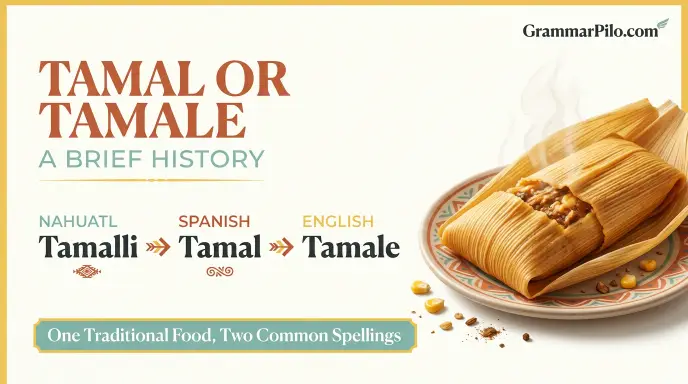
The history of tamales reaches back to ancient Mesoamerican food traditions. The dish developed around the use of maize, which was a fundamental crop in many Indigenous cultures of the region.
Where Does the Word Tamal Come From?
The Spanish word tamal comes from the Nahuatl word tamalli, which referred to a wrapped or steamed preparation made with corn dough.
Nahuatl was spoken by Indigenous communities in central Mexico, including the Aztecs. The word entered Spanish during the colonial period as Spanish speakers adopted local food names and culinary traditions.
Over time, the Spanish form tamal became established across different parts of Latin America.
How Did Tamale Enter English?
English adopted the word through contact with Spanish speaking communities and Mexican food culture.
The English spelling tamale developed as the food became more familiar to English speakers, especially in the United States. It became widely used in cookbooks, restaurant menus, newspapers, and everyday conversation.
Today, both forms remain connected to the same culinary tradition, although each has a different place in language usage.
Tamal or Tamale in American and British English
The spelling difference is not primarily a British versus American English issue. It is more closely related to the distinction between Spanish and English.
American English
In American English, tamale is the widely recognized spelling.
Restaurants, food publications, grocery stores, and recipes commonly use tamale for one serving and tamales for multiple servings.
Example:
- We ordered two chicken tamales from the Mexican restaurant.
British English
British English also commonly uses tamale when referring to the Mexican dish in English language writing.
The word is less familiar to some British readers than to American readers, but the English spelling remains tamale.
Example:
- The food festival offered freshly prepared tamales.
Which Form Should You Use?
| Writing Context | Recommended Form |
| American English | Tamale |
| British English | Tamale |
| Spanish writing | Tamal |
| Spanish plural | Tamales |
| General English recipes | Tamale |
| Traditional Spanish language references | Tamal |
For GrammarPilo readers, tamale is the best general English choice, while tamal should be used when the Spanish form is specifically intended.
Common Mistakes When Using Tamal and Tamale
Because the two words look similar, writers sometimes use them interchangeably without considering their language context.
Mistake 1: Treating Tamal and Tamale as Different Foods
Incorrect: A tamal is a completely different dish from a tamale.
Correct: Both words refer to the same traditional food. Their main difference is linguistic usage.
Mistake 2: Using Tamal as the Standard English Singular
Less natural in general English: I bought one tamal for lunch.
More familiar in general English: I bought one tamale for lunch.
The Spanish form is still valid, especially when the writer wants to preserve the original terminology.
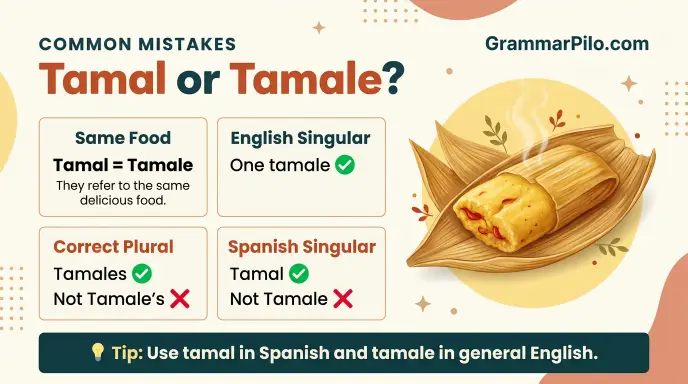
Mistake 3: Writing Tamales as Tamale’s
Incorrect: We ordered three tamale’s.
Correct: We ordered three tamales.
An apostrophe is not needed to form the plural.
Mistake 4: Assuming Tamale Is the Spanish Singular Form
Incorrect: Tamale is the standard Spanish singular spelling.
Correct: Tamal is the Spanish singular form, while tamales is plural.
Mistake 5: Mixing Language Forms Without Consistency
A sentence or article should follow a consistent language convention. If you are writing in Spanish, use tamal for one item. If you are writing in English, tamale is generally the more familiar singular form.
Everyday Examples of Tamal and Tamale
Seeing both words in context makes their correct usage easier to understand.
Examples Using Tamal
- Mi madre preparó un tamal para el desayuno.
- El tamal tradicional estaba envuelto en una hoja de maíz.
- Probé un tamal de pollo durante mi viaje a México.
- Cada familia tiene su propia receta de tamal.
- Este tamal tiene una mezcla de verduras y especias.
Examples Using Tamale
- I ordered a beef tamale for lunch.
- My grandmother makes delicious chicken tamales.
- The restaurant serves fresh tamales every weekend.
- She wrapped each tamale in a corn husk before steaming it.
- We bought a dozen tamales for the family gathering.
Tamale or Tamal in Common Phrases
| Phrase | Usage |
| Traditional tamal | Spanish influenced usage |
| Mexican tamale | Common English usage |
| Chicken tamale | English singular |
| Homemade tamales | English or Spanish plural |
| Tamal recipe | Spanish singular terminology |
| Tamales for dinner | Plural in both languages |
Google Trends and Modern Usage
The popularity of tamal and tamale can vary depending on the country, language, and type of search.
In the United States, tamale is a familiar search term for people looking for recipes, restaurant menus, cooking instructions, and information about Mexican food.
Tamal is particularly relevant to Spanish language searches and discussions about traditional Latin American cuisine. Searchers may also use the term when looking for regional recipes or cultural information.
What Influences Search Interest?
Several factors can influence searches for these terms:
- Language: English language searches often use tamale, while Spanish language searches commonly use tamal.
- Recipes: People may search for either spelling when looking for traditional cooking methods.
- Regional traditions: Different countries and communities have their own tamal and tamale recipes.
- Food culture: Restaurant menus, food festivals, and seasonal celebrations can influence interest.
Google Trends data can change according to the selected country, date range, and search category. A direct comparison using the same location and time period is necessary before making claims about which term receives more searches.
Frequently Asked Questions About Tamal or Tamale
1. Is Tamal or Tamale Correct?
Both are correct. Tamal is the Spanish singular form, while tamale is the commonly used English singular form.
2. Is Tamale an English or Spanish Word?
Tamale is the common English spelling for the food. It developed from the Spanish word tamal, which ultimately comes from the Nahuatl word tamalli.
3. What Is the Plural of Tamal?
The Spanish plural of tamal is tamales. The same spelling is used for the English plural of tamale.
4. Is Tamale Singular or Plural?
Tamale is singular in English. The plural is tamales.
5. Are Tamal and Tamale the Same Food?
Yes. Both terms refer to a traditional dish made with masa dough, usually filled with savory or sweet ingredients, wrapped in a leaf, and steamed.
6. How Do You Spell Tamale in American English?
The standard American English spelling is tamale. For more than one, write tamales.
7. Why Do Some People Write Tamal Instead of Tamale?
Some people use tamal because it is the Spanish singular form. It is also used in English discussions that preserve Spanish culinary terminology or regional naming traditions.
Conclusion: Should You Write Tamal or Tamale?
Both tamal and tamale are correct, but the best choice depends on the language and audience. In Spanish, tamal is the singular form, and tamales is its plural. In everyday English, particularly American English, tamale is the familiar singular spelling, while tamales is the plural.
The two words describe the same traditional dish made with masa dough and commonly steamed inside corn husks or leaves. Their difference comes from language conventions rather than ingredients or preparation methods.
When writing an English recipe, restaurant review, or food article, choose tamale for clarity and familiarity. When writing in Spanish or discussing the original terminology, use tamal. Keeping the language consistent will help readers understand your meaning without confusion.
Explore More Differences

I’m Claire Morgan, the author behind Grammarpilo.com, where I write about English grammar, sentence structure, punctuation, and everyday language. My goal is to make grammar simple, clear, and practical, helping readers understand the rules and apply them with confidence in real-world writing.







3 thoughts on “Tamal or Tamale: Which Is Correct and What Is the Difference?”