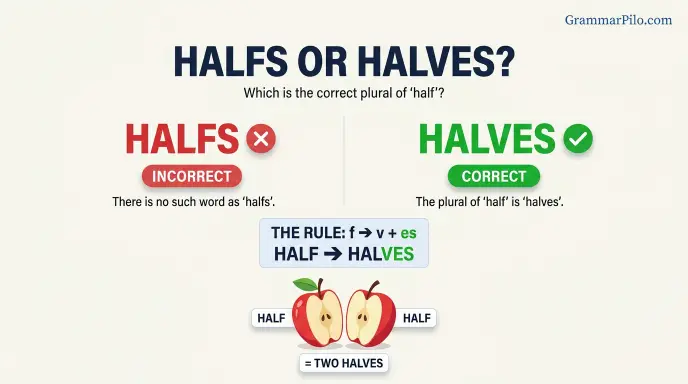
The correct plural of half is halves, not halfs. If you cut a sandwich into two equal parts, you have two halves. The spelling changes from half to halves because many English nouns ending in f or fe form their plurals by changing that ending to ves.
The confusion around halfs or halves is common because most English nouns form their plurals by adding s or es.
For example, book becomes books, and box becomes boxes. However, half follows a different spelling pattern, much like leaf and leaves or knife and knives.
You may see people search for halves or halfs, half vs. halves, halves vs. halfs, half and halves, or halfs and halves when writing about food, money, measurements, sports, or everyday situations.
Knowing the correct form helps you avoid spelling mistakes in schoolwork, emails, reports, and online content.
In this guide, you will learn why halves is correct, how to use it in sentences, where the spelling comes from, and how to remember the rule with ease.
Halfs or Halves: Quick Answer
Halves is the correct plural of half. The word half changes its final f to v and adds es to form halves. Use halves when you mean two or more parts, each equal to half of a whole. The word halfs is a common misspelling and should not be used in standard English. For example, “She cut the orange into two halves” is correct.
Examples:
- Correct: I divided the pizza into two halves.
- Incorrect: I divided the pizza into two halfs.
- Correct: We paid for our halves of the meal separately.
Remember these forms:
- Singular: half
- Plural: halves
- Incorrect plural: halfs
The comparison halfs vs. halves is simple once you learn the spelling rule. When you need the plural of half, change the final f to v and add es.
What Does Half and Halves Mean?
What Does Half Mean?
The word half means one of two equal parts of a whole. It can refer to an object, an amount, a period of time, or a portion of something.
Examples include:
- I ate half of the apple.
- She spent half her money on books.
- We waited for half an hour.
- He watched the first half of the match.
The word half is singular because it refers to one part.
What Does Halves Mean?
The word halves is the plural form of half. It refers to two or more half sized parts.
Examples include:
- Cut the lemon into two halves.
- The children shared the cake in halves.
- Both halves of the screen display different images.
- We compared the two halves of the painting.
In everyday English, halves often appears with the number two because dividing one whole into two equal parts creates two halves.
Is Half or Halves Correct?
Both half and halves are correct words, but they have different grammatical uses.
| Word | Grammatical form | Example |
| Half | Singular | I ate half the sandwich. |
| Halves | Plural | We shared the sandwich in halves. |
| Half’s | Possessive or contraction form | The half’s size was unusual. |
| Half’s | Contraction in context | Half’s enough for me. |
| Halfs | Nonstandard plural spelling | Avoid this form in standard writing. |
The apostrophe in half’s can show possession, as in “the half’s shape.” In informal speech, it can also represent half is or half has, depending on the sentence. It does not create the regular plural.
The Origin of Half and Halves
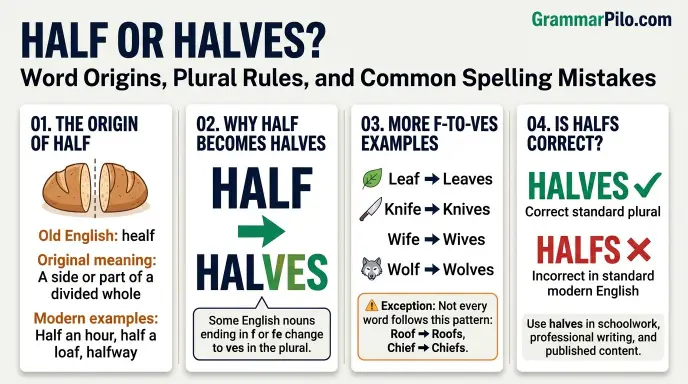
Where Does the Word Half Come From?
The word half has a long history in English. It developed from Old English healf, a word used for a side or part of something divided into two.
The word has Germanic roots and is related to similar words in other Germanic languages. Its meaning has remained closely linked to one of two parts of a whole.
Today, half appears in many common expressions, including half an hour, half a loaf, half asleep, and halfway.
Why Does Half Become Halves?
English has several plural patterns. Most regular nouns add s or es, as in car/cars and dish/dishes. Some nouns ending in f or fe, however, change that ending to ves.
Examples include:
- Half becomes halves.
- Leaf becomes leaves.
- Knife becomes knives.
- Wife becomes wives.
- Wolf becomes wolves.
This spelling pattern developed over time as English sounds and word endings changed. It is not a rule for every word ending in f, so each word must be learned according to its standard plural.
For instance, roof becomes roofs, not usually rooves in standard modern usage. The plural of chief is chiefs.
The key point is that half follows the halves pattern, not the regular add s pattern.
Is Halfs Ever Correct?
In standard modern English, halfs is not the accepted plural of half. You may encounter it in spelling exercises, informal online writing, search queries, or text written by someone who does not know the plural rule.
For formal writing, school assignments, published articles, and professional communication, use halves.
British English vs. American English
Do British and American English Spell Halves Differently?
No. Both British and American English use halves as the plural of half. This spelling is also standard in Canadian, Australian, and other major English varieties.
| British English | American English | Example |
| Half | Half | I ate half the sandwich. |
| Halves | Halves | Cut the sandwich into two halves. |
| Half’s | Half’s | The half’s length was measured. |
| Half an hour | Half an hour | The meeting lasted half an hour. |
There is no regional spelling difference between halves in British English and halves in American English.
Do Style Guides Prefer Halves?
Standard dictionaries and editorial references recognize halves as the plural of half. Writers should use the accepted spelling in both general and formal writing.
A publisher may have its own preferences for punctuation, capitalization, and number formatting. Those preferences do not change the standard plural spelling.
If you are writing an article, preparing a report, or editing a school assignment, choose halves regardless of the English variety you use.
Which Version Should You Use?
In the United States
Use halves in everyday writing, schoolwork, business documents, recipes, and news articles.
Example: “Divide the ingredients into two equal halves.”
In the United Kingdom
Use halves as well. The plural spelling is the same in British English.
Example: “The teacher asked us to compare the two halves.”
In Canada
Canadian English also uses halves. There is no special Canadian plural form.
Example: “The two halves of the book cover have different designs.”
In Australia
Use halves in Australian English, including educational materials and workplace documents.
Example: “Cut the fruit into halves and serve it chilled.”
In International Writing
For a global audience, halves is the correct choice. It is widely understood and does not require a regional spelling adjustment.
In Academic Writing
Use half for one part and halves for multiple parts. Check that the sentence makes clear how many parts you mean.
Example: “The researchers divided the sample into two halves.”
In Business Writing
Use halves when describing divided costs, portions, quantities, or resources.
Example: “The two departments will receive equal halves of the allocated budget.”
In financial writing, however, choose precise terms such as 50 percent, one half, or equal shares when they communicate the amount more clearly.
Common Mistakes When Using Halves and Halfs
Mistake 1: Adding Only S
Incorrect: The baker cut the cake into two halfs.
Correct: The baker cut the cake into two halves.
Explanation: The plural of half changes the final f to v and adds es.
Memory tip: Think of half and halves as a spelling pair, just like leaf and leaves.
Mistake 2: Using Halves for One Part
Incorrect: I ate halves of the sandwich.
Correct: I ate half of the sandwich.
Explanation: When you mean one of the two equal parts, use half. Use halves when referring to multiple parts.
Mistake 3: Confusing Halves With Half’s
Incorrect: Both half’s were placed on the table.
Correct: Both halves were placed on the table.
Explanation: Half’s usually indicates possession or a contraction. Halves is the plural form.
Mistake 4: Assuming Every F Word Changes to V
Incorrect: The two chiefves arrived early.
Correct: The two chiefs arrived early.
Explanation: Not all nouns ending in f follow the same plural pattern. Compare half/halves with chief/chiefs and roof/roofs.
Memory tip: Learn common plural pairs individually instead of changing every final f to v.
Mistake 5: Using Half and Halves Without Checking Meaning
Incorrect: Please divide the apple into two half.
Correct: Please divide the apple into two halves.
Explanation: The word after two must be plural when referring to two separate parts.
Everyday Examples of Half and Halves
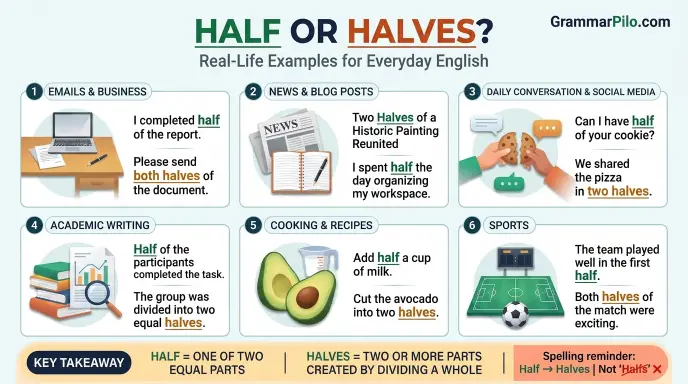
The best way to understand half or halves is to see how each form works in real situations.
In Emails
- “I have completed half of the report and will finish the rest tomorrow.”
- “Please send me both halves of the signed document.”
In Business Writing
- “The company divided the project into two halves.”
- “Each partner will cover half of the initial cost.”
News Headlines
- “Team Wins After Trailing at Half Time”
- “Two Halves of Historic Painting Reunited”
These examples show how half and halves work in headlines without changing their standard spelling.
In Blog Posts
- “Cut the watermelon into two halves before serving.”
- “I spent half the day organizing my workspace.”
On Social Media
- “Pizza tastes better when you share it with friends. Two halves, one happy meal!”
- “I have finished half of my reading list this week.”
In Academic Writing
- “The study group was divided into two equal halves.”
- “Half of the participants completed the first task.”
In Daily Conversation
- “Can I have half of your cookie?”
- “We split the orange into two halves.”
- “I watched half the movie last night.”
- “The two halves fit together perfectly.”
Cooking and Recipes
- “Cut the avocado into two halves.”
- “Add half a cup of milk.”
- “Place the two halves of the pepper on a baking tray.”
In Sports
The word half is also used for a period of play, especially in sports such as soccer.
Examples:
- “The team played well in the first half.”
- “Both halves of the match were exciting.”
- “The second half began with a quick goal.”
Notice that half can refer to a period of play, while halves refers to the two periods or parts.
Google Trends and Modern Usage
Why Do People Search for Halfs or Halves?
People often search for halfs or halves, halves or halfs, half vs. halves, and halves vs. halfs because they know that many English nouns form plurals by adding s.
Since half does not follow that simple pattern, writers may be unsure which spelling to use. The same question appears in school assignments, online discussions, recipes, and editing tasks.
Searches for half and halves or halfs and halves may also come from people trying to check the spelling of a phrase or understand how the word works in a sentence.
Is Halves More Common Than Halfs?
In standard English, halves is the accepted plural and is the form expected in edited writing. Halfs is generally an error when used as the plural of half.
Exact search popularity can change by location and over time. Without verified trend data for a defined period, it would be misleading to assign precise search volumes or claim a numerical difference between the two spellings.
How Can You Check Regional Usage?
You can explore the word in reference dictionaries and language resources, including Google Trends, to examine search interest by region and time.
Keep in mind that search interest does not prove a spelling is correct. A misspelling can attract searches precisely because people are trying to find the correct form.
For everyday writing, the practical recommendation remains the same across English speaking regions: use halves as the plural of half.
Quick Comparison Table: Half vs. Halves vs. Halfs
| Version | Meaning | Correct? | Region | Example |
| Half | One of two equal parts | Yes | All English varieties | I ate half the apple. |
| Halves | Two or more half sized parts | Yes | All English varieties | Cut the apple into halves. |
| Halfs | Intended as the plural of half | No | Not standard | Write “two halves.” |
| Half’s | Possession or a contraction | Yes, in the right context | All English varieties | The half’s shape was unusual. |
| One half | A fraction equal to 1/2 | Yes | All English varieties | One half of the class attended. |
| Halfway | At the middle point | Yes | All English varieties | We are halfway through the trip. |
The comparison half vs. halves concerns singular and plural forms. The comparison halves vs. halfs concerns correct and incorrect plural spelling. The forms half and halves are both useful, but each has its own grammatical role.
Similarly, writing halfs and halves in a sentence is appropriate only when discussing the competing spellings themselves. Do not use halfs as an ordinary plural noun.
Key Takeaways
- Halves is the correct plural of half.
- Halfs is not the standard plural spelling.
- Use half for one part and halves for multiple parts.
- The spelling changes from f to v before adding es.
- British, American, Canadian, and Australian English all use halves.
- Half’s is different from halves because it expresses possession or a contraction.
- Other nouns ending in f may follow different plural patterns, so do not assume every word changes to ves.
- When in doubt, remember the pair half → halves.
FAQs About Halfs or Halves
1. Is it halfs or halves?
Halves is correct. The plural of half changes the final f to v and adds es. For example, “The teacher divided the class into two halves” is correct. Halfs is a common spelling mistake and should be avoided in standard English writing.
2. Why does half become halves?
The word half follows a traditional English plural pattern used by several nouns ending in f or fe. These words change the final sound or spelling to v and add es. Similar examples include leaf/leaves, knife/knives, and wife/wives. This pattern applies to certain words, not all nouns ending in f.
3. Is halfs ever a correct word?
Halfs is not accepted as the standard plural of half. You might see it in informal writing, search queries, or examples that explain common spelling errors. In schoolwork, professional documents, articles, and other edited writing, use halves when referring to more than one half.
4. What is the plural of half?
The plural of half is halves. For example, one half of an orange becomes two halves when the orange is divided into two equal parts. Remember that half is singular and halves is plural. The spelling does not follow the usual pattern of simply adding s.
5. Is halves correct in American English?
Yes. Halves is the standard plural in American English. It is also correct in British, Canadian, and Australian English.
There is no regional spelling difference for this word, so you can use halves in American school assignments, business emails, recipes, and published writing.
6. What is the difference between half and halves?
Half refers to one of two equal parts of a whole, while halves refers to multiple such parts. For example, “I ate half the sandwich” describes one portion. “We divided the sandwich into two halves” describes the two resulting portions. The correct form depends on the number and meaning.
7. Is half’s the same as halves?
No. Half’s includes an apostrophe and usually indicates possession, as in “the half’s shape.” It can also represent a contraction, such as half is, in a suitable sentence. Halves is the regular plural of half. Use the form that matches the meaning you want to express.
8. How do you remember the spelling of halves?
Connect half with another familiar word that changes from f to v, such as leaf and leaves. Then remember the pair as half → halves. You can also write a short practice sentence, such as “I cut the pear into two halves.” Repeating the correct pair helps make the spelling easier to recall.
9. Do all words ending in f change to ves in the plural?
No. Some nouns change f or fe to ves, as in half/halves and knife/knives. Others simply add s, as in roof/roofs and chief/chiefs. Because there is no single rule that works for every noun, learn the standard plural form of each word.
10. Can I use halves in formal and academic writing?
Yes. Halves is appropriate in formal, academic, business, and everyday writing. Use it when referring to multiple parts, such as “The researchers divided the sample into two halves.”
If a technical passage needs greater precision, you can also use expressions such as two equal parts or one half of the sample.
Conclusion: Choose Halves, Not Halfs
The difference between halfs or halves comes down to one important spelling rule. Half is the singular form, and halves is the correct plural. When you divide an object into two equal parts, you have two halves, not two halfs.
This spelling may seem unusual because many English nouns form their plurals by adding s. However, certain words ending in f or fe change to ves. You can remember this pattern by learning familiar pairs such as half/halves, leaf/leaves, and knife/knives.
The rule is the same in American, British, Canadian, and Australian English. You do not need to choose a different spelling for a particular country.
Just make sure the form matches the meaning of your sentence. Use half for one part, halves for multiple parts, and half’s only when possession or a contraction is intended.
If you are writing an email, completing an assignment, preparing a recipe, or editing an article, halves is the spelling to use for the plural.
More Common Spelling Mistakes

I’m Claire Morgan, the author behind Grammarpilo.com, where I write about English grammar, sentence structure, punctuation, and everyday language. My goal is to make grammar simple, clear, and practical, helping readers understand the rules and apply them with confidence in real-world writing.








2 thoughts on “Halfs or Halves? The Correct Plural of Half”