
Klutz is the standard spelling of the informal English noun used to describe a clumsy or awkward person. Although clutz is sometimes seen in casual writing, klutz is the preferred form in standard English.
Both spellings are usually intended to express the same idea, but they are not equally accepted in edited writing.The confusion between clutz or klutz is understandable because both forms are pronounced the same way.
When people hear the word, they may naturally associate its first sound with the letter C, especially because the related adjective clumsy begins with C. However, the established spelling of the noun begins with K.
The word klutz comes from Yiddish and became familiar in American English. Today, people commonly use it in casual conversations, humorous stories, friendly messages, and social media posts to describe someone who frequently drops things, trips, or accidentally knocks objects over.
In this guide, you will learn the correct spelling, the meaning and origin of each form, the difference between clutz and klutz, common mistakes, regional usage, and practical examples to help you use the word confidently.
Quick Answer: Clutz or Klutz?
Klutz is the correct standard spelling. It is an informal noun that describes a clumsy person who may frequently drop things, stumble, or make small physical mistakes. Clutz is generally treated as a misspelling or nonstandard variant when used with this meaning.
Correct: I am such a klutz that I dropped my phone twice today.
Nonstandard: I am such a clutz that I dropped my phone twice today.
Remember the K in klutz when writing about someone who is clumsy.
What Does Klutz Mean?
Klutz is an informal noun for a person who is clumsy, awkward, or prone to accidents. It is often used when someone repeatedly drops objects, bumps into furniture, trips over their own feet, or struggles with activities that require coordination.
The word can describe someone in a humorous or affectionate way. People also use it to make fun of their own mistakes without taking themselves too seriously.
Examples of Klutz in Sentences
- I am a klutz whenever I try to carry too many bags.
- My brother is such a klutz that he knocked over his water glass.
- She felt like a klutz during her first skating lesson.
- He called himself a klutz after dropping his keys.
- Everyone laughed when the lovable klutz tripped over an empty box in the comedy.
In each example, klutz identifies a person rather than describing an action directly.
Is Klutz a Noun or an Adjective?
Klutz is a noun. The related adjective is clumsy.
Noun: He is a klutz.
Adjective: He is clumsy.
Noun: My sister is a klutz in the kitchen.
Adjective: My sister is clumsy in the kitchen.
Avoid combining the words incorrectly. For example, He is a klutz person is unnatural. Write He is a klutz or He is a clumsy person instead.
Is Klutz Always an Insult?
No. The tone depends on the situation and the relationship between the people involved.
Someone might say, “I am such a klutz,” after accidentally spilling a drink. In this case, the word is self deprecating and humorous.
However, calling another person a klutz can sound unkind if it is used to criticize, embarrass, or belittle them. In formal situations, expressions such as clumsy person, physically awkward, or accident prone may be more appropriate.
What Does Clutz Mean?
Clutz is a spelling sometimes used for the same word as klutz. In ordinary contemporary English, however, it is generally not the preferred standard spelling.
People may write clutz because they hear the word rather than see it written. The spelling may also be influenced by familiar words such as clumsy and clumsiness.
Examples of Clutz as a Nonstandard Spelling
Nonstandard: I felt like a clutz when I dropped all my books.
Preferred: I felt like a klutz when I dropped all my books.
Nonstandard: He is a clutz who always spills his coffee.
Preferred: He is a klutz who always spills his coffee.
Nonstandard: My friend joked that she was a clutz on the dance floor.
Preferred: My friend joked that she was a klutz on the dance floor.
The intended meaning is usually clear, but the K spelling is the better choice for articles, school assignments, professional communication, and other edited writing.
Can Clutz Ever Be Correct?
The spelling clutz may appear in a personal name, business name, brand, username, or direct quotation. In such cases, the spelling may be intentional and should be preserved when referring to that specific name or source.
For the ordinary English noun meaning a clumsy person, use klutz.
Clutz vs. Klutz: Key Differences
The main difference between clutz and klutz is spelling status. In ordinary usage, people who write clutz generally intend to express the same meaning as klutz.
| Feature | Clutz | Klutz |
| Standard spelling | Generally nonstandard | Standard |
| Meaning intended | Usually a clumsy person | A clumsy or awkward person |
| Pronunciation | Usually the same as klutz | Commonly pronounced /klʌts/ |
| Part of speech | Intended as a noun | Noun |
| American English | Usually avoid in edited writing | Preferred spelling |
| British English | Not the preferred form | Recognized spelling |
| Formal writing | Generally avoid | Correct spelling, but informal in tone |
| Example | Usually a spelling error | She is a klutz on the ice. |
The two forms are not a standard American versus British spelling pair. The distinction is not like color and colour, where both spellings are accepted regional forms.
The Origin and History of Klutz
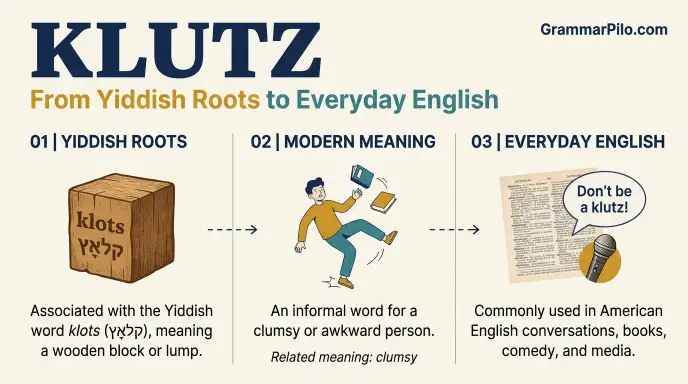
The word klutz entered English from Yiddish, a language historically spoken by Ashkenazi Jewish communities. It became especially familiar in American English through contact with Yiddish speaking communities.
The word is commonly connected with the Yiddish term klots, meaning a wooden block or lump, although etymological explanations can vary slightly among references. In English, klutz developed the meaning of a clumsy or awkward person.
Why Does Klutz Begin With K?
The spelling reflects the word’s linguistic history rather than the spelling of the English adjective clumsy. Because the word was borrowed into English, its initial K spelling does not have to match the first letter of a related English word.
This is why the following words can coexist:
- Klutz: A clumsy person.
- Clumsy: An adjective describing awkward or poorly coordinated movement.
- Clumsiness: The noun describing the quality of being clumsy.
Although these words are related in meaning, they have different forms and spelling patterns.
How Did Klutz Become Common in English?
Over time, klutz spread beyond its original linguistic setting and became a familiar informal term in American English. It appears in conversation, books, comedy, television, online discussions, and everyday messages.
Its humorous tone has helped it remain recognizable. People often use it to describe minor mishaps rather than serious problems.
Is Klutz American or British English?
Klutz is strongly associated with American English, but the word is also understood in other varieties of English, including British English.
Importantly, clutz and klutz do not represent two standard regional spelling conventions. Klutz is the safer spelling across English varieties when you want to use this particular informal noun.
| Region or context | Recommended usage |
| American English | Klutz |
| British English | Klutz, although clumsy person may be more natural in some contexts |
| Canadian English | Klutz |
| Australian English | Klutz may be understood in informal usage |
| International English | Klutz is the preferred spelling when using the word |
Which Spelling Should You Use?
Choose klutz for ordinary English writing. It is appropriate for casual conversation, humorous articles, friendly emails, and stories.
For formal reports, academic writing, or sensitive communication, consider using clumsy person or another neutral expression. The spelling may be correct, but the informal tone of klutz may not suit every situation.
Common Mistakes When Using Clutz or Klutz
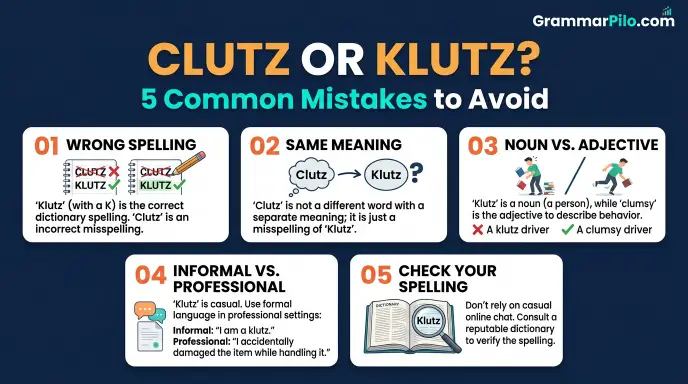
Knowing the correct spelling is important, but understanding the word’s grammar and tone will help you use it more naturally.
1. Writing Clutz Instead of Klutz
This is the most common spelling mistake.
Incorrect in standard usage: My brother is a clutz.
Correct: My brother is a klutz.
The word starts with K in its standard form.
2. Assuming the Two Spellings Have Different Meanings
Some writers think clutz and klutz describe different types of clumsiness. In ordinary usage, this is generally not the case. Clutz is usually an attempted spelling of klutz.
Preferred: She called herself a klutz after spilling her drink.
3. Using Klutz as an Adjective
Because klutz describes a person, writers sometimes use it incorrectly to modify a noun.
Unnatural: He is a klutz driver.
Better: He is a clumsy driver.
Also correct: He is a klutz behind the wheel.
Use clumsy as the adjective and klutz as the noun.
4. Using Klutz in a Formal Report
The word is informal and may sound judgmental when applied to another person.
Casual: I am a klutz with fragile objects.
Professional: I accidentally damaged the item while handling it.
The second sentence describes what happened without labeling the person.
5. Assuming Every Online Spelling Is Standard
A spelling may appear on social media, blogs, or discussion boards without being the preferred form in edited English.
If you are unsure, check a reputable dictionary rather than relying on the frequency of a spelling in casual posts.
Klutz in Everyday Examples

These examples demonstrate how to use the standard spelling naturally in different situations.
In School and Academic Settings
Correct: I felt like a klutz when I dropped my books in the hallway.
Correct: The student joked that he was a klutz after knocking over his pencil case.
Correct: My friend is a klutz at basketball, but she enjoys practicing.
Correct: The story features a lovable klutz who learns to become more confident.
For formal academic writing, a neutral expression such as clumsy person may be more suitable.
In Emails and Workplace Communication
Casual email: I am such a klutz. I spilled coffee on my notebook again!
Friendly workplace chat: Sorry about the mess. I was being a klutz with my coffee.
Professional email: I accidentally spilled coffee on the desk and have cleaned the area.
Workplace conversation: He laughed at himself for being a klutz while setting up the equipment.
The choice depends on the relationship between the people and the tone of the message.
In Everyday Conversation
Correct: Watch that step. I am a klutz, and I nearly tripped there yesterday.
Correct: She called herself a klutz after dropping her phone.
Correct: I cannot dance without feeling like a klutz.
Correct: My dad is a klutz when he tries to use the touchscreen on his new phone.
These examples use the word informally and conversationally.
In Social Media Posts
Correct: Officially a klutz after dropping my ice cream before taking a bite.
Correct: Being a klutz means turning a simple task into a comedy show.
Correct: I tripped over absolutely nothing. Total klutz moment!
Correct: My weekend activity was proving once again that I am a klutz in the kitchen.
The word is especially suitable for humorous captions about harmless mistakes.
In Stories, Books, and Entertainment
Correct: The comedy follows a lovable klutz who accidentally disrupts every important event.
Correct: Although he thought of himself as a klutz, he was an excellent musician.
Correct: The main character is a charming klutz whose mistakes often lead to unexpected adventures.
Correct: Her role as an awkward klutz made the audience laugh.
Writers can use the word to create a friendly, humorous character, but should consider the intended audience and tone.
Clutz and Klutz: Quick Comparison Examples
Use the following examples as a quick reference when checking your writing.
| Intended meaning | Preferred sentence |
| Someone often drops objects | He is a klutz. |
| Someone trips frequently | I am such a klutz on the stairs. |
| Someone feels awkward while dancing | She felt like a klutz at the party. |
| Someone makes a humorous self description | I am a total klutz today. |
| Someone is described professionally | The person appeared physically awkward. |
| Someone uses the nonstandard spelling | Replace clutz with klutz in standard writing. |
These examples show that the correct spelling depends on the established form of the noun, while the best word choice depends on the context.
Google Trends and Modern Usage
The search phrase clutz or klutz reflects a common spelling question. Because the two forms sound alike, writers may search for the correct spelling before using the word in an article, message, or assignment.
No verified live Google Trends figures are included here, so exact search volumes or popularity percentages should not be assumed.
To investigate current interest, compare both spellings in Google Trends and select the relevant country and period. You can also consult established dictionary entries to confirm standard spelling and meaning.
In modern online communication, nonstandard spellings may spread through quick typing, phonetic spelling, and repeated exposure to user generated content. Seeing clutz in a post does not necessarily mean it is the recommended form for edited writing.
For GrammarPilo.com articles, educational content, and general English usage, klutz is the recommended spelling when describing a clumsy person.
A Simple Trick to Remember Klutz
The easiest way to remember the correct spelling is to connect the word with its first letter.
K stands for keeping the standard spelling: klutz.
When describing someone who frequently drops things or bumps into objects, write klutz with a K.
You can also remember that clumsy and klutz are different words. The adjective begins with C, but the noun begins with K.
Correct: I am a klutz when I try to carry too many shopping bags.
Incorrect in standard usage: I am a clutz when I try to carry too many shopping bags.
A quick spelling check can prevent this common mistake before you submit an assignment or publish an article.
Frequently Asked Questions
1. Is it clutz or klutz?
Klutz is the standard spelling. It is an informal noun meaning a clumsy or awkward person. Clutz is generally considered a nonstandard spelling for this meaning.
2. What does klutz mean?
A klutz is someone who is physically clumsy or awkward, especially someone who often drops things, trips, or knocks objects over.
Example: I am such a klutz that I dropped my keys while opening the door.
3. Is clutz ever correct?
Clutz may occur in a personal name, brand, username, or quotation. However, when referring to an ordinary clumsy person, klutz is the preferred standard spelling.
4. Is klutz a real English word?
Yes. Klutz is an established English word borrowed from Yiddish. It is commonly used in informal American English to describe a clumsy person.
5. Is klutz American or British?
The word is especially associated with American English, but it is recognized in other English varieties. The spelling klutz is preferred; clutz is not a standard British alternative.
6. Is klutz rude?
It can be playful or insulting depending on the situation. Calling yourself a klutz is often humorous, while calling someone else a klutz may sound unkind if the intention is critical.
7. What is the plural of klutz?
The usual plural is klutzes.
Example: The comedy featured two lovable klutzes who kept making harmless mistakes.
8. What is another word for klutz?
Possible alternatives include clumsy person, awkward person, and accident prone person. Choose the term that best fits the intended meaning and level of formality.
9. Is klutz a noun or an adjective?
Klutz is a noun, while clumsy is an adjective.
Noun: He is a klutz.
Adjective: He is clumsy.
10. How can I remember the correct spelling?
Remember that the standard spelling begins with K: klutz. When you describe someone who is clumsy, choose klutz rather than clutz.
Conclusion: Always Choose Klutz in Standard English
When comparing clutz or klutz, the preferred choice is klutz. It is the established spelling of the informal noun used to describe a clumsy or awkward person.
Although clutz may appear in casual writing, it is generally not recommended in standard edited English.The word klutz has roots in Yiddish and became familiar through American English.
Today, it is commonly used in everyday conversation, humorous stories, friendly messages, and social media posts. Its playful tone makes it useful in informal contexts, although expressions such as clumsy person or accident prone person may be better for professional or sensitive situations.
Remember three essential points: klutz is the preferred spelling, it is a noun, and clumsy is the related adjective. The K spelling is the one to use in schoolwork, articles, and other edited content.
For your next conversation, assignment, or GrammarPilo.com article, choose klutz when you mean a clumsy person.
Make Your English More Accurate
- Carrer or Career: The Correct Spelling & Easy Way to Remember
- Colum or Column: The Missing Letter That Makes All the Difference
- Grimey or Grimy and the One Correct Spelling You Must Use

I’m Sloane Mercer, a U.S.-based English language writer focused on grammar, spelling, vocabulary, and everyday English usage. Through GrammarPilo, I provide clear and practical explanations to help readers choose the right words and communicate with confidence.