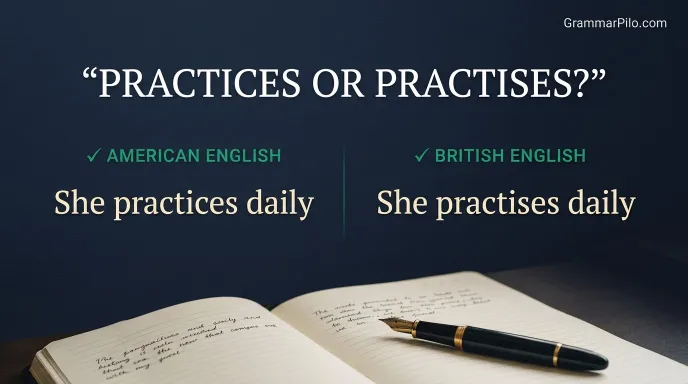
Practices and practises are both correct spellings, but their use depends on the type of English and the grammatical role of the word.
In American English, practices is used as both a noun and a verb. In British English, practices is the plural form of the noun practice, while practises is the verb form.
This difference often confuses students, writers, and English learners. Both words look almost identical, and both relate to doing something regularly to improve a skill or follow a method.
However, choosing the right form depends on the sentence and the spelling style you are using.For example, an American writer would say, “She practices the piano every day.” A British writer would usually write, “She practises the piano every day.”
Yet both American and British writers use the noun practices in a sentence such as “Good practices improve safety.”Understanding practices or practises, practises or practices, and practices vs. practises will help you write more clearly.
This guide explains the meanings, spelling rules, common mistakes, and everyday examples so you can choose the correct form with confidence.
Practices or Practises: Quick Answer
Practices and practises can both be correct, but they are used differently.
- Practices: The plural noun in both American and British English. It is also the verb form used in American English.
- Practises: The third person singular verb form in British English.
Examples:
- American English: She practices the piano every day.
- British English: She practises the piano every day.
- Both varieties: The school follows good teaching practices.
The main rule is to check the grammatical role of the word and the English style you are following. British English separates the noun and verb spellings, while American English uses practice for both forms.
| Word | Correct usage | Example |
| Practices | Plural noun in both varieties | These practices improve safety. |
| Practices | Verb in American English | He practices daily. |
| Practises | Verb in British English | He practises daily. |
| Practises | Noun in standard usage | Incorrect for the intended noun meaning |
When comparing practices or practises, remember that neither spelling is always wrong. The correct choice depends on the sentence and your regional spelling style.
Definition and Meaning of Practices or Practises
The words practices and practises relate to repeated actions, training, customs, or the way someone carries out an activity. Their meanings overlap, but their grammatical roles differ.
What Does Practices Mean?
Practices has two main uses.
As a plural noun: It refers to methods, customs, procedures, or repeated activities.
Examples:
- The company follows safe working practices.
- Traditional practices remain important in the community.
- Good study practices can help students learn.
- The hospital reviewed its safety practices.
As a verb in American English: It describes what one person regularly does to develop a skill or carry out an activity.
Examples:
- She practices the piano every evening.
- He practices law in New York.
- My brother practices speaking English daily.
In American English, practices can therefore be either a plural noun or a verb.
What Does Practises Mean?
Practises is the third person singular form of the verb practise in British English and other varieties that follow this spelling distinction.
It describes an action performed by one person or subject.
Examples:
- She practises the violin every morning.
- He practises medicine in London.
- The student practises new vocabulary after class.
- My friend practises yoga before work.
In these sentences, the word describes an action rather than naming an activity or method.
What Is the Difference Between Practice and Practise?
The singular forms make the rule easier to understand.
| Grammatical role | American English | British English |
| Noun | Practice | Practice |
| Verb with I, you, we, or they | Practice | Practise |
| Verb with he, she, or it | Practices | Practises |
| Plural noun | Practices | Practices |
For example, American English uses “I practice every day” and “She practices every day.” British English uses “I practise every day” and “She practises every day.”
The noun stays the same in both varieties.
Are Practices and Practises Pronounced the Same?
Yes. In their usual English pronunciation, practices and practises sound the same. The spelling difference is mainly a matter of grammar and regional convention.
This can make the words confusing for learners. You may hear someone say the word correctly but still need to decide how to spell it in writing.
A useful approach is to identify the subject, find the verb, and follow the spelling style used throughout your document.
The Origin of Practices and Practises
The history of these words helps explain why English uses two spellings for the verb in different regions.
Where Does the Word Practice Come From?
The word practice entered English through French forms related to carrying out an activity or putting a skill into use. Its history is linked to the idea of doing something repeatedly, following a method, or applying knowledge.
Over time, practice developed several meanings. It can describe training, a customary action, a professional activity, or the work carried out by someone in a profession.
For example, a musician needs practice to improve a skill. A company may follow certain business practices. A doctor may work in a medical practice.
The word’s history connects these meanings, even though they serve different purposes in modern sentences.
Why Do British and American English Use Different Spellings?
The difference developed through regional spelling conventions. British English commonly uses practice for the noun and practise for the verb. American English generally uses practice for both.
This distinction is similar to the British English pairing advice and advise, where the noun and verb use different endings. However, the words practice and practise are pronounced alike, so their spelling requires attention to grammar.
Why Do People Confuse Practices and Practises?
There are three common reasons.
1. The words sound the same.
Because pronunciation does not help much, writers may choose the wrong spelling when typing quickly.
2. The grammar can be difficult to identify.
A word that names a method is a noun, while a word that describes an action is a verb. Some sentences make this difference easy to see, but others require closer attention.
3. Different English styles use different rules.
A writer who learns American English may use practices as a verb in every situation. A writer following British English needs to use practises for the verb and practice for the noun.
The best way to avoid errors is to learn the regional rule and check how the word functions in the sentence.
British English vs American English Spelling
The main difference between British and American English is how the verb is spelled. Both varieties use practice as a noun, but they do not use the same spelling for every verb form.
Practices vs Practises in British English
In British English, use practice for the noun and practise for the verb.
Examples:
- Noun: She needs more practice before the test.
- Verb: She practises every afternoon.
- Plural noun: The school follows several teaching practices.
- Third person verb: He practises the piano after school.
The plural noun practices does not change to practises. The spelling with c remains correct because the word is a noun.
Practices vs Practises in American English
American English uses practice for both the noun and the verb.
Examples:
- Noun: She needs more practice before the test.
- Verb: She practices every afternoon.
- Plural noun: The school follows several teaching practices.
- Third person verb: He practices the piano after school.
In American writing, practises is not the standard spelling of the verb.
Comparison Table for British and American English
| Sentence type | British English | American English |
| Singular noun | Practice helps me improve. | Practice helps me improve. |
| Plural noun | These practices work well. | These practices work well. |
| First person verb | I practise daily. | I practice daily. |
| Third person verb | She practises daily. | She practices daily. |
| Present continuous | She is practising now. | She is practicing now. |
| Past tense | She practised yesterday. | She practiced yesterday. |
| Professional activity | He practises law. | He practices law. |
| Training session | Football practice starts soon. | Football practice starts soon. |
The same pattern applies to related forms such as practising and practiced. British English commonly uses practising and practised, while American English uses practicing and practiced.
Does Canadian English Use Practices or Practises?
Canadian usage can vary. Some Canadian writers follow British conventions for the verb, while other publications follow American style spelling. If you are writing for a Canadian audience, check the publication’s style guide and remain consistent.
For a general international audience, the safest approach is to select one recognized spelling system and use it throughout your work.
Which Spelling Should You Use?
Choosing between practices and practises is easy once you know your audience and the role of the word.
For American Readers
Use practice as the noun and verb, and use practices as the plural noun or third person singular verb.
Examples:
- She practices English every morning.
- He practices the guitar after school.
- The business follows ethical practices.
- The team practices three times a week.
Avoid practises when writing in standard American English.
For British Readers
Use practice as the noun and practise as the verb.
Examples:
- She practises English every morning.
- He practises the guitar after school.
- The business follows ethical practices.
- The team practises three times a week.
Notice that practices is still correct in the third example because it names multiple methods or procedures.
For Australian and Other Commonwealth Readers
Australian English generally follows the British distinction between the noun practice and the verb practise.
Examples:
- She practises swimming every weekend.
- Regular practice helps athletes improve.
- The organization reviewed its workplace practices.
Other English speaking regions may use different editorial conventions, so check local guidance when writing for a specific publication.
For Students, Bloggers, and Professional Writers
Use the spelling system required by your school, workplace, or publication. If no style guide is provided, choose American or British English and apply its rules consistently.
Professional tip: Do not automatically replace every instance of practices with practises. First, check if the word is a noun or a verb. A plural noun should remain practices in both varieties.
Common Mistakes with Practices and Practises
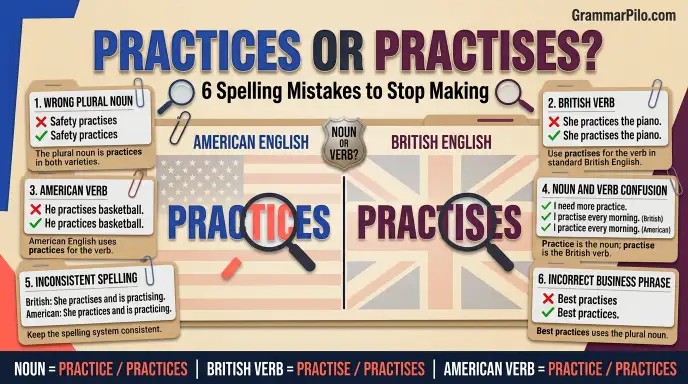
Writers often make errors because they focus on the ending rather than the grammatical role of the word.
Mistake 1: Using Practises as a Plural Noun
Incorrect: The company’s safety practises protect workers.
Correct: The company’s safety practices protect workers.
The word refers to several procedures, so it is a plural noun. Use practices in both British and American English.
Mistake 2: Using Practices as a British English Verb
Incorrect in standard British English: She practices the piano every day.
Correct in British English: She practises the piano every day.
Correct in American English: She practices the piano every day.
The correct form depends on the regional spelling system.
Mistake 3: Using Practises in American English
Incorrect in standard American English: He practises basketball every weekend.
Correct in American English: He practices basketball every weekend.
American English uses practice for the verb, including its third person singular form practices.
Mistake 4: Confusing the Noun and Verb
Compare these sentences.
- I need more practice.
- I practise every morning. (British English)
- I practice every morning. (American English)
In the first sentence, practice names an activity. In the next two, practise or practice describes an action.
Mistake 5: Mixing British and American Spellings
Inconsistent: She practises every morning, and he is practicing in the afternoon.
This sentence combines a British verb form with an American spelling of the continuous form.
Consistent British English: She practises every morning, and he is practising in the afternoon.
Consistent American English: She practices every morning, and he is practicing in the afternoon.
Consistency helps readers follow your writing and makes editing easier.
Mistake 6: Writing Best Practises
Incorrect: These are the company’s best practises.
Correct: These are the company’s best practices.
The phrase best practices uses a plural noun. It is correct in both British and American English.
Practices or Practises in Everyday Examples
The easiest way to learn the difference is to see how both spellings work in real situations. The examples below show the correct forms in emails, news, social media, and formal writing.
In Emails
In emails, the correct spelling depends on your audience and the role of the word.
American English examples:
- She practices her presentation before every meeting.
- Our team follows good communication practices.
- He practices his speech each morning.
British English examples:
- She practises her presentation before every meeting.
- Our team follows good communication practices.
- He practises his speech each morning.
For a work email, you could write:
“Please review the current workplace practices before the next meeting.”
Here, practices is a plural noun, so the spelling is the same in both varieties.
In News Articles
News articles often use practices to describe customs, procedures, and professional methods. The verb form follows the publication’s spelling style.
Examples:
- The company changed its business practices after the review.
- The athlete practices daily to prepare for the competition. (American English)
- The athlete practises daily to prepare for the competition. (British English)
- Local farming practices have changed over the past decade.
These sentences show why it is important to understand the word’s role rather than judging the spelling alone.
On Social Media
People use these words when discussing hobbies, study habits, work routines, and personal improvement.
Examples:
- She practices yoga every morning. (American English)
- She practises yoga every morning. (British English)
- Small daily practices can build better habits.
- Good writing practices make your posts easier to read.
If you create captions for an international audience, choose a spelling style and follow it throughout your account.
In Formal and Academic Writing
Formal writing often uses practices to describe procedures or accepted methods.
Examples:
- Research practices should follow clear ethical guidelines.
- The report examines modern teaching practices.
- The student practices pronunciation before the oral exam. (American English)
- The student practises pronunciation before the oral exam. (British English)
In academic work, check the style guide before editing spelling. Some institutions require a particular variety of English.
In Everyday Conversation
Both forms are common in writing, but the difference is usually not heard in speech because they are pronounced alike.
Examples:
- I need more practice before the exam.
- She practises every evening. (British English)
- He practices every evening. (American English)
- Our school has new sports practices.
The noun practice is useful when discussing training, while the verb describes the act of training or repeating an activity.
Practices vs Practises: Google Trends and Usage Data
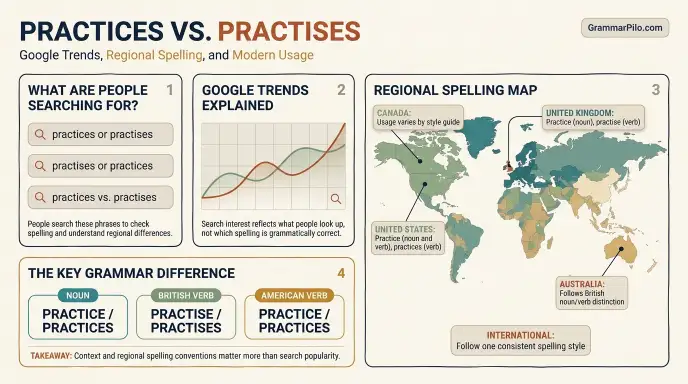
Searches for practices or practises, practises or practices, and practices vs. practises often come from people who want to check spelling or understand British and American English.
Search popularity can help explain common questions, but it does not decide which spelling is grammatically correct.
Which Spelling Is More Popular?
The form practices appears in both American and British English, but it serves different grammatical purposes. Practises is used for the third person singular verb in British English and related spelling systems.
A direct comparison of raw search counts may therefore be misleading. The results can include searches for plural nouns, verbs, grammar lessons, and spelling questions.
Practices or Practises by Country
| Country or region | Common spelling pattern |
| United States | Practice as noun and verb; practices as the third person verb |
| United Kingdom | Practice as noun; practise as verb |
| Australia | Generally follows the British distinction |
| Canada | Usage varies by publication and style |
| International audiences | Follow the spelling style chosen for the content |
These are general spelling conventions, not measured rankings of search volume by country.
What Can Google Trends Tell You?
Google Trends can compare interest in search phrases such as practices and practises across different regions and time periods. Its figures show relative search interest, not the exact number of searches.
For a meaningful comparison, use the same time range and search settings, then review the results for each country. You should also distinguish searches about the word itself from searches asking about spelling differences.
No verified live trend figures are presented here, so exact search volumes, percentages, and country rankings should not be assumed.
Why Do People Search for Practices vs Practises?
Common reasons include:
- Spelling checks: Writers want to avoid mistakes in their work.
- Grammar questions: Learners need to identify nouns and verbs.
- Regional differences: People want to understand American and British spelling.
- Academic writing: Students need to follow a consistent style.
- Professional editing: Businesses want their documents to use standard English.
The most useful takeaway is that spelling depends on both grammatical function and regional convention.
Practices and Practises: Comparison Table
This table covers the main keyword variations and related forms so you can recognize the correct spelling in different sentences.
| Keyword or phrase | Status | Explanation |
| Practices or practises | Correct comparison query | Both forms can be correct in different contexts. |
| Practises or practices | Correct comparison query | Check the region and grammatical role. |
| Practices and practises | Both forms mentioned | Their use depends on context. |
| Practises and practices | Both forms mentioned | The same regional rules apply. |
| Practices vs. practises | Correct comparison query | Compare noun and verb usage. |
| Practises vs. practices | Correct comparison query | Check the English variety. |
| Practice | Correct noun | I need more practice. |
| Practise | British English verb | I practise every day. |
| Practices | Plural noun | Good practices improve safety. |
| Practices | American English verb | She practices every day. |
| Practises | British English verb | She practises every day. |
| Practicing | American English form | He is practicing now. |
| Practising | British English form | He is practising now. |
| Practiced | American English past tense | She practiced yesterday. |
| Practised | British English past tense | She practised yesterday. |
| Best practices | Correct plural noun phrase | The team follows best practices. |
| Practice session | Correct noun phrase | Our practice session starts soon. |
How to Choose the Right Form in a Sentence
Use this simple three step check.
- Identify the meaning. Is the word naming a method or describing an action?
- Check the grammar. If it is a noun, use practice or practices. If it is a verb, check your regional spelling style.
- Keep the style consistent. Use the same English variety throughout the document.
These steps will help you choose between practices or practises without relying on guesswork.
Frequently Asked Questions About Practices or Practises
1. Is it practices or practises?
Both can be correct. Practices is the plural noun in British and American English and the verb form in American English. Practises is the third person singular verb form in British English.
2. Is practises correct in British English?
Yes. British English uses practises as a verb when the subject is he, she, or it.
Example: “She practises the piano every evening.”
3. Is practices correct in American English?
Yes. American English uses practice as both a noun and a verb. The form practices is used for plural nouns and third person singular verbs.
Example: “He practices the guitar every day.”
4. Is practices a noun or a verb?
It can be either.
As a noun: “The company follows safe practices.”
As an American English verb: “She practices every morning.”
The sentence tells you which meaning applies.
5. Is practises a noun or a verb?
In standard British English, practises is a verb, not a noun.
Example: “He practises speaking English every day.”
The plural noun is practices.
6. Is it best practices or best practises?
Best practices is correct in both British and American English. The phrase uses practices as a plural noun to describe recommended methods or procedures.
Example: “The team follows best practices for online safety.”
7. How can I remember practices vs practises?
Remember this simple rule: American English uses practice for nouns and verbs, while British English uses practice for nouns and practise for verbs.
For example, “She practices daily” is American English, while “She practises daily” is British English.
Conclusion: Practices or Practises, Which Should You Choose?
The difference between practices or practises comes down to grammar and regional spelling. Both forms are correct, but they do not always serve the same purpose.
In American English, practice is used as both a noun and a verb. Its plural noun form is practices, and its third person singular verb form is also practices. In British English, practice is the noun, while practise is the verb. As a result, British writers use practises when the verb has a third person singular subject.
Remember that practices remains the correct plural noun in both varieties. Phrases such as good practices, business practices, and best practices always use the noun form.
For school assignments, business documents, blog posts, and other formal writing, follow the spelling rules of your intended audience. Keep the same English style throughout your work to avoid confusion.
The easiest rule to remember is this: American English uses practice for both nouns and verbs. British English uses practice for nouns and practise for verbs. Once you understand this distinction, choosing the right form becomes much easier.
Learn the Correct Spelling

I’m Claire Morgan, the author behind Grammarpilo.com, where I write about English grammar, sentence structure, punctuation, and everyday language. My goal is to make grammar simple, clear, and practical, helping readers understand the rules and apply them with confidence in real-world writing.








3 thoughts on “Practices or Practises: Quick Guide to British & American English”