
Both traveler and traveller are correct spellings of the same word, but the preferred spelling depends on the variety of English you use.
Traveler is standard in American English, while traveller is the preferred spelling in British English and is also widely used in other varieties, including Australian and Canadian English. Both words refer to a person who travels from one place to another.
The difference between traveller and traveler often confuses students, writers, bloggers, and English learners because the two spellings have the same meaning and pronunciation. The only difference is the number of letters l. American English usually uses one l in this word, while British English generally uses two.
Understanding the distinction helps you write consistently in school assignments, professional documents, travel articles, website content, and everyday communication. Neither spelling is universally wrong. The best choice depends on your audience, location, and preferred style guide.
This guide explains the meanings, origins, regional spelling rules, common mistakes, and practical examples of traveler and traveller so you can choose the right form with confidence.
Quick Answer: Traveler or Traveller?
Traveler is the standard American English spelling, while traveller is the standard British English spelling.
| Spelling | Preferred variety | Example |
| Traveler | American English | The traveler booked a hotel near the airport. |
| Traveller | British English | The traveller booked a hotel near the airport. |
Both spellings are correct when used according to the appropriate regional convention.
Easy rule to remember: Use traveler for a primarily American audience and traveller for a primarily British audience. In other English speaking regions, follow the spelling convention used by your organization or publication.
Definition and Meaning of Traveler and Traveller
The words traveler and traveller have the same definition. They refer to someone who travels, makes a journey, or moves between places for personal, professional, educational, or recreational reasons.
What Does Traveler Mean?
Traveler is the American English spelling of a noun describing a person who travels.
A traveler might take a short road trip, fly to another country, visit family, attend a business meeting, or explore a new destination. The word can describe people traveling for almost any purpose.
Examples include:
- The traveler arrived at the airport two hours before departure.
- Every traveler should check the weather before beginning a long journey.
- The young traveler wrote about her experiences in a personal blog.
- A frequent traveler may benefit from joining an airline rewards program.
In American publications, travel websites, newspapers, and official communications, traveler is generally the expected spelling.
What Does Traveller Mean?
Traveller is the British English spelling of the same noun.
It describes exactly the same kind of person as traveler. The extra l does not change the word’s meaning, pronunciation, or grammatical function.
Examples include:
- The traveller arrived at the airport two hours before departure.
- Every traveller should check the weather before beginning a long journey.
- The young traveller wrote about her experiences in a personal blog.
- A frequent traveller may benefit from joining an airline rewards programme.
The spelling traveller is common in British English and is also used in other English varieties that follow similar spelling conventions.
Are Traveler and Traveller Different in Meaning?
No. There is no difference in meaning between the ordinary nouns traveler and traveller. The distinction is regional spelling.
For example, an American travel website might use traveler information, while a British travel website might use traveller information. Both expressions refer to information intended for people who travel.
The important point is consistency. Choose the spelling that suits your intended audience and use it throughout your writing.
The Origin and History of Traveler and Traveller
The spelling difference between traveler and traveller reflects a broader pattern in the development of American and British English.
Where Does the Word Traveler Come From?
The English word travel developed through Old French travailler, a word associated with working or laboring. Its earlier history is commonly linked to the Latin term tripaliare, associated with an instrument of torture, although the exact historical development involves several stages.
Over time, the meaning of travel shifted toward making a journey or moving from one place to another. The noun traveler developed from the verb travel by adding the suffix –er, which commonly identifies a person who performs an action.
In American English, the spelling gradually became standardized with a single l in forms such as traveler, traveled, and traveling.
Why Does British English Use Traveller?
British English generally doubles the final l in certain words when adding endings such as -er, -ed, and -ing. This convention appears in words such as traveller, travelled, and travelling.
American English often keeps a single l in comparable forms, giving traveler, traveled, and traveling.
These conventions are not universal rules for every English word. Spelling patterns depend on the word and the variety of English being used. However, the travel family is a familiar example of the regional difference.
How Did the Two Spellings Become Established?
As English developed in different regions, dictionaries, publishers, educational systems, and national writing conventions helped standardize different spellings.
American spelling conventions became widely associated with simplified forms in several word families. British spelling retained double consonants in many comparable forms.
Today, both spellings are established and accepted. The difference is a normal feature of international English rather than evidence that one spelling is incorrect.
British English vs. American English Spelling
The clearest difference between traveler and traveller is the extra letter l in the British form. The same pattern appears in several related words.
Traveler vs. Traveller: Regional Comparison
| Feature | American English | British English |
| Noun | Traveler | Traveller |
| Past tense | Traveled | Travelled |
| Present participle | Traveling | Travelling |
| Related noun | Travel | Travel |
| Meaning | A person who travels | A person who travels |
| Pronunciation | Same | Same |
The table shows that the spelling convention extends beyond the noun. Writers should pay attention to related forms so the entire article or document follows one consistent style.
Examples of American English Usage
American English generally uses the single l spelling in everyday and professional writing.
- The traveler requested a window seat.
- We met several travelers during our trip to California.
- She traveled across the United States last summer.
- He is traveling to Chicago for a conference.
- The traveler’s passport was checked at the border.
These forms are suitable for American audiences and publications that follow standard American spelling conventions.
Examples of British English Usage
British English generally uses the double l spelling.
- The traveller requested a window seat.
- We met several travellers during our trip to Scotland.
- She travelled across the United Kingdom last summer.
- He is travelling to London for a conference.
- The traveller’s passport was checked at the border.
These forms are appropriate for British audiences and publications that follow standard British spelling conventions.
What About Canadian and Australian English?
Canadian English often uses traveller, travelled, and travelling, although Canadian spelling includes a mixture of British and American conventions. Australian English generally follows the double-l forms as well.
However, individual publishers, institutions, and businesses may have their own style preferences. If you are writing for a Canadian or Australian organization, check its style guide instead of assuming that every word follows one regional pattern.
Which Spelling Should You Use: Traveler or Traveller?
The correct choice depends on your audience and the spelling standard you want to follow.
Use Traveler for American Readers
Choose traveler when writing primarily for readers in the United States.
This spelling is suitable for:
- American travel blogs and tourism websites
- School assignments using American English
- Business reports and professional emails in the United States
- American newspapers and magazines
- Website content following American spelling conventions
For example, an American travel company might write, “Every traveler deserves a comfortable and enjoyable journey.”
Use Traveller for British Readers
Choose traveller when writing primarily for readers in the United Kingdom.
This spelling is appropriate for:
- British travel guides and tourism websites
- Schoolwork following British English
- British newspapers and magazines
- Professional documents using British spelling
- Publications aimed at readers in the United Kingdom
For example, a British travel company might write, “Every traveller deserves a comfortable and enjoyable journey.”
Which Spelling Is Better for International Writing?
Neither spelling is automatically better for a global audience. The most useful approach is to choose a consistent variety of English that matches your publication’s goals.
If your audience is mainly American, use traveler. If your audience is mainly British, use traveller. And if your readers come from many countries, select a clear house style and apply it consistently.
For GrammarPilo.com, explaining both spellings helps readers understand the regional difference without treating either form as an error.
Common Mistakes When Using Traveler and Traveller
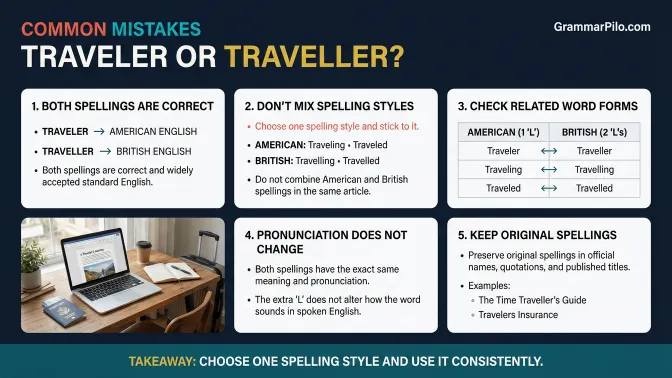
Although the difference is small, writers can make several avoidable mistakes when using these spellings.
Treating One Spelling as Completely Wrong
A common mistake is assuming that traveller is misspelled because it contains an extra l, or that traveler is incorrect because it contains only one.
Both forms are correct in their respective spelling systems. The mistake occurs when a writer uses a spelling that conflicts with the chosen regional convention.
Incorrect assumption: Traveller is always wrong.
Correct understanding: Traveller is standard in British English, while traveler is standard in American English.
Mixing American and British Spellings
Writers sometimes use traveler in one paragraph and traveller in another without a reason. This can make an article or report appear inconsistent.
For example, an article that uses traveling in one section and travelling in another should be reviewed unless the difference appears in a direct quotation or an official name.
Choose one spelling system and check related words throughout the document.
Forgetting Related Word Forms
The difference is not limited to traveler and traveller. The same regional pattern generally applies to traveled/travelled and traveling/travelling.
A writer might correctly use traveller but then write traveling in the same British English article. Although readers will understand the meaning, the mixed spelling is inconsistent.
Review the entire word family when editing.
Assuming Pronunciation Changes
The extra l does not create a different pronunciation. In ordinary usage, traveler and traveller are pronounced the same way.
Their meanings are also identical. The difference exists in written spelling rather than spoken English.
Changing Spelling Inside Official Names or Quotations
Sometimes a company, publication, book, or quotation uses a particular spelling. Preserve the original form when accuracy requires it, even if it differs from the spelling used in the rest of your writing.
For example, do not alter an official title simply to make it match your preferred spelling convention.
Traveler or Traveller in Everyday Examples
Seeing both forms in realistic sentences makes the regional distinction easier to remember.
In School Assignments
American English: The traveler kept a journal to record each day’s activities.
British English: The traveller kept a journal to record each day’s activities.
Students should follow the spelling convention their teacher or institution requires.
In Emails and Business Writing
American English: Please send the traveler’s itinerary before Friday.
British English: Please send the traveller’s itinerary before Friday.
Both sentences are grammatically correct. The spelling should match the intended regional style.
In Travel Blogs
American English: Every traveler should explore the local food and culture.
British English: Every traveller should explore the local food and culture.
Travel bloggers can use either spelling, but choosing one form helps maintain a consistent voice across articles.
In News and Magazine Writing
American English: The traveler was among the first passengers to arrive at the station.
British English: The traveller was among the first passengers to arrive at the station.
Newspapers and magazines usually follow an established editorial style, so writers should use the form required by their publication.
In Social Media Posts
American English: A happy traveler always brings home wonderful memories.
British English: A happy traveller always brings home wonderful memories.
Social media does not impose one universal spelling standard. Your choice can reflect your audience, location, or brand identity.
In Formal Reports
American English: The report examines the experiences of international travelers.
British English: The report examines the experiences of international travellers.
In formal writing, consistency matters more than choosing one spelling as universally superior.
Google Trends and Modern Usage
Google Trends can help writers explore how interest in different spellings changes by region and over time. However, search interest should be interpreted carefully.
Traveller vs. Traveler Search Interest
The two spellings are associated with different regional conventions. As a result, traveler may be more familiar to American users, while traveller is often preferred in British English and other regions that use similar spelling rules.
A Google Trends comparison can help investigate regional search patterns, but the results depend on the selected country, time period, search category, and search term settings.
It is important not to confuse relative search interest with exact search volume. Google Trends typically presents normalized interest rather than a direct count of every search made.
Which Spelling Do People Search For More?
There is no single worldwide result that should be treated as proof that one spelling is correct or universally more popular. The comparison can change depending on the location and period selected.
For example, a comparison limited to the United States may show a different pattern from one limited to the United Kingdom. A worldwide comparison can also combine users who follow different English spelling conventions.
For a useful investigation, compare the terms separately in the United States, the United Kingdom, Canada, and Australia, using the same time range and search settings.
Why Search Trends Matter for Writers
Search trends can help publishers understand regional vocabulary preferences and plan content for a particular audience. They should be used as supporting evidence rather than as a substitute for dictionaries, established spelling conventions, or editorial guidance.
For a spelling comparison article, the essential fact remains straightforward: traveler is standard American English, and traveller is standard British English.
Traveler and Traveller: Quick Comparison Table
The following table summarizes the main differences and similarities.
| Question | Traveler | Traveller |
| Is it a real English word? | Yes | Yes |
| Is it correct in American English? | Yes | Less common as the standard form |
| Is it correct in British English? | Less common as the standard form | Yes |
| Does the meaning change? | No | No |
| Does pronunciation change? | No | No |
| Does it refer to a person who travels? | Yes | Yes |
| Related past-tense spelling | Traveled | Travelled |
| Related -ing spelling | Traveling | Travelling |
| Best use | American English writing | British English writing |
The most important distinction is regional spelling, not meaning or grammar.
Frequently Asked Questions
1. Is Traveller or Traveler Correct?
Both spellings are correct. Traveler is the standard American English form, while traveller is the standard British English form.
2. Is Traveller British or American?
Traveller is primarily associated with British English. It is also widely used in Australian English and commonly appears in Canadian English.
3. Is Traveler American English?
Yes. Traveler is the standard spelling in American English. It follows the single-l pattern also found in traveled and traveling.
4. Why Does Traveller Have Two Ls?
British English generally doubles the final l in this word family when adding certain suffixes. This produces traveller, travelled, and travelling. American English usually uses one l in these forms.
5. Is Travelling or Traveling Correct?
Both are correct, depending on the spelling convention. Traveling is standard in American English, while travelling is standard in British English and many other varieties.
6. Do Traveler and Traveller Have Different Meanings?
No. Both words describe a person who travels. The spelling difference does not change the definition, pronunciation, or grammatical role.
7. Which Spelling Should I Use on My Website?
Use traveler if your website follows American English and traveller if it follows British English. For a global audience, choose one consistent spelling convention and follow it throughout your website.
Conclusion: Traveler or Traveller?
The choice between traveler and traveller comes down to regional spelling conventions. Both words refer to a person who travels, and neither spelling is universally incorrect.
Use traveler when writing in American English. It is the standard form used in American publications, educational materials, and professional communication. Use traveller when writing in British English, where the double l spelling is preferred. Australian English and many Canadian contexts also commonly use traveller.
Remember that the difference continues in related words. American English generally uses traveled and traveling, while British English generally uses travelled and travelling. Keeping these forms consistent helps your writing look polished and professional.
When comparing traveler or traveller, traveler vs. traveller, traveller or traveler, and traveller vs. traveler, the answer remains the same: both spellings are valid, but the appropriate choice depends on your intended audience.
Once you select a regional style, apply it consistently across your articles, emails, reports, and other written content.
Explore More Articles

I’m Claire Morgan, the author behind Grammarpilo.com, where I write about English grammar, sentence structure, punctuation, and everyday language. My goal is to make grammar simple, clear, and practical, helping readers understand the rules and apply them with confidence in real-world writing.







5 thoughts on “Traveler or Traveller: The US and UK Rule in Simple Words”