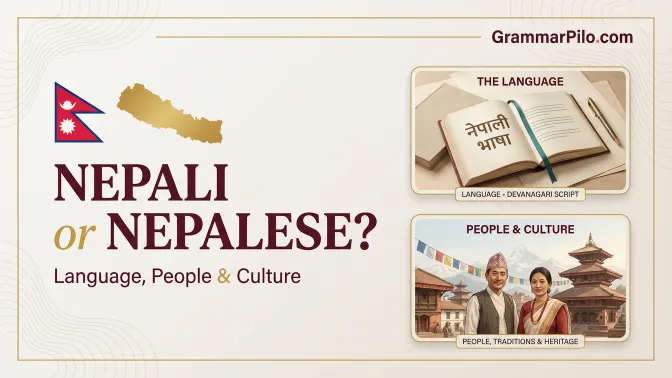
Nepali and Nepalese are both correct English words associated with Nepal, but they are used in slightly different ways.
Nepali is the standard name for the country’s official language and is also widely used as an adjective and a noun for people, culture, and things connected with Nepal. Nepalese is another accepted term, particularly when referring to people from Nepal or describing something related to the country.
The difference between Nepalese or Nepali can be confusing because both words appear in dictionaries, news articles, travel writing, and everyday conversations.
You might read about Nepali food, Nepalese people, Nepali literature, or Nepalese traditions. Although these expressions can overlap, Nepali is generally the more versatile and widely preferred form.
Understanding the distinction is useful for students, writers, travelers, journalists, and anyone discussing Nepal’s language, people, geography, and traditions.
In this guide, you will learn the meanings of both words, explore their origins, compare their usage in American and British English, and discover which term is most appropriate in different situations.
Quick Answer: Nepali or Nepalese?
Nepali is generally the preferred and more widely used term for the language, people, and culture of Nepal. Nepalese is also correct, especially when referring to people or things associated with the country.
Here is a simple breakdown:
- Nepali: The name of Nepal’s official language and a common adjective or noun for people and things connected with Nepal.
- Nepalese: An accepted term for a person from Nepal or something associated with the country.
- Nepal: The name of the country itself.
Examples:
- She speaks Nepali fluently.
- He is a Nepalese citizen.
- We enjoyed traditional Nepali food.
- The Nepalese community celebrated the festival.
Both Nepalese and Nepali are correct. However, Nepali is usually the more natural choice when discussing the language or describing cultural subjects.
What Does Nepali Mean?
Nepali refers to the official language of Nepal and is also used as an adjective or noun to describe people, culture, and things associated with the country.
The word is particularly common in education, language studies, cultural writing, news reporting, and everyday communication.
Nepali as a Language
Nepali is the official language of Nepal. It belongs to the Indo Aryan language family and is written using the Devanagari script.
Examples:
- Nepali is the official language of Nepal.
- My friend is learning Nepali.
- She can read and write in Nepali.
- The students studied Nepali literature at school.
- I would like to improve my Nepali vocabulary.
When referring to the language, Nepali is the standard and natural choice. Nepalese is not normally used as the language name.
Nepali as an Adjective
As an adjective, Nepali describes something connected with Nepal, including its culture, traditions, cuisine, music, and literature.
Examples:
- We tried traditional Nepali food.
- Nepali music has a rich cultural history.
- The museum displayed Nepali artwork.
- She enjoys reading Nepali poetry.
- They attended a Nepali cultural event.
In these sentences, Nepali describes the cultural or national connection of the subject.
Nepali as a Noun
Nepali can also refer to a person from Nepal or someone who belongs to the Nepali community.
Examples:
- He is Nepali.
- She is a Nepali living abroad.
- Many Nepalis work in different parts of the world.
- The event attracted Nepalis from several cities.
The plural form is generally Nepalis when referring to people.
What Does Nepalese Mean?
Nepalese is an accepted English term for a person from Nepal or something associated with the country. It is used as both a noun and an adjective.
Although it can overlap with Nepali, the word is especially familiar in expressions such as Nepalese people, Nepalese citizens, and the Nepalese community.
Nepalese as a Noun
As a noun, Nepalese refers to a person who comes from Nepal or is associated with the country.
Examples:
- She is a Nepalese living in London.
- The Nepalese community organized a cultural celebration.
- Many Nepalese work in international tourism.
- The conference welcomed several Nepalese delegates.
The word can refer to one person or be used collectively for people from Nepal. In many contexts, the plural is expressed as Nepalese people rather than adding another ending.
Nepalese as an Adjective
As an adjective, Nepalese describes something related to Nepal, its people, or its national identity.
Examples:
- The Nepalese government introduced a new policy.
- We learned about Nepalese history.
- The restaurant serves Nepalese dishes.
- Nepalese traditions are celebrated in different parts of the world.
- She attended a Nepalese cultural festival.
These expressions are grammatically correct, although many writers may prefer Nepali in similar contexts.
Is Nepalese a Language?
Nepalese is sometimes used informally to refer to the language spoken in Nepal, but Nepali is the standard name of the language.
For example:
- Preferred: She speaks Nepali.
- Less standard: She speaks Nepalese.
When discussing the language in educational, academic, or formal writing, use Nepali.
The Origin and History of Nepali and Nepalese
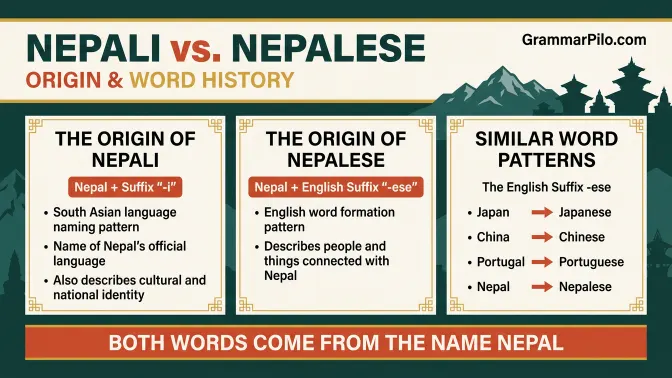
Both words are connected to the name Nepal, but they developed through different language patterns.
Where Does the Word Nepali Come From?
Nepali is derived from Nepal with the suffix -i, which is commonly used in South Asian language names and identity terms.
The word developed as a name for the language associated with Nepal and also became a term describing the country’s people and cultural identity.
Today, Nepali is widely used in language education, literature, cultural studies, and everyday communication. It is also the official language name used in Nepal.
Where Does the Word Nepalese Come From?
Nepalese is formed from the country name Nepal with the English suffix -ese. This suffix appears in several English words describing people, languages, or things associated with particular places.
Examples of similar formations include:
- Japanese, associated with Japan.
- Chinese, associated with China.
- Portuguese, associated with Portugal.
- Nepalese, associated with Nepal.
The word became established in English as a way to describe people and things connected with Nepal.
Why Do Both Words Exist?
English often develops more than one term for the same nationality or cultural identity. Some forms come from local language traditions, while others develop through English word building patterns.
Nepali and Nepalese are examples of this variation. Their meanings overlap, but their preferred uses are not always identical.
Nepali vs. Nepalese in American and British English
Both Nepali and Nepalese are accepted in American and British English. The main difference is how they are commonly used, not a regional spelling rule.
| Feature | Nepali | Nepalese |
| Refers to people from Nepal | Yes | Yes |
| Refers to Nepal’s official language | Yes, standard term | Not the standard term |
| Describes Nepalese culture | Yes | Yes |
| Used as a noun | Yes | Yes |
| Used as an adjective | Yes | Yes |
| Common in American English | Yes | Yes |
| Common in British English | Yes | Yes |
| Preferred for language studies | Yes | No |
| Common plural form for people | Nepalis | Nepalese people |
Is Nepali More Common in American English?
Yes, Nepali is widely used in American English, particularly when discussing the language, cultural identity, and people from Nepal.
Examples:
- Nepali restaurants are popular in several American cities.
- She is learning Nepali.
- The Nepali community organized a local event.
Nepalese is also understood and used, especially in references to people and national identity.
Is Nepalese More Common in British English?
Both terms appear in British English. Nepali is widely used for the language and cultural identity, while Nepalese remains familiar in descriptions of people, communities, and national affairs.
Examples:
- The Nepali language is taught at the university.
- The Nepalese community celebrated the festival.
- The documentary explored Nepali traditions.
There is no strict rule that British writers must use Nepalese while American writers must use Nepali. The choice depends on meaning, context, and editorial preference.
When Should You Use Nepali Instead of Nepalese?
Although both terms can describe people and cultural subjects, Nepali is usually the more versatile choice. Here is how to select the appropriate word.
Use Nepali for the Language
Choose Nepali when referring to the language spoken in Nepal.
Examples:
- I want to learn Nepali.
- Nepali is written in the Devanagari script.
- She teaches Nepali at a language school.
- The book contains several Nepali poems.
This is the most important distinction between the two words.
Use Nepali for Culture and Traditions
Nepali is a natural choice when describing cultural subjects.
Examples:
- Nepali cuisine includes many regional dishes.
- The festival celebrates Nepali traditions.
- We listened to Nepali folk music.
- The exhibition featured Nepali paintings.
Use Nepali for National Identity
You can use Nepali as a noun or adjective when describing someone from Nepal.
Examples:
- He is Nepali.
- She is a Nepali student.
- Many Nepalis live outside their home country.
Use Nepalese for People and Communities
Nepalese is also correct when referring to people from Nepal, particularly in formal or general descriptions.
Examples:
- The Nepalese community organized a gathering.
- Several Nepalese citizens attended the event.
- The organization supports Nepalese families abroad.
Use Nepalese for National or Country Related Descriptions
Nepalese can describe institutions, national affairs, or things connected with the country.
Examples:
- The Nepalese government announced a new program.
- The Nepalese economy has several important sectors.
- The museum displayed Nepalese historical objects.
However, Nepali would also be natural in many of these sentences.
Common Mistakes With Nepali and Nepalese
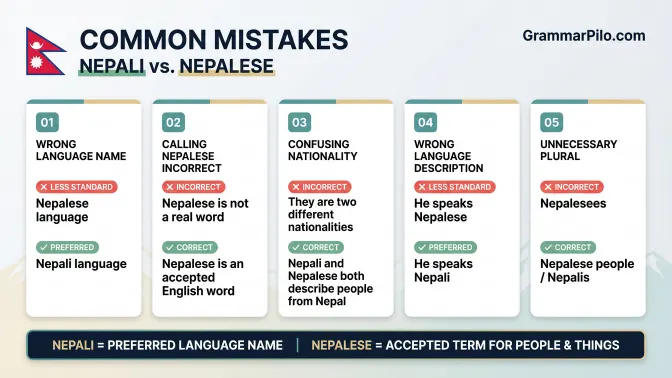
The two words have overlapping meanings, so it is easy to use them incorrectly in certain contexts. Understanding their preferred uses can help you avoid confusion.
Mistake 1: Calling the Language Nepalese
Less standard: She is learning the Nepalese language.
Preferred: She is learning the Nepali language.
Explanation: Nepali is the standard name of the official language of Nepal.
Mistake 2: Assuming Nepalese Is Incorrect
Incorrect claim: Nepalese is not a real English word.
Correct explanation: Nepalese is an accepted English word used for people and things associated with Nepal.
Example: The Nepalese community organized a cultural event.
Mistake 3: Treating Nepali and Nepalese as Two Different Nationalities
Incorrect: Nepali and Nepalese are people from two different countries.
Correct explanation: Both terms can refer to people from Nepal.
Example: She is Nepali, and her brother is Nepalese.
The sentence uses two accepted descriptions for people from the same country.
Mistake 4: Using Nepalese as the Preferred Language Name
Less standard: He speaks Nepalese fluently.
Preferred: He speaks Nepali fluently.
Explanation: Although readers may understand the intended meaning, Nepali is the established language name.
Mistake 5: Adding an Unnecessary Plural Ending
Incorrect: Nepalesees attended the event.
Correct: Nepalese people attended the event.
Correct: Many Nepalis attended the event.
Explanation: Nepalese does not normally take an additional plural ending. Use Nepalis when choosing the plural form of Nepali.
Nepali or Nepalese: Everyday Examples
The following examples demonstrate how both terms are used in common situations.
Examples of Nepali in Everyday English
- She speaks Nepali with her grandparents.
- I want to learn the Nepali language.
- We enjoyed traditional Nepali food.
- The students studied Nepali literature.
- He is a Nepali living in Canada.
- Many Nepalis celebrate Dashain.
- The documentary explored Nepali culture.
- She bought a book about Nepali history.
- The restaurant specializes in Nepali dishes.
- Nepali music was played during the celebration.
Examples of Nepalese in Everyday English
- The Nepalese community organized a cultural event.
- She is a Nepalese citizen.
- The documentary explored Nepalese traditions.
- We visited a restaurant serving Nepalese cuisine.
- Several Nepalese students attended the conference.
- The Nepalese government announced a new policy.
- He works with Nepalese families abroad.
- The museum displayed Nepalese artifacts.
- The festival attracted many Nepalese visitors.
- They read a book about Nepalese history.
Using Both Words in Everyday Examples
These examples show how the two terms can appear naturally in the same sentence.
- The Nepali language is an important part of Nepalese cultural identity.
- The Nepalese community organized an event featuring Nepali music.
- She is Nepali and teaches the language to Nepalese children.
- The documentary explored Nepali traditions and interviewed Nepalese families.
- Many Nepalis living abroad continue to celebrate Nepalese cultural festivals.
These examples demonstrate that the words can overlap without being identical in every context.
Google Trends and Modern Usage
People search for “Nepali or Nepalese,” “Nepalese vs. Nepali,” and “Nepali vs. Nepalese” because both words appear in English, but their preferred uses can be confusing.
Why Do People Search for Nepali or Nepalese?
Several reasons explain the interest in this comparison.
- Language questions: Students want to know the correct name for the language spoken in Nepal.
- Nationality descriptions: Writers may be unsure which term to use when describing people from Nepal.
- Cultural writing: Travel writers and journalists encounter both expressions in articles about food, traditions, and festivals.
- Academic work: Students need consistent terminology for research papers and educational materials.
- Everyday communication: English learners want to understand the difference between two accepted terms.
Which Word Is More Common?
Nepali is widely used for the language and is also common in discussions of people and culture. Nepalese remains established in English, especially in expressions describing citizens, communities, and national subjects.
Their frequency can vary by region, publication, and topic. Google Trends can help compare search interest for both terms over a selected period, but search interest does not directly measure their frequency in everyday speech or published writing.
Without a verified comparison for a specific location and date range, exact search popularity figures should not be assumed.
For general writing, Nepali is a flexible choice. Use Nepalese when it sounds natural in the context or matches the terminology of your source.
Nepali vs. Nepalese: Key Differences at a Glance
| Comparison | Nepali | Nepalese |
| Basic meaning | Related to Nepal; also the country’s official language | Related to Nepal or a person from Nepal |
| Language name | Standard | Not standard |
| Nationality description | Yes | Yes |
| Cultural description | Yes | Yes |
| Part of speech | Noun and adjective | Noun and adjective |
| Plural for people | Nepalis | Usually Nepalese people |
| Common example | Nepali language | Nepalese community |
| American English | Accepted | Accepted |
| British English | Accepted | Accepted |
The main distinction is simple: Nepali is the standard language name and a versatile term for people and culture, while Nepalese is another accepted term for people and things connected with Nepal.
Frequently Asked Questions
1. Is It Nepali or Nepalese?
Both are correct English words associated with Nepal. Nepali is the standard name of the country’s official language and is widely used for people and cultural subjects. Nepalese is also accepted, particularly for people and things connected with Nepal.
2. Is Nepali or Nepalese the Correct Language Name?
Nepali is the correct and standard name of the official language of Nepal. Although some people informally say Nepalese, Nepali is preferred in educational, academic, and formal writing.
3. Are Nepali and Nepalese the Same?
They have overlapping meanings, but they are not interchangeable in every situation. Both can describe people or cultural subjects associated with Nepal, but Nepali is the standard language name.
4. Should I Say Nepali People or Nepalese People?
Both expressions are correct. Nepali people and Nepalese people can refer to people from Nepal. Choose the form that best matches your writing style and use it consistently.
5. Is Nepalese a Correct English Word?
Yes. Nepalese is an accepted English noun and adjective. It can describe a person from Nepal, a community, or something associated with the country.
6. What Is the Plural of Nepali?
The plural form is generally Nepalis when referring to people.
Example: Many Nepalis live and work abroad.
7. What Is the Plural of Nepalese?
Nepalese can refer to one person or people collectively. For clarity, writers often use Nepalese people when referring to multiple individuals.
Example: Nepalese people participated in the cultural celebration.
8. Is Nepali Used in American English?
Yes. Nepali is widely used in American English for the language, people, and cultural subjects associated with Nepal. Nepalese is also accepted.
9. Is Nepalese Used in British English?
Yes. Nepalese is used in British English, particularly when describing people and communities from Nepal. Nepali is also common, especially as the language name.
10. Which Word Should I Use in Formal Writing?
Use Nepali when referring to the language. For people and cultural subjects, either Nepali or Nepalese can work. Follow the terminology used by your organization or publication and remain consistent.
Conclusion: Choosing Between Nepali and Nepalese
The difference between Nepali and Nepalese is mainly about usage rather than correctness. Both words are accepted English terms connected with Nepal, but they have slightly different preferences.
Nepali is the standard name of Nepal’s official language and is widely used to describe the country’s people, culture, food, and traditions. Nepalese is also correct and commonly refers to people, communities, and things associated with Nepal.
For language related writing, always choose Nepali. When discussing nationality, both Nepali and Nepalese are appropriate. For example, you can write “She is Nepali” or “She is a Nepalese citizen.” Both sentences communicate the same national connection.
In everyday communication, Nepali is generally the more versatile choice, while Nepalese remains a natural alternative in many contexts. The most important thing is to understand the meaning of each word and use it consistently.
Remember this simple rule: Nepali is the standard language name, while both Nepali and Nepalese can describe people and cultural subjects connected with Nepal.
Explore More Articles

I’m Sloane Mercer, a U.S.-based English language writer focused on grammar, spelling, vocabulary, and everyday English usage. Through GrammarPilo, I provide clear and practical explanations to help readers choose the right words and communicate with confidence.