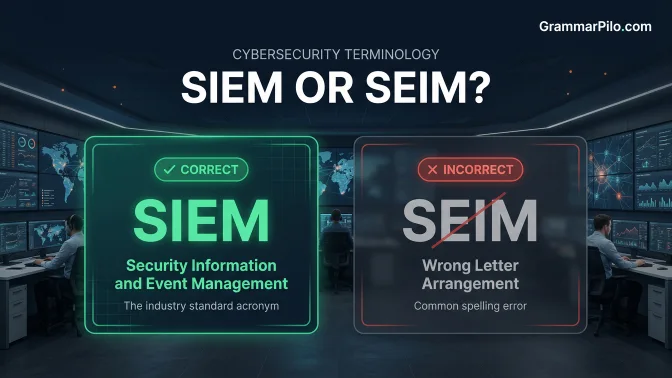
Are you searching for SIEM or SEIM? SIEM is the correct and widely accepted spelling in cybersecurity. It stands for Security Information and Event Management, a technology used by organizations to collect, analyze, and monitor security data from different systems.
SEIM is generally a misspelling or letter order mistake when referring to this cybersecurity term.Although SEIM and SIEM look almost identical, only one is the established industry abbreviation.
Understanding the correct spelling is important when researching cybersecurity tools, writing technical documents, discussing security operations, or comparing software platforms.
SIEM technology helps security teams identify suspicious activity, investigate potential threats, and respond to security incidents.
It brings together information from servers, applications, networks, endpoints, and other sources to provide a clearer picture of an organization’s security environment.
In this guide, we explain SEIM vs. SIEM, explore the meaning and origin of the abbreviation, discuss how SIEM software works, and highlight common spelling mistakes. You will also find practical examples and answers to frequently asked questions.
SIEM or SEIM: Quick Answer
SIEM is the correct spelling when referring to Security Information and Event Management. SEIM is not the standard abbreviation used by the cybersecurity industry.
| Term | Correctness | Meaning |
| SIEM | Correct | Security Information and Event Management |
| SEIM | Incorrect in this context | Common letter order mistake |
The abbreviation SIEM combines two important cybersecurity concepts:
- Security Information Management (SIM): Collecting, storing, and analyzing security related information.
- Security Event Management (SEM): Monitoring and responding to security events in real time.
Together, these functions help organizations monitor their IT environments and identify potential security threats.
Remember: Write SIEM, not SEIM, when discussing cybersecurity software, security monitoring, or threat detection.
What Does SIEM Mean?
SIEM stands for Security Information and Event Management. It refers to a cybersecurity technology that collects and analyzes security related information from different sources across an organization’s IT infrastructure.
Instead of examining each system separately, security teams can use SIEM software to bring relevant data into one centralized platform.
For example, a company may have hundreds of computers, servers, cloud applications, network devices, and user accounts. Each system can generate activity records, commonly called logs.
A SIEM platform collects these logs, analyzes them, and looks for unusual patterns that may indicate a security problem.
Main Functions of SIEM
SIEM technology supports several important cybersecurity activities.
1. Log Collection
It gathers activity records from different systems, including servers, firewalls, applications, and endpoints.
2. Event Correlation
It connects related events from different sources to identify patterns that might otherwise go unnoticed.
3. Threat Detection
It helps identify suspicious behavior, unusual login attempts, malware activity, and other potential security threats.
4. Security Alerts
It generates alerts when monitored activity matches predefined rules or suspicious behavior patterns.
5. Incident Investigation
It provides security teams with information that helps them understand what happened, when it happened, and which systems may be affected.
6. Compliance Reporting
It can support auditing and regulatory requirements by organizing security records and generating reports.
What Does SEIM Mean?
SEIM is generally an incorrect spelling of SIEM when referring to Security Information and Event Management.
The mistake happens because people sometimes rearrange the letters while typing, remembering, or searching for the cybersecurity term.
For example:
- Incorrect: Our company uses SEIM software to monitor network activity.
- Correct: Our company uses SIEM software to monitor network activity.
The correct abbreviation follows the established order of the words in Security Information and Event Management.
Why Do People Write SEIM Instead of SIEM?
Several reasons explain this common mistake.
- Letter confusion: The letters I and E can easily be switched when typing an unfamiliar abbreviation.
- Unfamiliar terminology: People who are new to cybersecurity may not know the correct sequence.
- Search mistakes: Users may enter SEIM when looking for SIEM platforms or security tools.
- Memory errors: The abbreviation contains four letters, making it easy to remember them in the wrong order.
Although SEIM may appear in informal writing or search queries, SIEM is the recognized industry term.
SIEM vs. SEIM: Origin and Development
The term SIEM emerged from the combination of two established cybersecurity concepts: Security Information Management and Security Event Management.
Understanding these earlier technologies helps explain why the abbreviation is written as SIEM.
Security Information Management (SIM)
SIM focuses on collecting, storing, and analyzing security related information.
Organizations use it to maintain records of system activity, support investigations, and review security events over time.
Its functions include:
- Centralized log storage
- Security data management
- Historical event analysis
- Compliance reporting
- Security record retention
Security Event Management (SEM)
SEM focuses more directly on monitoring security events and identifying potential threats.
Its purpose is to help security teams recognize suspicious activity and respond to incidents.
Common functions include:
- Real time event monitoring
- Security alert generation
- Event correlation
- Threat identification
- Incident response support
How SIEM Combined Both Concepts
SIEM brought together the information management capabilities of SIM and the event monitoring capabilities of SEM.
This combination allows security teams to collect large amounts of data, analyze events, recognize suspicious patterns, and investigate possible attacks through a centralized platform.
The technology has continued to evolve with cloud computing, automation, behavioral analytics, and artificial intelligence.
How Does SIEM Software Work?
SIEM software works by collecting security data from different parts of an organization’s IT environment and analyzing it for suspicious activity.
Although individual products have different features, most SIEM platforms follow a similar process.
1. Data Collection
The platform gathers logs and event information from sources such as:
- Firewalls
- Servers
- Computers and laptops
- Cloud services
- Business applications
- Network devices
- Identity and access management systems
2. Data Normalization
Information from different systems may use different formats.
SIEM software organizes and standardizes the collected data so that events from multiple sources can be analyzed together.
3. Event Correlation
The platform examines relationships between different events.
For example, several failed login attempts followed by a successful login from an unusual location may deserve investigation.
Looking at each event separately might not reveal the same level of concern.
4. Threat Detection
SIEM tools use detection rules, analytics, and other techniques to identify suspicious patterns.
Some platforms also use machine learning or behavioral analytics to identify activity that differs from normal user or system behavior.
5. Alerts and Investigation
When the platform identifies potentially dangerous activity, it can generate an alert for the security team.
Analysts can review the related events, investigate the activity, and decide if further action is necessary.
6. Reporting and Response
SIEM platforms can support incident reporting, compliance reviews, and security investigations.
Some products also integrate with security orchestration and automation tools to help automate selected response actions.
SIEM vs. SEIM: Common Examples and Usage
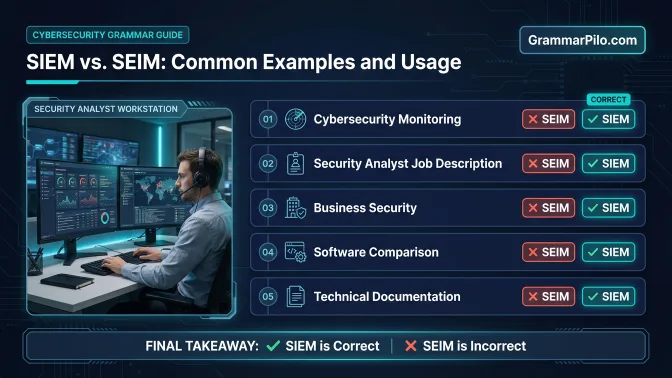
Using the correct abbreviation is particularly important in professional cybersecurity communication.
Here are examples showing how to use SIEM correctly.
Example 1: Cybersecurity Monitoring
Incorrect: The IT department installed a SEIM system to monitor network traffic.
Correct: The IT department installed a SIEM system to monitor network traffic.
Example 2: Security Analyst Job Description
Incorrect: Experience with SEIM platforms is required for this position.
Correct: Experience with SIEM platforms is required for this position.
Example 3: Business Security
Incorrect: Our organization uses SEIM technology to detect suspicious activity.
Correct: Our organization uses SIEM technology to detect suspicious activity.
Example 4: Software Comparison
Incorrect: We are comparing different SEIM solutions for enterprise security.
Correct: We are comparing different SIEM solutions for enterprise security.
Example 5: Technical Documentation
Incorrect: The SEIM platform collects logs from multiple servers.
Correct: The SIEM platform collects logs from multiple servers.
These examples demonstrate that SIEM should be used consistently in cybersecurity writing.
Popular SIEM Tools and Platforms
Several technology companies offer SIEM products designed for different organizational needs.
Here are some widely recognized examples.
1. Microsoft Sentinel
Microsoft Sentinel is a cloud native security information and event management platform. It helps organizations collect security data, detect threats, investigate incidents, and automate selected responses.
2. Splunk Enterprise Security
Splunk Enterprise Security provides security monitoring, analytics, investigation, and threat detection capabilities. It is designed to help security teams analyze information from different sources.
3. IBM QRadar
IBM QRadar is a security intelligence platform that helps organizations monitor events, analyze network activity, and investigate potential threats.
4. Google Security Operations
Google Security Operations provides security analytics, threat detection, investigation, and response capabilities. It is designed to help security teams manage information from complex IT environments.
5. Securonix
Securonix offers security analytics and threat detection capabilities, including user and entity behavior analytics.
These platforms differ in deployment options, integrations, pricing structures, and technical capabilities. Organizations should evaluate their security requirements before choosing a solution.
SIEM or SEIM: Which One Should You Use?
Use SIEM whenever you are discussing Security Information and Event Management.
The correct abbreviation applies to:
- Cybersecurity articles
- Technical documentation
- Security analyst job descriptions
- Enterprise software comparisons
- Network monitoring discussions
- Security operations center (SOC) procedures
- IT and cybersecurity training materials
Avoid using SEIM as an alternative spelling in this context because it is not the recognized industry abbreviation.
If you are writing for a general audience, introduce the complete term before using the abbreviation.
For example:
Security Information and Event Management (SIEM) helps organizations monitor security activity and identify potential threats.
After introducing the term, you can use SIEM throughout the rest of the document.
Common Mistakes With SIEM and SEIM
Because the two abbreviations contain the same letters, it is easy to mix them up. These mistakes can appear in technical articles, professional emails, presentations, and online searches.
Mistake 1: Reversing the Middle Letters
Incorrect: SEIM software helps organizations monitor security events.
Correct: SIEM software helps organizations monitor security events.
The letters I and E appear in the wrong order in the incorrect version.
Mistake 2: Using Both Spellings in the Same Document
Incorrect: Our company uses SIEM software. The SEIM platform generates security alerts.
Correct: Our company uses SIEM software. The SIEM platform generates security alerts.
Consistency is important in technical writing.
Mistake 3: Writing the Wrong Abbreviation in a Job Application
Incorrect: I have experience working with SEIM tools and security monitoring systems.
Correct: I have experience working with SIEM tools and security monitoring systems.
Using the established terminology makes a professional application clearer.
Mistake 4: Confusing SIEM With a Single Security Tool
SIEM is not the name of one particular software product. It is a category of cybersecurity technology.
Incorrect: SIEM is the name of Microsoft’s security monitoring software.
Correct: Microsoft Sentinel is a SIEM platform.
This distinction helps prevent confusion when comparing different cybersecurity products.
Frequently Asked Questions
1. Is It SEIM or SIEM?
SIEM is correct when referring to Security Information and Event Management. SEIM is a common spelling mistake and is not the standard cybersecurity abbreviation.
2. What Does SIEM Stand For?
SIEM stands for Security Information and Event Management. It describes technology that collects, analyzes, and monitors security information from different systems.
3. Is SEIM a Real Cybersecurity Term?
SEIM is not the standard abbreviation for Security Information and Event Management. It may appear as a typing mistake or in unrelated contexts, but cybersecurity professionals generally use SIEM.
4. What Is the Difference Between SIEM and SOC?
SIEM is a technology used to collect and analyze security information. A Security Operations Center (SOC) is a team or organizational function responsible for monitoring, investigating, and responding to cybersecurity threats. A SOC may use SIEM software as part of its operations.
5. Is SIEM the Same as SOAR?
No. SIEM focuses on collecting and analyzing security information to identify threats. Security Orchestration, Automation, and Response (SOAR) focuses on coordinating security tools and automating response workflows. Some security platforms combine capabilities from both categories.
6. What Are Examples of SIEM Software?
Popular SIEM platforms include Microsoft Sentinel, Splunk Enterprise Security, IBM QRadar, Google Security Operations, and Securonix.
7. Why Is SIEM Important in Cybersecurity?
SIEM helps organizations monitor activity across their IT environments, identify suspicious patterns, investigate security incidents, and support compliance reporting. It gives security teams a centralized view of relevant security information.
Conclusion
When comparing SIEM or SEIM, SIEM is the correct spelling for the cybersecurity abbreviation Security Information and Event Management. It describes technology that helps organizations collect security logs, monitor events, identify suspicious activity, and investigate potential threats.
SEIM is generally a letter order mistake rather than an accepted alternative in this industry. The correct abbreviation combines Security Information Management and Security Event Management into one term.
Remember to use SIEM in cybersecurity articles, professional documents, software comparisons, job applications, and technical discussions.
If you are introducing the abbreviation for the first time, write its full meaning as Security Information and Event Management (SIEM). This simple approach keeps your writing accurate, clear, and consistent.
Discover More Differences

I’m Sloane Mercer, a U.S.-based English language writer focused on grammar, spelling, vocabulary, and everyday English usage. Through GrammarPilo, I provide clear and practical explanations to help readers choose the right words and communicate with confidence.






2 thoughts on “SIEM or SEIM: Which Spelling Is Correct in Cybersecurity?”