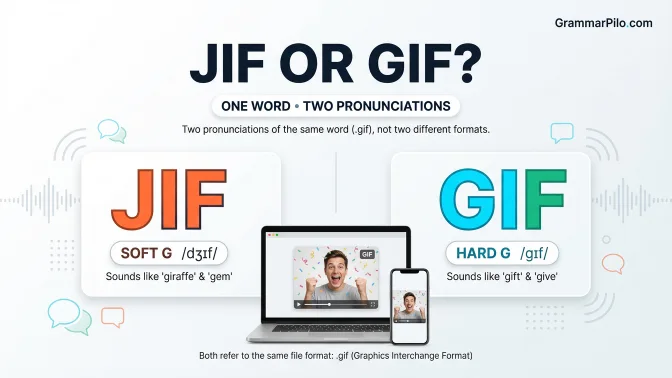
The word GIF can be pronounced in two accepted ways: “JIF,” with a soft G, or “GIF,” with a hard G. Both pronunciations refer to the same digital image format, so neither changes its spelling or meaning.
The debate has continued for years because the format’s creator preferred the soft G, while many English speakers use the hard G.
People search for Gif or Jif because they want to know which pronunciation is correct, how the word should sound in conversation, and why people disagree about it.
The confusion also comes from the word’s full name, Graphics Interchange Format, which begins with a hard G sound. However, the creator, Steve Wilhite, intended the name to sound like the peanut butter brand Jif.
Today, both pronunciations are widely recognized. Major dictionaries have accepted both forms, and people use them in everyday speech, online conversations, and professional settings.
This guide explains the difference, the history behind the debate, and which pronunciation you can confidently use.
Jif or Gif: Quick Answer
Both GIF and JIF are accepted pronunciations of the same word. The difference is the sound of the first letter.
- JIF: Pronounced with a soft G, like the J in jam or jelly.
- GIF: Pronounced with a hard G, like the G in gift or game.
The word is always spelled GIF. Jif is a way of showing how some people say it, not a different spelling of the file format.
| Form | Pronunciation | Similar Sound |
| GIF (soft G) | JIF | Jam, jelly, giant |
| GIF (hard G) | GIF | Gift, game, garden |
Quick rule: Use GIF when writing about the image format. You can pronounce it with either a soft or hard G.
Definition and Meaning of Jif or Gif
What Does GIF Mean?
GIF stands for Graphics Interchange Format. It is a digital image format used to display pictures and short animations.
GIF files are popular because they can show simple moving images without requiring a video player. People often use them to express emotions, reactions, jokes, and ideas online.
For example, someone might send a GIF of a person laughing to show that a message is funny.
What Does JIF Mean?
Jif is the pronunciation of GIF with a soft G. It sounds like the name of the popular Jif peanut butter brand.
In this context, JIF does not represent a separate file type. It simply describes one way to say the letters in GIF.
What Is the Difference Between the Two?
The difference is pronunciation, not meaning.
- Soft G: The first sound is like the J in jump.
- Hard G: The first sound is like the G in go.
Both forms refer to the same image format. A GIF pronounced as JIF is still a GIF file.
How Is GIF Used Today?
GIF is common in digital communication. It appears in:
- Text messages
- Social media posts
- Online comments
- Messaging apps
- Websites and blogs
- Digital presentations
- Marketing content
The word can also be used as a verb. For example, someone might say, “I GIFed that moment” to mean they turned it into a GIF.
The Origin of Jif or Gif
The history of GIF explains why the pronunciation debate began.
When Was GIF Created?
The Graphics Interchange Format was developed in 1987 by a team at CompuServe, an early online service provider. Computer scientist Steve Wilhite led the development.
The format helped people share images online when internet connections were much slower than they are today.
GIF became popular because it could store images efficiently and support simple animations. Over time, it became a common part of internet culture.
Why Did the Creator Choose JIF?
Steve Wilhite intended GIF to be pronounced with a soft G, like the word JIF.
The pronunciation was reportedly inspired by the Jif peanut butter brand. The CompuServe team even used the playful phrase “Choosy developers choose GIF,” based on the brand’s advertising slogan.
Wilhite later repeated his preference at the 2013 Webby Awards. His acceptance message famously stated that it was pronounced JIF, not GIF.
However, his preferred pronunciation did not end the debate. Many speakers continued to use the hard G sound.
Why Did the Hard G Become Popular?
The hard G pronunciation makes sense to many English speakers because GIF begins with the word Graphics.
People often expect the first letter of an abbreviation to keep the sound of the original word. Since Graphics starts with a hard G, they naturally pronounce GIF the same way.
This is a common reason for the disagreement. One group follows the creator’s intended pronunciation, while another follows the sound of the word from which the abbreviation comes.
Do Dictionaries Accept Both Pronunciations?
Yes. Major dictionaries have recognized both pronunciations.
The Oxford English Dictionary and other reference sources have included the soft G and hard G forms. This reflects how people actually use the word in English.
The creator’s preference is important to the history of GIF, but common usage also plays a role in how English words are accepted.
British English vs. American English Pronunciation
Unlike words such as color and colour, GIF does not have separate British and American spellings.
The spelling remains GIF in both varieties of English. The difference is how individual speakers pronounce it.
Is GIF Pronounced Differently in the US and UK?
Both pronunciations can be heard in the United States and the United Kingdom.
Some American speakers prefer the hard G, while others use the soft G. The same variation exists among British speakers.
There is no fixed national rule that requires Americans to say one version and British speakers to say the other.
British English vs. American English Comparison
| Feature | American English | British English |
| Correct spelling | GIF | GIF |
| Soft G pronunciation | Accepted | Accepted |
| Hard G pronunciation | Accepted | Accepted |
| Separate regional spelling | No | No |
| Formal writing | GIF | GIF |
Examples in Both Varieties
American English:
- I found a funny GIF online.
- Send me that GIF again.
- The GIF makes the conversation more interesting.
British English:
- I found a funny GIF online.
- Can you share that GIF?
- This GIF is perfect for the group chat.
The spelling and meaning remain the same in both examples.
Which Pronunciation Should You Use?
You can use either pronunciation because both are understood and accepted. Your choice may depend on personal preference, audience, and the way people around you speak.
For American English Speakers
Both forms are common in American English.
The hard G is easy to connect with the word Graphics, while the soft G follows the creator’s original preference.
If you are speaking with friends or colleagues, either pronunciation is fine.
For British English Speakers
British English also accepts both pronunciations.
You do not need to change the spelling or pronunciation when writing for a British audience. Simply write GIF and use the pronunciation that feels natural.
For International English Speakers
For international communication, clarity matters more than choosing one side of the debate.
People around the world recognize GIF as the name of a digital image format. If someone uses the other pronunciation, the meaning is usually clear from the context.
For Professional and Technical Writing
Always write the abbreviation as GIF.
In technical documents, presentations, emails, and reports, the written form is more important than the pronunciation.
For example:
- Correct: The website supports animated GIF files.
- Correct: Please insert a GIF into the presentation.
- Correct: The designer created a GIF for the campaign.
There is no need to write JIF in professional documents to show the soft G pronunciation.
Common Mistakes With Jif and Gif
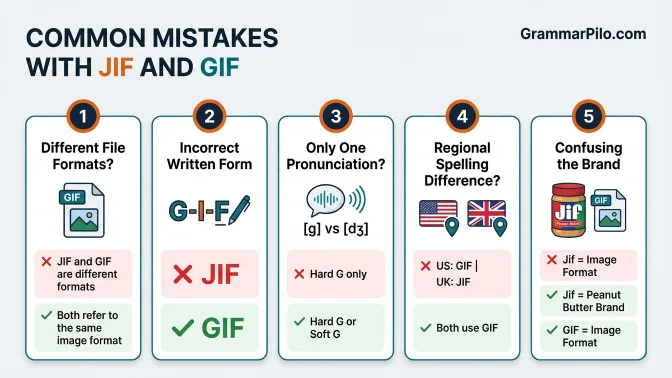
The debate often leads to confusion about spelling, meaning, and pronunciation. Here are some common mistakes and their corrections.
Mistake 1: Thinking JIF Is a Different File Format
Incorrect: JIF and GIF are two different image formats.
Correct: JIF is one way to pronounce GIF. Both refer to the same image format.
Mistake 2: Writing JIF Instead of GIF
Incorrect: Please send me the JIF file.
Correct: Please send me the GIF file.
When referring to the digital image format, always use GIF as the written spelling.
Mistake 3: Claiming Only One Pronunciation Is Accepted
Incorrect: GIF must always be pronounced with a hard G.
Correct: GIF can be pronounced with either a hard or soft G.
Both pronunciations are recognized in English.
Mistake 4: Assuming British and American English Use Different Spellings
Incorrect: Americans write GIF, but British speakers write JIF.
Correct: Both American and British English use the spelling GIF.
There is no regional spelling difference.
Mistake 5: Confusing the Peanut Butter Brand With the Image Format
Incorrect: The GIF file is named after the Jif brand, so both words mean the same thing.
Correct: Jif is a peanut butter brand, while GIF is a digital image format. Their names are connected through the pronunciation debate, but they are different things.
Jif or Gif in Everyday Examples
GIF is used in many types of communication. The pronunciation does not change its spelling or meaning.
Here are practical examples from everyday situations.
1. Text Messages
Example: I sent you a funny GIF last night.
The sentence refers to an animated image shared through a message.
2. Social Media
Example: This GIF perfectly describes how I feel today.
People often add GIFs to comments, posts, and replies to express emotions.
3. Emails
Example: Please include the animated GIF in the email campaign.
This is a common way to refer to an image used in digital marketing.
4. News Articles
Example: The viral GIF quickly spread across social media platforms.
News writers use GIF when discussing popular online images and internet trends.
5. Formal Writing
Example: The presentation includes several GIF files to demonstrate the process.
In formal writing, GIF is the correct written form. The pronunciation does not need to be explained unless it is relevant to the discussion.
6. Everyday Conversation
Example: Do you say GIF with a hard G or a soft G?
This sentence directly introduces the pronunciation debate.
Gif vs. Jif: Google Trends and Usage Data
The Jif or Gif debate has remained popular because GIFs are part of everyday internet communication.
People search for the two forms for different reasons. Some want to settle an argument, while others are curious about the creator’s intended pronunciation.
Why Do People Search for GIF Pronunciation?
Common search interests include:
- How to pronounce GIF
- Is it pronounced JIF or GIF?
- Hard G or soft G?
- What does GIF stand for?
- Who invented GIF?
- Why is GIF pronounced JIF?
These searches show that people are interested in both the meaning of the abbreviation and the way it should sound.
Popularity in Different Countries
The debate is not limited to one country.
People in the United States, United Kingdom, Canada, Australia, and other English speaking regions use GIF in digital communication.
However, pronunciation preferences can vary between individuals and communities. There is no reliable universal rule that assigns the soft G to one country and the hard G to another.
What Does Google Trends Show?
Google Trends can help explore interest in searches such as “GIF pronunciation,” “JIF or GIF,” and “how to pronounce GIF.”
However, search interest is not the same as a pronunciation survey. It cannot prove how most people in a country actually say the word.
Interest may rise when the debate appears in news stories, social media discussions, or popular online content.
For this reason, it is better to use Google Trends to understand search interest over time rather than claim that it establishes one pronunciation as correct.
Why Does the Debate Continue?
GIF is used by millions of people in online communication. Its frequent use keeps the pronunciation question alive.
The creator’s preference supports the soft G, while the word Graphics gives many speakers a reason to choose the hard G.
Both forms remain recognizable, so the debate is unlikely to disappear completely.
Jif vs. Gif: Comparison Table
The following table summarizes the main differences and similarities.
| Comparison | JIF | GIF |
| Meaning | Soft G pronunciation | Name and spelling of the image format |
| Sound | Like J in jam | Like G in gift |
| Written form for the format | Not standard | GIF |
| Refers to an animated image | Yes, when used as pronunciation | Yes |
| British English spelling | GIF | GIF |
| American English spelling | GIF | GIF |
| Accepted pronunciation | Yes | Yes |
| Creator’s preference | Yes | Not his preferred pronunciation |
Important: JIF and GIF are not two competing spellings. GIF is the written abbreviation, and JIF describes one accepted way to pronounce it.
Frequently Asked Questions
1. Is It Pronounced JIF or GIF?
Both pronunciations are accepted. JIF uses a soft G, like the J in jam, while GIF uses a hard G, like the G in gift. Both refer to the same image format.
2. Which Pronunciation Did the Creator Prefer?
Steve Wilhite, the creator of the Graphics Interchange Format, preferred the soft G pronunciation, which sounds like JIF. He publicly repeated this preference at the 2013 Webby Awards.
3. Why Do Some People Say GIF With a Hard G?
Many people pronounce GIF with a hard G because the abbreviation comes from Graphics Interchange Format. Since Graphics begins with a hard G, they naturally use the same sound.
4. Is JIF the Correct Spelling?
No. GIF is the correct spelling of the digital image format. JIF is a pronunciation guide for the soft G sound, not an alternative spelling.
5. Do British People Say JIF or GIF?
British speakers use both pronunciations. There is no fixed British English rule that requires one form over the other.
6. Is GIF an Acronym or an Initialism?
GIF is commonly treated as an acronym because people pronounce it as a single word rather than saying each letter separately. Its full form is Graphics Interchange Format.
7. Can I Use Either Pronunciation in Professional Conversations?
Yes. Both pronunciations are widely recognized. In professional writing, use the spelling GIF. In conversation, either pronunciation is acceptable.
Conclusion
The Jif or Gif debate is about pronunciation, not spelling. GIF is the correct written form of Graphics Interchange Format, a popular digital image format used for pictures and short animations. People pronounce it in two ways: with a soft G, like JIF, or with a hard G, like gift.
Steve Wilhite, who helped create the format, preferred the soft G pronunciation. However, many English speakers use the hard G because the abbreviation comes from the word Graphics. Major dictionaries recognize both pronunciations, and neither changes the meaning of the word.
For American, British, and international audiences, the spelling remains GIF. You can choose either pronunciation in everyday conversation without worrying about making a language mistake. In emails, articles, presentations, and technical documents, always write GIF rather than JIF.
The simplest way to remember the difference is this: GIF is how you write it, while JIF and GIF are two accepted ways to say it.
Discover More Differences

I’m Claire Morgan, the author behind Grammarpilo.com, where I write about English grammar, sentence structure, punctuation, and everyday language. My goal is to make grammar simple, clear, and practical, helping readers understand the rules and apply them with confidence in real-world writing.