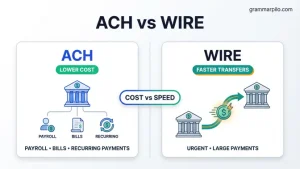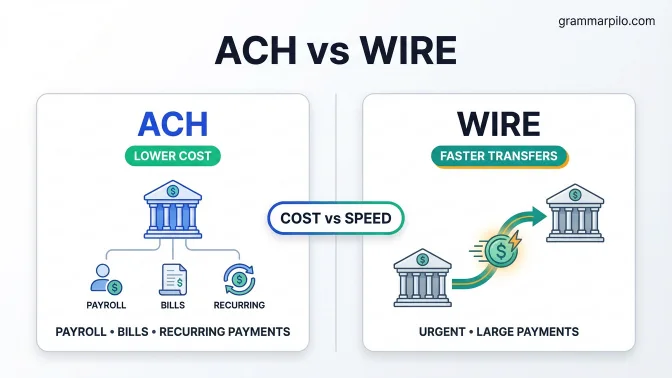
ACH and wire transfers are two common ways to move money between bank accounts in the United States, but they work differently. ACH is usually cheaper and better for routine payments, while a wire transfer is often faster and more suitable for urgent or high value transactions.
People search for ACH or wire when they need to pay a bill, send money to another person, receive business payments, or transfer funds for a major purchase.
The confusion often comes from the fact that both methods move money electronically, yet they differ in processing speed, fees, payment rules, and how easily a transaction can be corrected.
Choosing the wrong method can lead to unnecessary fees or delays. For example, a regular rent payment may work well through ACH, while a time sensitive real estate payment may require a wire.
This guide explains how both methods work, compares their costs and risks, and helps you choose the right option for your situation.
ACH or Wire: Quick Answer
Wire and ACH transfers both move money electronically between bank accounts. ACH payments travel through a network that processes transactions in batches and are generally less expensive.
Wire transfers move funds directly between participating financial institutions and are often faster, but usually cost more. Choose ACH for routine payments and wire transfers for urgent transactions when speed and payment finality matter.
The main difference between Wire and ACH transfers is how banks process the payments.
ACH (Automated Clearing House) is an electronic payment network commonly used for direct deposits, bill payments, recurring transfers, and business payments.
Wire transfer is a method of sending money directly between financial institutions through a wire network. Domestic US wires are commonly used for urgent payments and large transactions.
Here is a simple comparison:
- ACH: Usually lower cost, suitable for recurring payments, and may take one or more business days.
- Wire: Often faster, usually more expensive, and commonly used for urgent or high value payments.
- ACH credit: Pushes money into another account, such as an employer paying an employee.
- ACH debit: Pulls money from an account with authorization, such as a company collecting a bill.
- Wire transfer: Generally initiated by the sender to push funds to the recipient.
For example, an employer may use ACH to pay salaries, a customer may use ACH to pay a monthly bill, and a homebuyer may use a domestic wire to send closing funds.
What Does ACH or Wire Mean?
ACH and wire transfers are different electronic payment methods. Understanding their definitions makes it easier to choose the right one.
What Is an ACH Transfer?
ACH stands for Automated Clearing House. It is a US electronic payment network that allows banks and credit unions to exchange payment instructions and move money between accounts.
ACH payments can be credits or debits.
ACH credit: The sender’s bank sends money to the recipient’s bank. Direct deposit is a common example.
ACH debit: A company or authorized party requests money from the sender’s account. Monthly utility payments and subscription charges often use this method.
Common ACH uses include:
- Employee salary deposits
- Government benefit payments
- Tax refunds
- Mortgage and rent payments
- Utility bills
- Subscription payments
- Transfers between personal bank accounts
- Business to business payments
ACH is especially useful when payments are regular, predictable, and do not require immediate settlement.
What Is a Wire Transfer?
A wire transfer is an electronic movement of money between financial institutions. In the United States, domestic wires commonly use networks such as Fedwire and the Clearing House Interbank Payments System (CHIPS).
Unlike ACH, which processes payments in batches, the Fedwire Funds Service processes qualifying payment orders individually in real time.
Wire transfers are commonly used for:
- Real estate transactions
- Large business payments
- Urgent personal transfers
- Payments to suppliers
- Certain international transfers
- Time sensitive financial transactions
A wire transfer usually requires the recipient’s banking details. Depending on the transfer, the sender may need the recipient’s name, bank name, account number, routing number, and additional information.
International wires may also require a SWIFT/BIC code, an intermediary bank, or other details.
ACH vs. Wire: The Basic Difference
ACH uses a network designed to handle many electronic payments efficiently. Wire transfers are designed to move funds directly between participating financial institutions.
This difference affects the speed, cost, processing, and finality of each payment.
The Origin and Development of ACH and Wire Transfers
ACH and wire transfers developed to make money movement faster and more efficient than traditional paper based payment methods.
How ACH Developed
ACH grew from the need to process large numbers of payments electronically.
During the late 1960s and early 1970s, banks in the United States began developing automated systems to handle growing payment volumes. These systems reduced the need to process every check manually.
The Automated Clearing House system became an important part of the US banking infrastructure. It now supports direct deposits, bill payments, account transfers, and many business transactions.
Nacha develops and administers the operating rules for the ACH Network. The network itself is operated through ACH operators, including the Federal Reserve and The Clearing House.
How Wire Transfers Developed
Wire transfers have a longer history than modern ACH payments.
Early wire based money transfers used telegraph networks to send payment instructions between financial institutions. Over time, electronic communication replaced older manual processes.
Modern domestic wire systems allow banks to transfer funds electronically. Fedwire, operated by the Federal Reserve Banks, is a major US system for large value and time sensitive payments.
Today, wire transfers are used by individuals, businesses, financial institutions, and government agencies.
ACH vs. Wire: Key Differences in the United States
ACH and wire transfers serve different payment needs. The following comparison highlights their main differences.
| Feature | ACH Transfer | Wire Transfer |
| Processing method | Batch processing through ACH operators | Individual payment orders through wire networks |
| Typical speed | Same day to one or more business days | Often same business day for domestic wires |
| Cost | Usually low or free for consumers | Often higher fees |
| Payment direction | Credit or debit | Generally sender initiated credit |
| Recurring payments | Very suitable | Less convenient |
| International use | Available through certain international ACH arrangements | Commonly used for international payments |
| Reversibility | Some returns and corrections are possible under network rules | Generally difficult to reverse after processing |
| Common uses | Payroll, bills, subscriptions | Real estate, urgent and large payments |
| Processing schedule | Banking days and settlement windows | Depends on the wire network and bank cutoff |
| Limits | Bank and network rules apply | Bank and network rules apply |
Are ACH Transfers Faster Than Wire Transfers?
In most situations, domestic wire transfers are faster.
A domestic wire may reach the receiving bank on the same business day if the sender submits it before the bank’s cutoff time and the payment is accepted.
Standard ACH payments commonly take one or more banking days. However, Same Day ACH can settle eligible payments on the same business day when they meet the required processing windows.
Nacha states that the ACH Network supports same day payments and that a substantial majority of ACH payments settle in one banking day or less. Actual availability can still depend on the sending and receiving banks.
Which Is Cheaper: ACH or Wire?
ACH is generally cheaper.
Many banks offer standard ACH transfers at no charge for consumers. Some banks and payment providers may charge for certain ACH services, expedited payments, or business transactions.
Wire transfers often have separate sending and receiving fees. International wires may also involve intermediary bank charges and currency conversion costs.
Always check your bank’s fee schedule before sending money.
Which Is Safer: Wire or ACH?
Both methods use established banking systems, but they have different risks.
ACH transactions can be returned for certain reasons, such as insufficient funds, invalid account information, or unauthorized activity. Applicable rules also provide processes for handling errors and disputes.
Wire transfers are generally harder to recover once processed. The Federal Reserve describes qualifying Fedwire payments as immediate, final, and irrevocable once processed.
Neither method protects you from every type of fraud. Always verify the recipient’s banking details through a trusted channel before sending money.
Which Payment Method Should You Use?
The best option depends on how quickly the money must arrive, how much you are sending, and what the payment is for.
Use ACH for Regular Payments
ACH is usually the better option for predictable payments that do not need immediate processing.
Choose ACH for:
- Monthly rent payments
- Utility bills
- Employee payroll
- Recurring subscriptions
- Routine business invoices
- Transfers between your own bank accounts
For example, a company paying 50 employees may use ACH because it can process many payments efficiently.
Use a Wire for Urgent Payments
A wire transfer may be the better choice when the recipient needs the funds quickly.
Choose a wire for:
- Real estate closing payments
- Large business transactions
- Urgent supplier payments
- Certain international payments
- Time sensitive financial transfers
For example, a homebuyer may need to send closing funds before a specific deadline. A domestic wire may be appropriate if the title company or closing agent requires it.
Always confirm the payment instructions directly with the intended recipient. Real estate wire fraud is a serious risk.
Use ACH for Lower Cost Business Payments
Businesses often use ACH for payroll, vendor payments, and recurring collections.
It can help reduce payment costs when a company sends many transactions. ACH also supports payment information that can make it easier to match incoming funds with invoices.
However, a business should check transaction limits, authorization requirements, settlement timing, and return rules before choosing ACH.
Use a Wire for High Value Transactions When Required
Some transactions have strict payment instructions. A bank, seller, title company, or financial institution may specifically request a wire.
Do not assume ACH is acceptable just because it can transfer the same amount. Confirm the required payment method before initiating the transaction.
What About International Transfers?
International payments require extra care.
ACH is primarily a US payment network, but certain international ACH arrangements can send payments to participating financial institutions outside the United States. Availability depends on the banks and countries involved.
International wire transfers are more widely used for cross border payments. They may pass through intermediary banks and can involve currency conversion, additional fees, and longer processing times.
If you are sending money abroad, compare the total cost, exchange rate, delivery estimate, and recipient bank requirements.
Common Mistakes When Choosing ACH or Wire
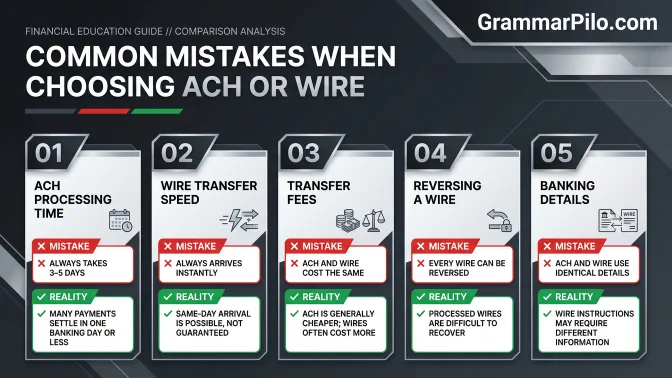
Both methods are useful, but a few common mistakes can cause delays, extra fees, or lost money.
Mistake 1: Assuming ACH Always Takes Three to Five Days
Incorrect: Every ACH payment takes at least three to five business days.
Correct: Many ACH payments settle in one banking day or less, and eligible Same Day ACH payments can settle on the same business day.
Explanation: Timing depends on the payment type, processing window, bank policies, and funds availability.
Memory tip: Standard ACH is often fast enough for routine payments, but check the expected arrival date.
Mistake 2: Assuming Every Wire Arrives Instantly
Incorrect: A wire transfer always reaches the recipient immediately.
Correct: A domestic wire may arrive the same business day, but timing depends on bank cutoff times, processing, review, and receiving bank procedures.
Explanation: A wire can be delayed if information is incorrect or a bank needs additional verification.
Memory tip: Same day does not mean instant or guaranteed.
Mistake 3: Thinking ACH and Wire Fees Are the Same
Incorrect: ACH and wire transfers always cost the same amount.
Correct: ACH is generally less expensive, while wires often carry higher sending or receiving fees.
Explanation: Banks set their own customer fees. Business pricing and international charges can differ.
Memory tip: Check the fee schedule before choosing a payment method.
Mistake 4: Believing a Wire Can Always Be Reversed
Incorrect: You can cancel any wire after the recipient receives it.
Correct: A processed wire is generally final and difficult to recover. A bank may attempt a recall, but success is not guaranteed.
Explanation: Wire transfers are designed for final settlement. This makes recipient verification especially important.
Memory tip: Verify every detail before confirming a wire.
Mistake 5: Assuming ACH and Wire Use the Same Banking Details
Incorrect: Every ACH and wire transfer requires exactly the same information.
Correct: Both may require account and routing information, but wire instructions can include additional details, especially for international payments.
Explanation: Some banks use different routing numbers for ACH and wire transfers.
Memory tip: Use the exact instructions provided by the recipient’s bank.
Everyday Examples of ACH and Wire Transfers
Understanding real situations makes the difference easier to remember.
Example 1: Employee Payroll
A company pays employees every two weeks.
Best option: ACH
The company can send payroll payments through ACH, allowing employees to receive direct deposits into their bank accounts.
Example 2: Monthly Utility Bill
A customer authorizes an electric company to collect a monthly bill from a checking account.
Best option: ACH debit
The company can collect the payment electronically on the scheduled date.
Example 3: Buying a House
A buyer needs to send closing funds to a title company before the closing deadline.
Best option: Wire, if required by the closing instructions
A domestic wire may be suitable because it can move funds quickly and provides final settlement. The buyer should independently verify the instructions before sending money.
Example 4: Paying a Business Supplier
A business needs to pay a supplier for a regular monthly invoice.
Best option: ACH, if the supplier accepts it
ACH can reduce payment costs and simplify recurring transactions.
Example 5: Sending Money Overseas
A person needs to send money to a family member in another country.
Best option: Compare international wire services and other supported payment options
An international wire may work, but exchange rates, intermediary fees, and delivery times matter. A specialized money transfer service may be less expensive.
Example 6: Sending Money Between Your Own Accounts
A customer wants to move money from a checking account to a savings account at another bank.
Best option: ACH
A standard ACH transfer is often a convenient and low cost choice if the money is not needed immediately.
Google Trends & Modern Usage
Searches for ACH or wire often come from people who need to make a payment and want to avoid delays or unnecessary charges.
The terms are especially relevant in US banking because ACH is a major part of the country’s electronic payment system, while domestic wire transfers remain important for urgent and high value transactions.
Common searches include:
- ACH vs. wire transfer
- ACH transfer vs. bank wire
- ACH or wire for large payments
- How long does ACH take?
- How long does a wire transfer take?
- ACH transfer fees
- Wire transfer fees
- Wire vs. ACH for business payments
- International ACH vs. wire transfer
Modern payment systems have also expanded the choices available to consumers and businesses. Same Day ACH offers faster ACH processing, while instant payment services such as FedNow and RTP provide other ways to move funds.
Search interest can vary by region, banking needs, and major payment situations. These observations describe general search patterns rather than verified live Google Trends rankings or search volume figures.
The main reason people compare ACH and wire is simple: they want to know which option will move their money safely, quickly, and at the lowest reasonable cost.
Quick Comparison Table: ACH vs. Wire
| Version | Meaning | Correct? | Region | Example |
| ACH | Automated Clearing House electronic payment | Yes | Primarily United States | Monthly bill payment |
| Wire | Electronic transfer through a wire network | Yes | Domestic and international banking | Real estate closing |
| ACH credit | Payment that pushes funds into an account | Yes | US ACH Network | Payroll deposit |
| ACH debit | Authorized payment that pulls funds from an account | Yes | US ACH Network | Utility bill |
| Domestic wire | Wire between banks within one country | Yes | United States and other countries | Urgent business payment |
| International wire | Cross border bank transfer | Yes | International | Overseas supplier payment |
Key Takeaways
- ACH stands for Automated Clearing House and is a major US electronic payment network.
- Wire transfers move funds directly between participating financial institutions.
- ACH is generally cheaper and works well for payroll, bills, and recurring payments.
- Domestic wire transfers are often faster and are useful for urgent or high value payments.
- Same Day ACH can settle eligible payments on the same business day.
- ACH transactions may be returned or corrected under applicable rules, while processed wires are generally difficult to reverse.
- International wires may involve intermediary fees and currency conversion.
- Always verify recipient details and check your bank’s fees and processing deadlines.
Frequently Asked Questions
1. Is ACH or wire better?
ACH is generally better for routine payments because it usually costs less and works well for payroll, bills, and recurring transfers.
A wire is often better for urgent or high value payments when same day delivery or final settlement matters. The right choice depends on your deadline, bank fees, and the recipient’s payment requirements.
2. Is ACH cheaper than a wire transfer?
Yes, ACH is generally cheaper. Many banks offer standard ACH transfers free to consumers, although some services may have fees.
Domestic and international wires often carry sending fees, receiving fees, or intermediary charges. Check your bank’s current fee schedule before sending money.
3. How long does an ACH transfer take?
Standard ACH transfers commonly settle in one or more banking days, although many settle in one day or less. Eligible Same Day ACH payments can settle within hours on the same banking day.
Weekends, federal holidays, processing windows, and bank policies can affect when funds become available.
4. How long does a wire transfer take?
A domestic wire transfer often reaches the receiving bank on the same business day if it is submitted before the bank’s cutoff time.
International wires can take several business days or longer. Processing reviews, incorrect details, intermediary banks, and currency conversion may affect delivery.
5. Can you reverse an ACH or wire transfer?
Some ACH payments can be returned or corrected under network rules, and certain unauthorized transactions may qualify for dispute procedures.
A processed wire is generally final and much harder to recover. If you send money to the wrong account, contact your bank immediately.
6. Is ACH safer than a wire transfer?
Both use established financial systems, but their risks differ. ACH has return and dispute processes for certain transactions.
A wire is generally difficult to reverse once processed. For either method, verify the recipient’s identity and banking details before authorizing payment.
7. Can you send a large amount through ACH?
Yes, but limits depend on the bank, account type, payment type, and applicable network rules. Same Day ACH currently supports eligible payments up to $1 million per payment.
Standard ACH limits may differ. For large transactions, confirm the limit and processing time with your bank.
8. Can ACH transfers be international?
Certain international ACH arrangements support payments to participating financial institutions outside the United States. However, ACH is primarily a US payment network, and international availability is more limited than domestic coverage.
For overseas payments, check if your bank supports the destination country and compare other transfer options.
Conclusion: ACH or Wire, Which Should You Choose?
ACH and wire transfers both provide convenient ways to move money electronically, but they serve different purposes. ACH is generally the better choice for everyday payments because it is usually less expensive and supports direct deposits, recurring bills, account transfers, and business payments.
Wire transfers are often the better option when a payment is urgent, involves a large amount, or must meet a specific deadline. They can provide same day domestic processing, but they usually cost more and are difficult to reverse once completed.
Before choosing, consider the transfer amount, delivery deadline, fees, and recipient’s instructions. For international payments, compare exchange rates and intermediary charges as well.
The simplest rule is to use ACH for routine, lower cost payments and a wire when speed and final settlement are essential. Always verify the recipient’s details before sending money, especially when using a wire transfer.
Discover More Differences

I’m Sloane Mercer, a U.S.-based English language writer focused on grammar, spelling, vocabulary, and everyday English usage. Through GrammarPilo, I provide clear and practical explanations to help readers choose the right words and communicate with confidence.